WhatsApp
 Call Us
 Email Us
 Whatsapp Community

Would you like to schedule a call back


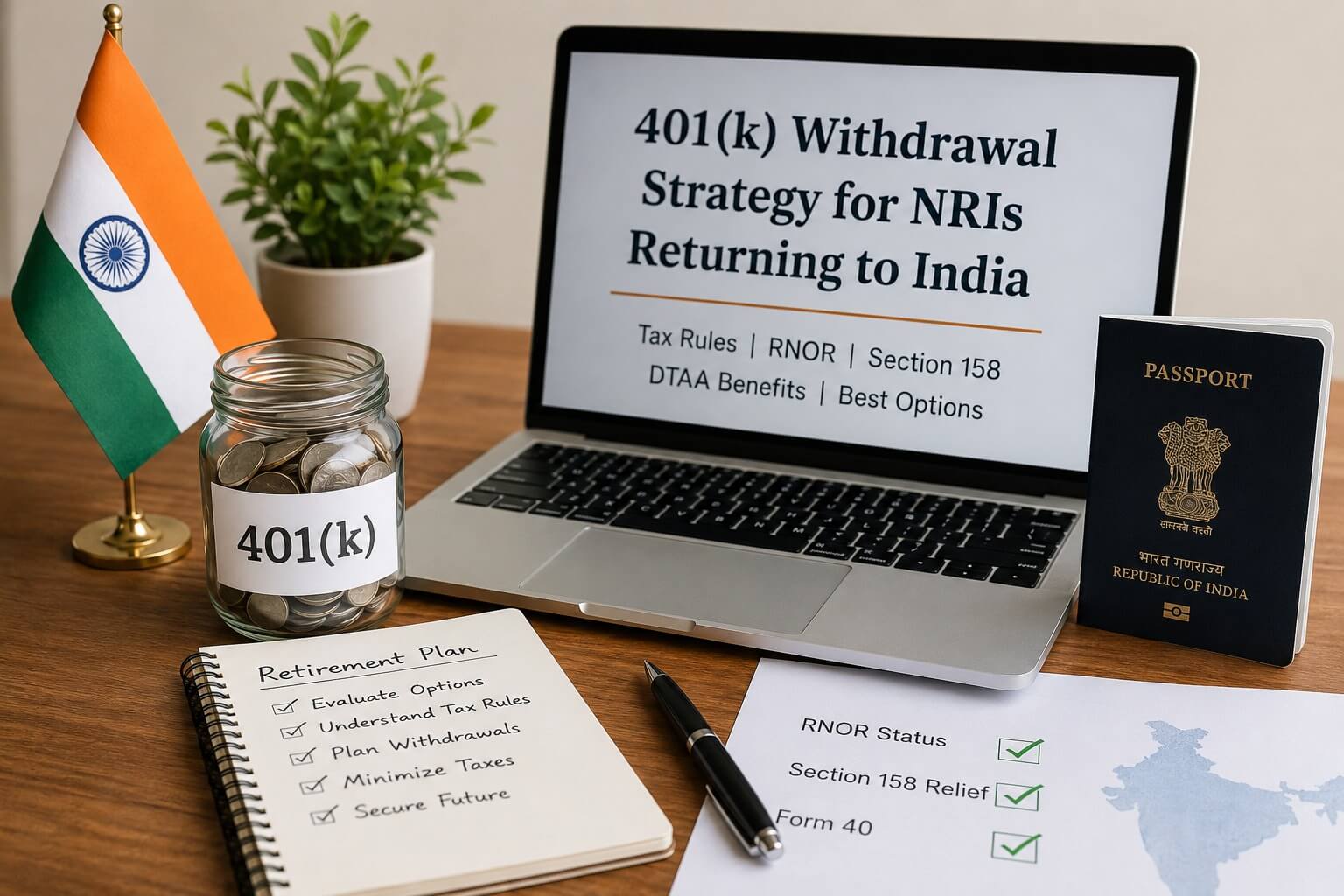


A question we get almost every week from clients moving back from the US: “What do I do with my 401(k)?” It's usually asked with a mix of relief and worry relief that there's finally a plan to move home, worried that one wrong move on a retirement account built over fifteen or twenty years could trigger a tax bill in two countries at once.
The good news is that the decision isn't as binary as most people assume. A well-timed 401(k) withdrawal strategy can preserve real wealth; a rushed one can hand a chunk of it straight to US withholding tax and early-withdrawal penalties, sometimes with an Indian tax bill layered on top. This guide walks through the three core options for a 401(k) after returning to India, how RNOR status and Section 158 of the Income-tax Act, 2025 actually help, what Form 40 requires, and how to avoid paying tax on the same dollar twice.
Yes, you can withdraw money from a 401(k) before age 59½, but early withdrawals may trigger ordinary income tax plus a 10% additional tax penalty. Certain exceptions can reduce or eliminate the penalty, including qualifying medical expenses, disability, substantially equal periodic payments, or separation from service after age 55. Always check your plan rules before withdrawing.
No. This is worth saying plainly because it's the single biggest misconception we run into: moving back to India does not force you to withdraw or close a 401(k). In most cases, the account can simply stay invested in the United States exactly as it is.
Once you're back, there are really three paths open to you: leave the 401(k) invested where it is, roll it over into an IRA, or withdraw the funds, in part or in full. Which one makes sense depends on your age, how much liquidity you actually need, your retirement goals, whether you're likely to qualify for RNOR status, your future Indian residential status, and whether Section 158 relief will apply to you.
This is the path most returning NRIs end up choosing, and for good reason it's the simplest and it keeps every door open.
Generally, people under 59½ who don't need immediate access to the money, want the growth to keep compounding tax-deferred, and would rather not deal with the paperwork of a rollover or withdrawal right now.
Rolling a 401(k) into an IRA is mainly about control broader investment choices and a single account instead of several old employer plans scattered around.
This usually fits people who want more investment choice than their old employer's plan offers, want to consolidate several old 401(k)s from different jobs, or simply want tighter control over how the money is managed.
Some returning NRIs genuinely need the liquidity a home purchase in India, ongoing living expenses, or simply the start of retirement itself.
People who need cash for a home purchase or day-to-day retirement expenses, have a specific near-term cash-flow need, or are deliberately timing a withdrawal to fall inside a tax-efficient window during RNOR status.
This is where US taxation, the early-withdrawal penalty, Indian taxation, Foreign Tax Credit mechanics and Section 158 eligibility all need to be looked at together not one at a time after the fact.
| Situation | Potential Strategy |
|---|---|
| Under 59½ with no immediate cash need | Continue holding the 401(k) where you left it |
| Need more investment flexibility than the employer plan offers | Consider an IRA rollover |
| Likely to qualify for RNOR status | Evaluate strategic, timed withdrawals |
| Already retired | Consider structured, staggered distributions |
| Need liquidity now | Assess partial withdrawals carefully, penalty and tax included |
| Worried about being taxed twice | Review Section 158 relief and Foreign Tax Credit planning |
There is no universal answer here, whatever a quick internet search might suggest. The right approach is the one that fits your age, your liquidity needs and your residential-status trajectory — not a generic rule of thumb.
Once you're back in India, your 401(k) doesn't stop being a US account for tax purposes it's still governed by US rules first.
Withdraw before age 59½ and you're generally looking at ordinary US income tax on the distribution, plus an additional 10% early-withdrawal penalty, unless a specific exception applies. Take Rahul, 45, who withdraws USD 100,000 from his 401(k) after returning to India: he's potentially facing US withholding tax, the extra 10% penalty on top of that, and an Indian tax question depending on his residential status that year. That's three separate consequences from one decision which is exactly why the timing of a withdrawal matters as much as the amount.
It's worth checking with your financial institution whether Form W-8BEN needs updating once you're back in India, since it's what certifies your foreign status and lets you claim treaty benefits where they apply.
Certain retirement distributions can trigger a Form 1040-NR filing obligation in the US even after you've become an Indian resident this is worth confirming with a professional rather than assuming it doesn't apply to you.
RNOR Resident but Not Ordinarily Resident is one of the more useful tools available to a returning NRI, and it's often underused simply because people don't know it exists until they've already made a withdrawal decision.
If you satisfy the prescribed conditions under Indian tax law, you can qualify for RNOR status for a limited period after you return. During that window, it's worth using the time to evaluate withdrawal strategies, weigh up an IRA rollover, coordinate your Indian and US tax obligations together rather than separately, and structure retirement income in a way that's actually efficient. Because RNOR benefits are temporary by design, this only works if the planning happens in advance not once the RNOR window has already closed.
Understanding 401(k) taxation India requires looking beyond withdrawal rules. Your residential status can significantly influence whether and how your U.S. retirement income is taxed in India, making timing an important part of cross-border tax planning.
| Residential Status | General Tax Position |
|---|---|
| NRI | Foreign income, including 401(k) income, is generally outside the Indian tax net |
| RNOR | Certain foreign income, including 401(k) income, may get more favourable treatment |
| Resident and Ordinarily Resident (ROR) | Global income, including 401(k) withdrawals, is generally taxable in India |
The takeaway here is simple: the timing of a 401(k) withdrawal should always be checked against your residential status for that specific year, not against a general rule you read somewhere.
Indian taxation of a 401(k) withdrawal comes down to four things working together: your residential status at the time, when the withdrawal happens, whether Section 158 relief applies, and how the India-US DTAA and Foreign Tax Credit provisions interact with all of it. Skip the planning and it's easy to end up more exposed to tax than you needed to be.
Section 158 gives relief from a timing mismatch that has tripped up returning NRIs for years; it aligns Indian taxation of a foreign retirement account with the year the income actually becomes taxable in the country where the account is held.
| India | United States |
|---|---|
| Residents are taxed on global income as it accrues | A 401(k) is taxed only when you actually withdraw from it |
| That timing mismatch used to create real complications for returning NRIs | Tax is deferred until distributions are taken, sometimes decades later |
| Foreign Tax Credit claims became hard to align without matching timelines | US tax gets paid years after the Indian tax year in question |
Section 158 exists precisely to close that gap between when India wants to tax the income and when the US actually taxes it.
You may qualify if you're a resident in India, you opened the retirement account while you were still a non-resident, the account sits in a notified country, that country taxes the account upon withdrawal rather than as it accrues, and you meet the prescribed compliance requirements. As of now, the notified countries are the United States, the United Kingdom, Canada and Australia all places where retirement accounts are typically taxed at the point of withdrawal rather than year by year.
Form 40 is what you use to actually exercise the Section 158 option. It generally has to be filed within prescribed timelines, it carries forward to subsequent years once exercised, and it deserves a proper review before filing rather than a last-minute tick-box exercise miss it, and the relief simply isn't available to you.
They're not competing options they solve different problems, and for most NRIs the two work best stacked together rather than used in isolation.
| Feature | RNOR / Section 158 |
|---|---|
| Based on residential status | Yes / No |
| Available automatically once conditions are met | Yes / No |
| Requires a separate election | No / Yes |
| Built specifically for foreign retirement accounts | No / Yes |
| Helps align the timing of taxation | Limited / Yes |
| Continues beyond the RNOR period | No / Yes |
A foreign retirement account like a 401(k) generally needs to be disclosed in Schedule FA once you're a resident. That typically covers the country where the account sits, the financial institution's details, the peak balance during the year, and the closing balance.
Foreign-source retirement income, separate from the asset disclosure itself, may also need to be reported in the applicable schedules of your return; the two obligations are related but not identical.
| Situation | Applicable ITR |
|---|---|
| Salary income with foreign assets | ITR-2 |
| Business or professional income with foreign assets | ITR-3 |
Professional guidance is worth getting here the reporting side of a 401(k) trips up as many people as the tax calculation itself does.
No immediate need for the money, planning a permanent move back to India. The priorities here: avoid triggering the early-withdrawal penalty, work out whether RNOR status is available, check Section 158 eligibility, and weigh maintaining the account against an IRA rollover before deciding either way.
Needs periodic retirement income rather than a lump sum. The priorities shift: structure the distributions efficiently, work through the treaty implications properly, coordinate Foreign Tax Credit claims as the withdrawals happen, and keep the Indian reporting obligations current year over year.
There is no single right answer for every NRI returning to India with a 401(k). The right approach depends on your age and retirement goals, RNOR eligibility, whether Section 158 applies to you, your liquidity needs, the India-US DTAA position, and how 401(k) withdrawal may affect your tax position and Foreign Tax Credit opportunities. Get this planning done properly, and NRIs can preserve real retirement wealth, keep the tax bill efficient, and stay compliant on both sides of the DTAA without last-minute scrambling.
At Dinesh Aarjav & Associates, we help NRIs work through exactly this 401(k) and IRA planning, RNOR eligibility assessment, Section 158 and Form 40 compliance, Foreign Tax Credit and DTAA planning , and Schedule FA and ITR reporting once you're back.
CA Priyal Goel Jain is a Partner at Dinesh Aarjav & Associates and a leading expert in India–US cross-border taxation, NRI taxation, and international tax advisory. She advises NRIs, OCIs, and global families on complex cross-border transactions, tax planning, foreign asset reporting, and multi-jurisdictional compliance matters.






Stay in the loop, subscribe to our newsletter and unlock a world of exclusive updates, insights, and offers delivered straight to your inbox.

.webp)