WhatsApp
 Call Us
 Email Us
 Whatsapp Community

Would you like to schedule a call back


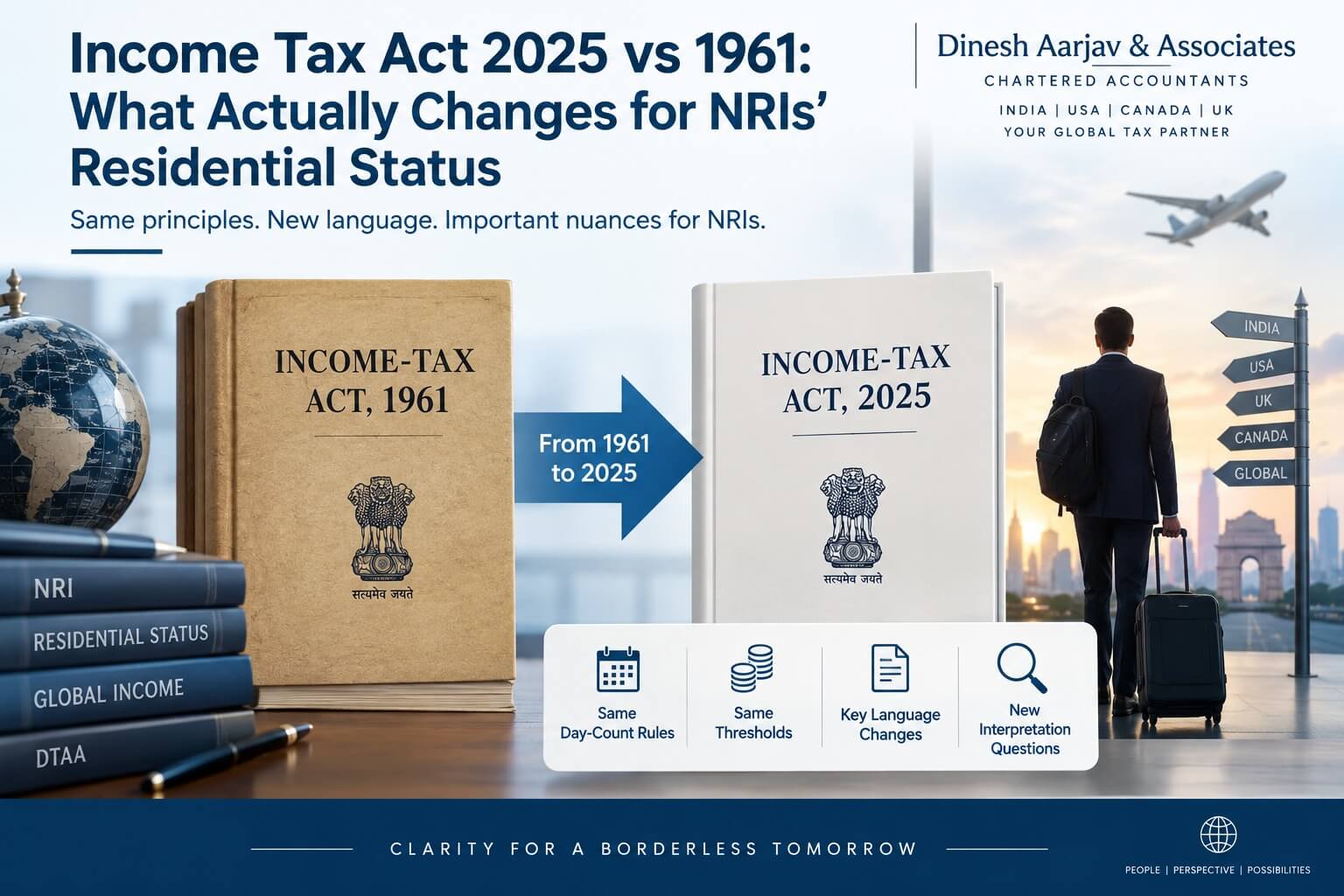


If you're an NRI wondering whether the new law changes how your residency is decided, here's the short version: it doesn't. Under the Income Tax Act 2025 vs 1961, every day-count, every threshold and every resident category stays the same. The 182-day test is still 182 days. The ₹15 lakh limit is still ₹15 lakh. ROR, NOR and NR still mean what they always meant.
What did change is the wording in four spots. And because no tribunal or court has ruled on that new wording yet, those four spots are where the real risk sits for anyone giving advice.
The Income-tax Act, 1961 was repealed on 1 April 2026. From tax year 2026-27 onward, the Income-tax Act, 2025 decides residential status for everyone.
NRIs and returning Indians feel this more than anyone else. Residential status is the one question that decides whether Indian tax law reaches your worldwide income or stops at the border.
Most write-ups treat the switch as a renumbering job: same rules, new labels. For most of Section 6, that's fair. But not all of it. In four places the drafting genuinely shifted, and anyone who assumes a straight carry-forward is carrying risk they haven't priced in.
Start with the easy part. Two provisions moved to a new number with zero change in text, so any older ruling still applies without a caveat.
| What it governs | Old citation (ITA, 1961) | New citation (ITA, 2025) |
|---|---|---|
| The 182-day test | Section 6(1)(a) | Section 6(2)(a) |
| Resident status covers all sources of income | Section 6(5) | Section 6(12) |
If you've already advised a client on the 182-day rule, that advice holds. Only the citation in your opinion letter needs updating.
One provision reaches the same answer by a different route, and the difference is worth a footnote.
This is the carve-out for Indian citizens who leave India as ship crew or for a job abroad.
Under the 1961 Act, the 60-day test was never switched off for this group. The statute simply raised its own bar: wherever the 60-day test applied, "sixty days" was read as "one hundred and eighty-two days." The test still existed on paper. It just matched the 182-day test in practice.
Section 6(3) of the ITA, 2025 skips the substitution entirely. It says the 60/365-day test in Section 6(2)(b) "shall not apply" to this group. Only the 182-day test survives.
The client outcome is the same either way: they're measured against 182 days. But the legal path is different, so a court reading Section 6(3) isn't strictly bound by how courts read the old substitution clause. Low risk, but flag it in technical opinions instead of citing old case law as if nothing moved.
These are the places where a single word change, or continuing silence from the rulemakers, means you can't just swap section numbers and move on.
Section 6(1)(c) of the old Act used "period or periods amounting in all" to describe how broken stays are added up for the 60-day and four-year look-back tests. That phrasing was airtight. Plural "periods," plus "amounting in all" as the operator. No court ever had to rule on fragmented visits, because the statute answered it on its face.
Section 6(2)(b) of the ITA, 2025 swaps all of that for one word: "cumulatively." It isn't defined anywhere in Section 6, and it has no prior reading in the Indian residency context.
Picture an NRI who visits India three times in a tax year (25 days, 20 days and 20 days, so 65 in total) and has already spent 370 days in India over the last four years.
The visiting-citizen carve-out in the old Act applied to "a person of Indian origin within the meaning of Explanation to clause (e) of section 115C." That definition covered anyone born in undivided India, or whose parent or grandparent was.
Section 6(4) of the ITA, 2025 uses "a person of Indian origin" with no cross-reference to any definition at all.
Take a foreign passport holder whose parents were born in India, present for 130 days in the tax year, earning ₹18 lakhs from Indian sources. Under the old Act, Section 115C settled his PIO status on the spot. He was non-resident at 130 days, safely under 182, and the 60-day limb never touched him because the carve-out applied.
Under the new Act, whether he still qualifies depends on whether an equivalent definition sits somewhere else in the ITA, 2025. Right now, none has been clearly identified.
This is the biggest open point in the whole transition. People whose PIO status rests on a grandparent rather than a parent (the marginal cases) carry the most exposure until a circular or ruling clears it up.
The old Act left day-counting for crew on foreign-bound ships to prescribed rules. Rule 126 of the Income-tax Rules, 1962 excluded the stretch between the joining date and the sign-off date entered on the Continuous Discharge Certificate.
Section 6(6) of the ITA, 2025 keeps that mechanism, and Rule 8 of the Income-tax Rules, 2026 mirrors Rule 126 on substance. But the wording doesn't line up:
| Source | Phrase used |
|---|---|
| Section 6(6), ITA 2025 | "total number of days in India" |
| Rule 8, Income-tax Rules 2026 | "period or periods of stay in India" |
On the facts this reads like a drafting slip, not a policy change. Still, mention it in client memos so nobody is blindsided by a mismatched cross-reference later.
One more trap for practitioners: Section 6(6) used to govern Not Ordinarily Resident status under the old numbering. It now covers something completely different. Working from old notes is an easy way to cite the wrong thing.
Section 6(1A) of the old Act opened with "Notwithstanding anything contained in clause (1)," so the deemed-residency override technically reached only the tests inside clause (1).
Section 6(7) of the ITA, 2025 opens with "Irrespective of the provisions of sub-sections (2) to (6)." That override expressly names the crew carve-out, the employment carve-out, the visiting-citizen carve-out and the ₹15 lakh modification.
Consider an Indian citizen who spent the full year outside India as crew on an Indian ship, earning ₹20 lakhs from Indian sources with no tax liability anywhere else. Under the old Act, the settled reading was that deemed residency overrode the crew carve-out anyway, because courts reasoned their way there. Under the new Act, Section 6(7) simply says it, and Section 6(8) adds an explicit exclusion for anyone already resident under sub-sections 2 to 6.
Same result for the taxpayer. What changed is that an interpretive question became an explicit two-step test on the face of the statute: check the carve-outs first, then check whether deemed residency catches the person regardless.
Cleaner drafting, yes. But "notwithstanding" and "irrespective of" have no binding authority testing their equivalence under this Act, and a broader override paired with a fresh named exclusion is exactly the mix that tends to produce litigation over where the boundary sits.
Here's the whole of Section 6 side by side, so you can find any provision quickly.
| Provision | ITA, 1961 | ITA, 2025 | Status |
|---|---|---|---|
| Governing clause | None | 6(1) | New drafting convention, no counterpart |
| 182-day test | 6(1)(a) | 6(2)(a) | Renumbered, identical |
| 60/365-day test | 6(1)(c) | 6(2)(b) | Open point, "cumulatively" undefined |
| Crew and employment carve-out | Explanation 1(a) to 6(1) | 6(3) | Same outcome, different mechanism |
| Visiting citizen / PIO carve-out | Explanation 1(b) to 6(1) | 6(4) | Open point, PIO anchor removed |
| ₹15 lakh / 120-day modification | Explanation 1(b) to 6(1) | 6(5) | Cosmetic, now standalone |
| Foreign-bound ship crew day-count | Explanation 2 to 6(1) | 6(6) | Open point, Section and Rule mismatch |
| Deemed residency | 6(1A) | 6(7) and 6(8) | Open point, broader override |
| Resident for all sources | 6(5) | 6(12) | Renumbered, identical |
| Not Ordinarily Resident conditions | 6(6) | 6(13) | Cosmetic, Individual and HUF merged |
| Income from foreign sources, defined | Explanation to 6(6) | 6(14) | Cosmetic, now standalone sub-section |
For most NRI and returning-Indian clients, nothing about the answer changes. Only the section number you cite does. Same day counts, same thresholds, same categories.
The four open points bite for a narrower group:
Until a circular, ruling or tribunal decision settles these, the safest route is to document your reasoning conservatively and spell out the residual uncertainty in the opinion itself. Don't assume the 1961 position travels forward untouched.
Getting residential status right under the Income-tax Act, 2025 is the foundation for every NRI tax decision that follows, from ITR filing to DTAA relief. That's especially true where deemed residency, PIO status or fragmented travel patterns are in play.
If your position touches any of the open points above, Dinesh Aarjav & Associates can help you document it properly before it turns into a dispute. Explore our NRI & OCI Services, or get in touch for a residential status review as part of your Returning to India tax planning.
Quick answers to the questions that come up most.
Ans: No. The 182-day test moved from Section 6(1)(a) to Section 6(2)(a) with identical wording. It works exactly as before.
Ans: Yes. The threshold, and the mechanism that swaps "120 days" for "60 days" once a visiting citizen's or PIO's Indian-source income crosses ₹15 lakh, is unchanged in substance under Section 6(5).
Ans: In practical effect, almost certainly not. Both call for adding up broken stays. But "cumulatively" is undefined in Section 6 of the ITA, 2025 and has no prior judicial reading in this context, so it remains a first-impression question.
Ans: This one is unsettled. The old definition was anchored to Section 115C. Section 6(4) of the ITA, 2025 uses the phrase with no cross-reference, and no clear replacement definition has been identified. Anyone relying on a grandparent's birthplace faces the most uncertainty.
Ans: No. The conditions for Not Ordinarily Resident status are unchanged in substance. Section 6(13) just consolidates and renumbers what used to sit in Section 6(6). If you qualified before, you should still qualify.
Ans: The 182-day test (now 6(2)(a)) and the resident-for-all-sources rule (now 6(12)). Both are pure renumbering with identical text, so prior case law applies without qualification.
CA Priyal Goel Jain is a Partner at Dinesh Aarjav & Associates and a leading expert in India–US cross-border taxation, NRI taxation, and international tax advisory. She advises NRIs, OCIs, and global families on complex cross-border transactions, tax planning, foreign asset reporting, and multi-jurisdictional compliance matters.






Stay in the loop, subscribe to our newsletter and unlock a world of exclusive updates, insights, and offers delivered straight to your inbox.

.webp)