WhatsApp
 Call Us
 Email Us
 Whatsapp Community

Would you like to schedule a call back


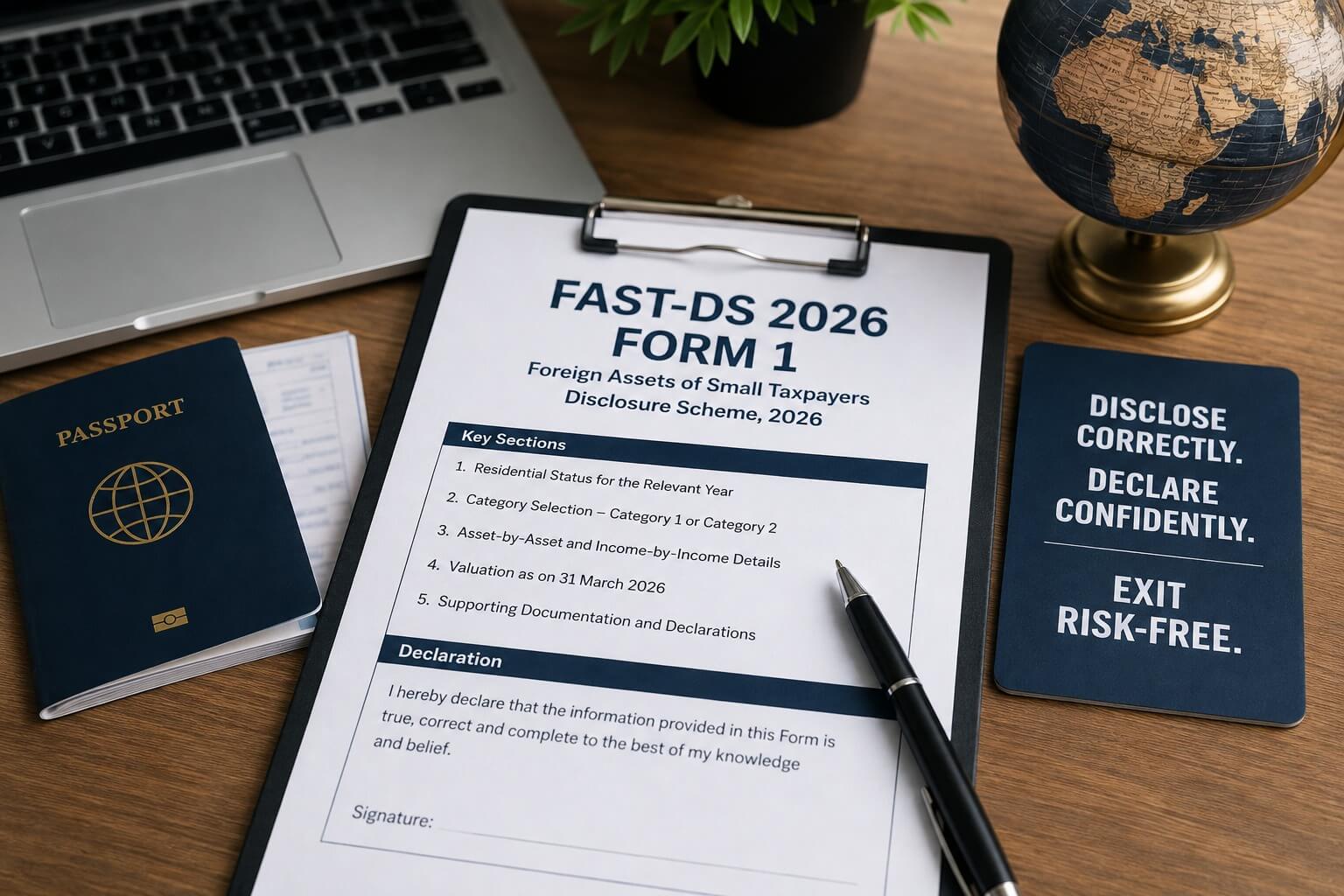


FAST-DS Form 1 is the official declaration form under the Foreign Assets of Small Taxpayers Disclosure Scheme, 2026 (FAST-DS 2026). It is filed electronically on the Income Tax e-Filing portal and converts your entire analysis of foreign assets, residential status, category selection, and valuation into a single, binding, non-reversible declaration.
This is the third post in our FAST-DS 2026 series. We have already covered eligibility, the two payment categories, the valuation rules, and how AIS and the Foreign Assets Information (FAI) mechanism feed into the scheme. This post focuses on Form 1 itself: what it requires, where the real decision points sit, and why this is not a form you want to file without a careful review first.
FAST-DS full form is the Foreign Assets of Small Taxpayers Disclosure Scheme. Form 1 is the cornerstone of FAST-DS Form 1 filing. Every piece of your analysis gets locked in here, including residential status, the category you have chosen, your asset valuations, and your source of funds. There is no revision route once the form is submitted and payment is made. Get it right before you file, or wait until you can.
FAST-DS Form 1 is filed through the Income Tax e-Filing portal, under its own declaration category rather than as part of a regular income-tax return. Here is the navigation path:
FAST-DS Form 1 meaning becomes clear when you look past the portal interface. The form is built around five core decision blocks. Each one is a place where an incorrect entry can change what you owe or whether you qualify at all.
Form 1 asks for your residential status not as it stands today, but for the specific previous year in which the asset was acquired or the foreign income arose. Eligibility covers current non-residents and RNORs, provided they were resident in India in that relevant year. This is a historical determination, worked out year by year from your actual travel and stay records, not a present-day checkbox.
This is the single most consequential field on the form, and getting it wrong is the most common FAST-DS Form 1 compliance error. Here is how the two categories compare:
| Category 1 | Category 2 | |
|---|---|---|
| Who it covers | Assets or income whose source was never satisfactorily explained or taxed | Assets with a clean or already-taxed source, or acquired while genuinely non-resident |
| Cap | Up to ₹1 crore | Up to ₹5 crore |
| Payment | Effective 60% of declared value | Flat ₹1 lakh fee |
| Default being corrected | Non-disclosure of income or asset | Non-disclosure in the FA Schedule only |
Form 1 asks you to place each asset into one category or the other. It does not allow you to hedge between the two.
A single Form 1 can cover multiple assets and income items across multiple countries. A US 401(k), a UK pension, unreported Canadian property, and RSUs can all sit inside one declaration. For each item, the form requires:
Vague or incomplete entries here invite scrutiny later. The final acceptance order under Form 4 is treated as conclusive only for what was actually declared, so precision matters.
Every asset must be valued as on the prescribed valuation date using the asset-specific methodology set out in the notified Rules. This is not today's market price, a current account balance, or a rough exchange rate conversion. Listed shares, unlisted shares, bullion, jewellery, immovable property, and bank accounts each follow their own valuation logic. For several of these, the choice between a formal valuation and the indexed cost of acquisition can materially affect both the declared value and whether the asset falls within the relevant ceiling.
FAST-DS Form 1 requirements include uploading supporting documents as part of the declaration itself, not afterward. These typically include bank and brokerage statements, employer equity records, property purchase deeds, foreign tax returns, prior Indian ITRs, Schedule FA entries, and any formal valuation reports obtained. Filing first and planning to send documents later is not how the form is designed to work.
Understanding FAST-DS Form 1 reporting requirements is one thing. Applying them under deadline pressure is where most people slip. The most common mistakes are:
Form 1 asks you to commit in writing to a category, a valuation, and a residential-status history, all before any conversation with the tax authority about whether your reading of the facts is correct. The Form 2 order that follows is based entirely on what you declared. If the category or valuation was wrong, that mistake is locked into a binding, non-refundable declaration. A proper review before filing is worth far more than the time it takes.
We approach FAST-DS Form 1 compliance the same way we approach a returning NRI's full compliance picture. As part of our NRI Returning to India advisory, we start by reconstructing the year-by-year residential status, tracing every foreign asset back to its source, and only then determining which category each item genuinely fits.
From there, we run the valuation methodology asset by asset (including the indexed-cost comparison where it applies), assemble the documentation Form 1 requires, and prepare the declaration itself so that what gets filed is something we would be comfortable defending, not just something submitted before the deadline.
If your situation also involves FEMA reporting, DTAA claims, or repatriation planning, our NRI & OCI Services team can handle the full picture in one engagement rather than treating FAST-DS as an isolated filing.
Aarjav Jain is the Executive Director at Dinesh Aarjav & Associates, specializing in India–US cross-border transactions, NRI taxation, international tax advisory, and global investment structuring. With over 10 years of experience in project financing and cross-border advisory, he assists NRIs and businesses with regulatory compliance, repatriation planning, and international transaction structuring.






Stay in the loop, subscribe to our newsletter and unlock a world of exclusive updates, insights, and offers delivered straight to your inbox.

.webp)