WhatsApp
 Call Us
 Email Us
 Whatsapp Community

Would you like to schedule a call back


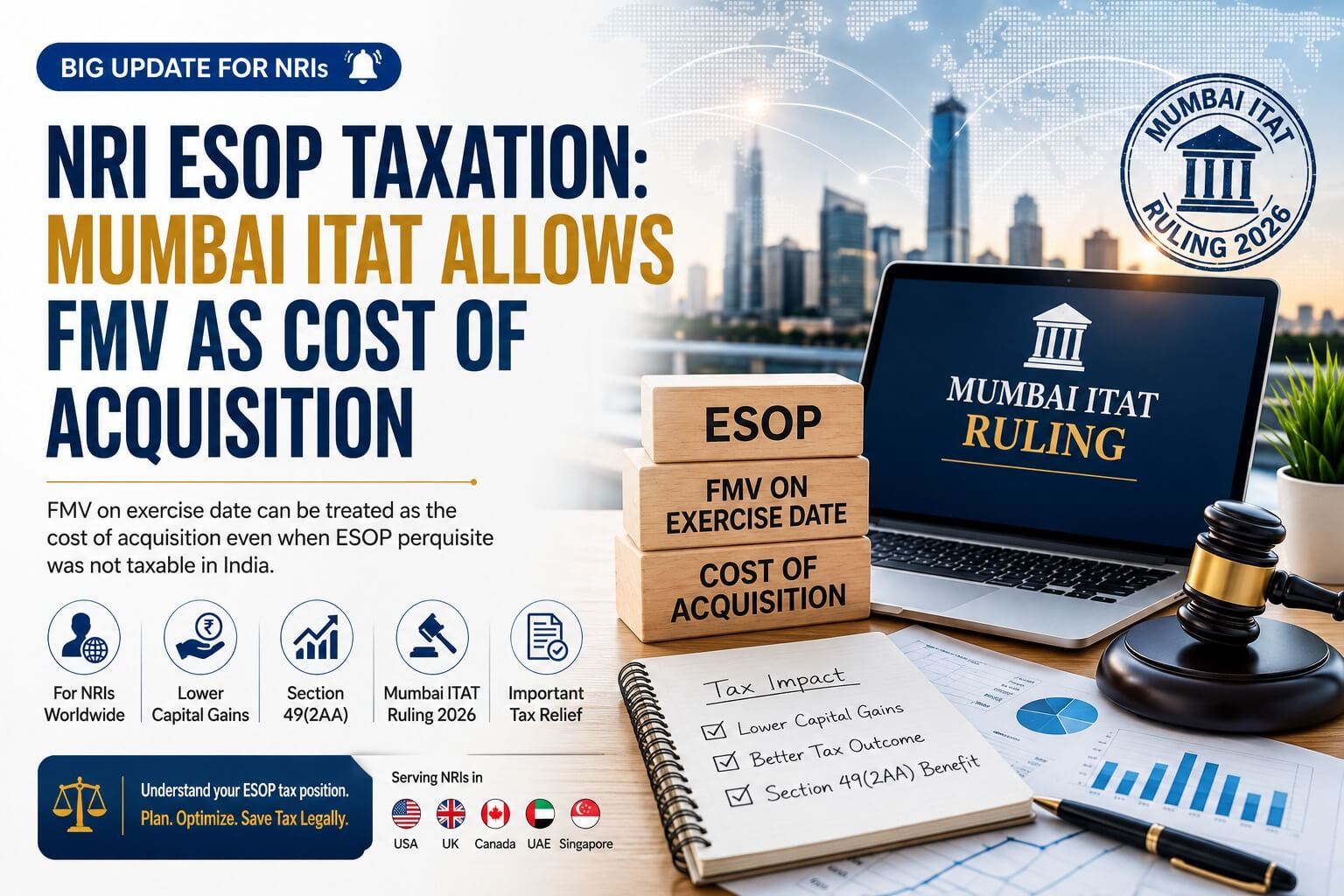


A recent Mumbai Income Tax Appellate Tribunal (ITAT) ruling has provided an important answer: yes, where Section 49(2AA) applies, the FMV of the shares on the ESOP exercise date can be considered the cost of acquisition, even if the ESOP perquisite was not taxable in India.
The ruling is particularly important for NRIs, overseas employees and returning Indians who hold ESOPs of Indian companies and later sell those shares.
Key Takeaways
FMV on the ESOP exercise date can be the cost of acquisition for capital gains purposes.
The ESOP perquisite does not necessarily have to be taxed in India for Section 49(2AA) to apply.
The actual ESOP exercise price alone may not be the correct cost basis.
The ruling is particularly relevant where an NRI exercises Indian-company ESOPs while working overseas.
When the shares are subsequently sold, the difference between the sale price and FMV at exercise can be critical in determining Indian capital gains.
The ruling is an ITAT decision, so the facts and applicable law should be reviewed before relying on it.
ESOP taxation for an NRI can involve two different taxable events:
When an employee exercises an ESOP, the difference between the FMV of the shares and the exercise price can represent an ESOP perquisite.
Whether that perquisite is taxable in India depends on factors such as:
When the employee subsequently sells the shares of an Indian company, the transaction can give rise to capital gains taxable in India.
At this stage, one of the most important questions is:
That is precisely the issue considered by the Mumbai ITAT.
Rajesh R. Hemrajani Case: Facts of the ESOP Tax Dispute
The taxpayer was a non-resident Indian and UK tax resident who was employed with the UK branch of an Indian company.
He exercised 1,540 ESOPs at an exercise price of only ₹1 per share.
The FMV of the shares on the date of exercise was approximately ₹1,754 per share.
The shares were subsequently sold for an aggregate consideration of approximately ₹25.99 lakh.
While calculating his Indian capital gains, the taxpayer adopted the FMV on the date of exercise as the cost of acquisition under Section 49(2AA).
This resulted in a short-term capital loss of approximately ₹1 lakh.
The tax authorities disagreed.
The Revenue's position was essentially:
This would have resulted in a dramatically higher capital gain.
The Mumbai ITAT ruled in favour of the taxpayer.
The Tribunal held that the taxpayer was entitled to use the FMV of the shares on the date of exercise as the cost of acquisition under Section 49(2AA) when calculating capital gains on the subsequent sale of the ESOP shares.
The Tribunal specifically rejected the argument that Section 49(2AA) can be used only when the ESOP perquisite has actually been taxed in India.
Section 49(2AA) provides the statutory mechanism for determining the cost of acquisition of specified securities received under an ESOP.
The provision links the cost of acquisition to the FMV taken into account for computing the ESOP perquisite.
The Mumbai ITAT focused on the words “taken into account.”
According to the Tribunal, the law does not say that the FMV can be used as the cost of acquisition only if the resulting perquisite was actually taxed in India.
Therefore, the Tribunal refused to read an additional condition into Section 49(2AA).
Not necessarily.
This is one of the most important points for NRI ESOP taxation.
In the case before the Mumbai ITAT, the taxpayer was a UK resident working in the UK. The ESOP benefit related to employment services performed outside India and was therefore not taxable as an Indian salary/perquisite in the circumstances of the case.
However, the subsequent sale of shares of the Indian company created a separate capital gains issue.
The Tribunal treated the computation of the ESOP perquisite and its Indian taxability as separate questions.
Consider a simplified example.
An NRI receives ESOPs with:
| Particulars | Amount |
| ESOP exercise price | ₹ 100 |
| FMV on exercise | ₹ 1,000 |
| Sale price | ₹ 900 |
If ₹100 is treated as the cost:
Capital gain = ₹900 − ₹100
= ₹800 per share
If ₹1,000 FMV is treated as the cost:
Capital gain = ₹900 − ₹1,000
= ₹100 capital loss per share
The difference is therefore significant.
This is why ESOP cost of acquisition is a critical issue in NRI tax planning.
The ruling can be particularly relevant to:
The key question is not simply:
The tax analysis may instead require determining:
No.
The Mumbai ITAT ruling is important, but it should not be interpreted as an automatic rule that every NRI can claim FMV as the cost of every ESOP.
The actual position depends on the facts, including:
The Tribunal's ruling is an ITAT decision, and the decision itself recognises that there have been differing judicial views on this issue.
The taxpayer in this case was a UK tax resident and also raised arguments under the India-UK DTAA, including the treatment of employment income and double taxation.
However, the Mumbai ITAT ultimately decided the Section 49(2AA) issue on the basis of the domestic law and stated that it was not necessary to give a conclusive finding on the alternative India-UK DTAA argument.
This is important because the DTAA analysis should be considered separately from the cost-of-acquisition question.
If you are an NRI holding ESOPs of an Indian company, you should maintain records of:
Good documentation can be critical when establishing the cost basis of ESOP shares.
Dinesh Aarjav & Associates specialises in NRI taxation, cross-border taxation and India overseas tax matters.
For NRIs holding ESOPs, RSUs, employee shares and other equity compensation, our team can assist with:
We analyse your residential status, employment location, ESOP structure and applicable Indian tax provisions.
We help assess the potential Indian tax implications before exercising ESOPs, particularly where your tax residency is changing.
When Indian ESOP shares are sold, we review the appropriate cost of acquisition, FMV at exercise, holding period and capital gains tax implications.
For NRIs residing in the US, UK, Canada, Singapore, UAE and other countries, we can review the relevant DTAA alongside Indian domestic law.
If you are returning to India, the timing of ESOP vesting, exercise and sale can have significant tax consequences. We can help evaluate the tax position before and after your return.
Where an ESOP transaction has both Indian and foreign tax implications, our India and international tax teams can help coordinate the reporting and tax position.
Final Takeaway:
NRI ESOP Taxation Requires More Than Looking at the Exercise Price
The Rajesh R. Hemrajani ruling is an important development for NRI ESOP taxation in India.
The Mumbai ITAT has held that where Section 49(2AA) applies, the FMV of ESOP shares on the exercise date can be used as the cost of acquisition for subsequent capital gains, even when the underlying ESOP perquisite was not taxable in India.
For NRIs, this can make a major difference to the amount of Indian capital gains arising when ESOP shares are eventually sold.
If you hold Indian ESOPs, RSUs or employee shares while living overseas or are planning to return to India your ESOP exercise and sale should be reviewed as part of your overall NRI tax planning strategy.
Need help with NRI ESOP taxation, ESOP exercise planning or capital gains on Indian shares?
Speak to Dinesh Aarjav & Associates for cross-border tax and NRI tax advisory.
CA Priyal Goel Jain is a Partner at Dinesh Aarjav & Associates and a leading expert in India–US cross-border taxation, NRI taxation, and international tax advisory. She advises NRIs, OCIs, and global families on complex cross-border transactions, tax planning, foreign asset reporting, and multi-jurisdictional compliance matters.





Stay in the loop, subscribe to our newsletter and unlock a world of exclusive updates, insights, and offers delivered straight to your inbox.

.webp)