WhatsApp
 Call Us
 Email Us
 Whatsapp Community

Would you like to schedule a call back





Returning to India after spending years or even decades abroad is one of the biggest financial decisions an NRI will ever make. While the emotional aspects of coming home are exciting, the financial implications are often underestimated.
Many returning NRIs spend months deciding where to live, where their children should study, or what household goods to ship. Yet, surprisingly few devote the same level of attention to questions that could have a far greater financial impact:
Will my worldwide income become taxable in India?
What happens to my US 401(k), Canadian RRSP, or UK pension?
Can I continue holding US stocks after returning?
Should I sell foreign investments before relocating?
What happens to my NRE, NRO, FCNR, or RFC accounts?
Will my RSUs, ESOPs, or employer stock options be taxed differently?
How long can I benefit from RNOR status?
Do I need to disclose foreign bank accounts or overseas assets?
How can I legally minimize taxes while staying fully compliant?
The answers to these questions depend on your tax residency, country of return, investment profile, future employment plans, and timing of your move. A decision made six months before relocating could save you lakhs or even crores over the coming years. Conversely, waiting until after you arrive in India may permanently close off valuable planning opportunities.
At Dinesh Aarjav & Associates, we have advised more than 10,500 NRIs over the last 25+ years, helping clients relocate from the United States, Canada, the United Kingdom, Australia, the UAE, Singapore, and several other countries. Our multidisciplinary team of Chartered Accountants and international tax professionals regularly assists NRIs returning to india with RNOR planning, FEMA compliance, cross-border tax strategy, DTAA, foreign retirement accounts, global investments, and wealth restructuring.
This guide has been designed to be the most comprehensive Returning to India resource available online. Whether you are relocating for family, retirement, career opportunities, entrepreneurship, or simply a better quality of life, this article will help you understand the financial roadmap before making the move.
|
If you are returning to India in the next 6–18 months, your financial checklist should include:
Most NRIs think relocation begins with booking flights and arranging movers. In reality, your financial relocation should begin 12–18 months before your physical move.
Over the years, your financial life has likely become spread across multiple countries. You may have accumulated:
Once your Indian tax residency changes, many of these assets may be taxed differently or become subject to additional reporting requirements.
Planning early allows you to:
Think of returning to India as a financial migration, not merely a geographical one.
Over the past decade, India has seen a steady increase in reverse migration. Professionals who once viewed overseas careers as permanent are now increasingly choosing to return.
Several factors are driving this trend.
India has become one of the world's fastest-growing major economies, creating opportunities across technology, healthcare, consulting, finance, manufacturing, and entrepreneurship.
Senior professionals who once moved abroad for career advancement now find comparable leadership opportunities in India.
Remote and hybrid work have fundamentally changed relocation decisions.
Many professionals now continue working for overseas employers while living in India, allowing them to earn globally while enjoying lower living costs and proximity to family.
However, this arrangement also introduces complex tax residency questions that require careful planning.
For many NRIs, returning is no longer about finances alone.
Common reasons include:
India continues to be an attractive retirement destination for many overseas Indians.
Compared to several developed countries, retirees often benefit from:
Proper planning becomes especially important where retirement income continues to arise from foreign pensions, Social Security, or investment portfolios.
Many returning NRIs choose to leverage their international experience to launch businesses, invest in startups, or expand family enterprises.
India's startup ecosystem and digital economy provide significant opportunities but business owners should also evaluate cross-border tax implications before relocating.
This guide is designed for:
Whether you have lived abroad for three years or thirty years, understanding your financial transition before returning can significantly improve your long-term outcomes.
Every relocation is different. Before finalizing your move, consider the following questions.
Will India become your permanent home, or do you expect to work overseas again in the future?
Your answer influences:
You may:
Each option has distinct tax and compliance implications.
Future income may include:
Every income stream should be evaluated separately before your residency changes.
Questions to consider include:
The answers depend on taxation, investment goals, and long-term residency plans.
Healthcare planning is often overlooked until after relocation.
Consider:
Healthcare decisions should be integrated into your financial plan rather than treated as an afterthought.
This is perhaps the most frequently asked question by returning NRIs.
The answer depends on factors such as:
An indicative monthly budget may look like this:
|
Lifestyle |
Estimated Monthly Expenses |
|---|---|
|
Comfortable retired couple (Tier-2 city) |
₹80,000–₹1.5 lakh |
|
Family in metro city |
₹2–4 lakh |
|
Premium lifestyle |
₹5 lakh+ |
Rather than focusing only on current expenses, prepare a financial plan that accounts for inflation, medical emergencies, education, travel, and longevity. A successful relocation is one where your cash flow remains sustainable for decades not just during the first year after returning.
One of the most common mistakes is waiting until the last few weeks before relocation.
A structured timeline gives you enough flexibility to optimize taxes, review investments, and avoid rushed decisions.
|
Timeline |
Recommended Action |
|---|---|
|
18 Months Before |
Review global investments, retirement accounts, business interests, and overseas property. |
|
12 Months Before |
Begin tax residency and RNOR planning. Evaluate timing of major transactions. |
|
9 Months Before |
Review RSUs, ESOPs, pensions, and stock compensation. |
|
6 Months Before |
Assess real estate, gifts, insurance, and estate planning. |
|
3 Months Before |
Review banking arrangements, FEMA implications, and documentation. |
|
Arrival |
Track days in India, update records, and preserve travel history. |
|
First Few Months |
Update KYC, redesignate bank accounts, review investments, and prepare for future tax filings. |
Planning early provides more options, greater flexibility, and often significant tax savings.
If there is one concept every returning NRI must understand, it is Residential Status.
Surprisingly, many NRIs assume that the day they land in India, they automatically become Indian tax residents. Others believe that obtaining an Indian passport, Aadhaar card, OCI status, or even buying a home determines their tax status.
None of these determine your residential status under Indian tax law.
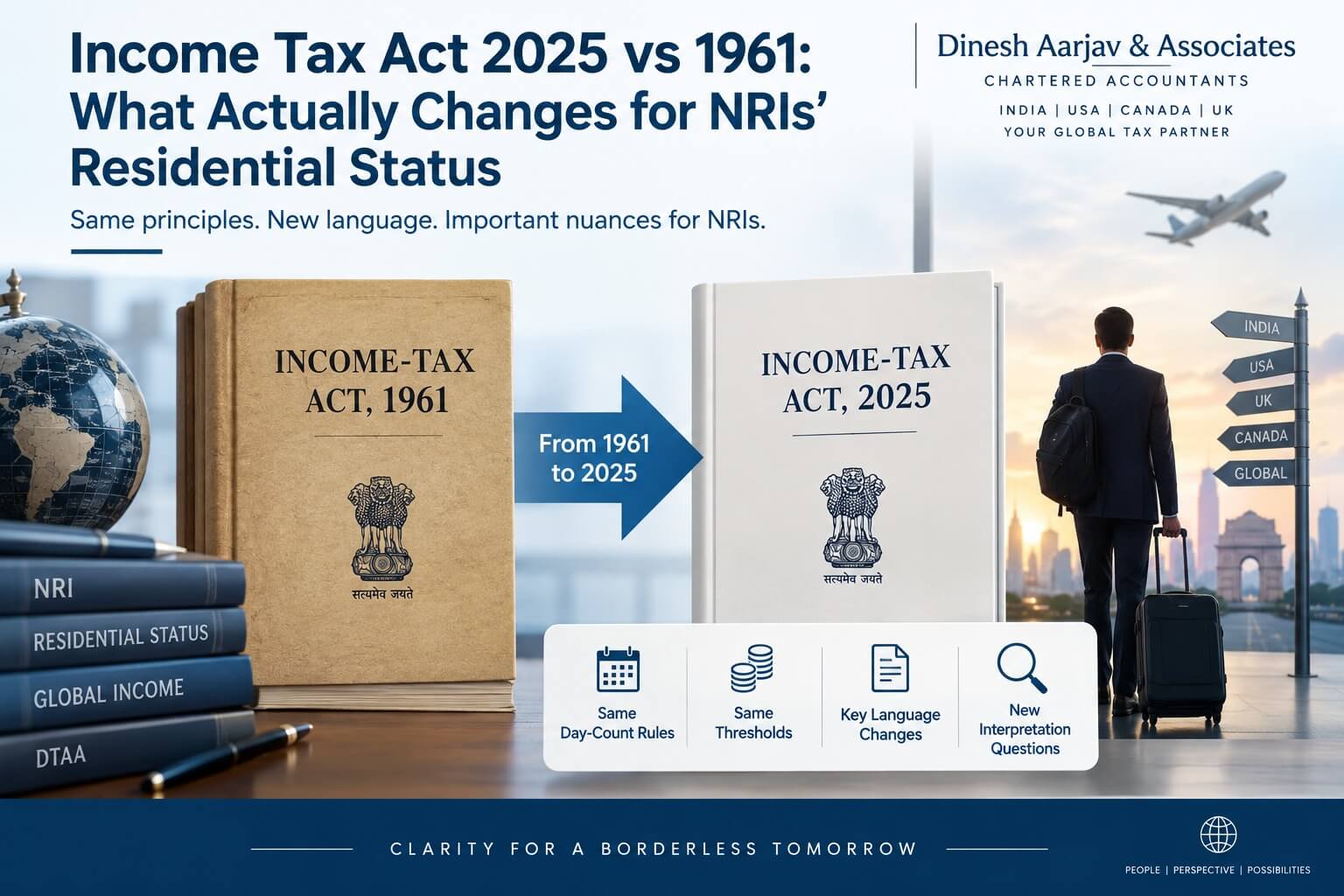
Instead, your residential status is determined independently every financial year based on the provisions of the Income-tax Act, 2025, primarily considering your physical presence in India and your residential history.
This distinction is critical because your residential status determines:
A wrong assumption here can cost lakhs in avoidable taxes or trigger unnecessary reporting obligations.
After relocating to India, you may fall into one of three categories.
|
Residential Status |
Foreign Income Taxability |
Foreign Asset Reporting |
Ideal Stage |
|---|---|---|---|
|
Non-Resident (NR) |
Generally not taxable in India |
Generally not applicable |
Before relocation |
|
Resident but Not Ordinarily Resident (RNOR) |
Limited taxation on foreign income |
Limited reporting in many cases |
Transition period |
|
Resident and Ordinarily Resident (ROR) |
Worldwide income generally taxable |
Full reporting obligations apply |
Permanent residents |
Most NRIs transition from NR → RNOR → ROR, making the RNOR period one of the most valuable tax planning windows available under Indian law.
Think of RNOR status as a financial transition bridge between your overseas life and your new life in India.
The Indian government recognizes that returning NRIs often have complex financial affairs abroad foreign investments, retirement accounts, rental properties, business interests, pensions, and bank accounts. Instead of immediately subjecting all these assets to Indian taxation, the law provides eligible returning NRIs with a transitional status known as Resident but Not Ordinarily Resident (RNOR).
This period allows you to reorganize your global finances in a structured and tax-efficient manner.
Many tax-saving opportunities available during RNOR disappear permanently once you become an Ordinary Resident.
The RNOR period is often the difference between a well-planned relocation and an expensive one.
Depending on your facts and the nature of the income, several categories of foreign income may continue to enjoy favourable tax treatment during RNOR.
This allows returning NRIs time to:
Without this planning window, many individuals become fully taxable on worldwide income sooner than necessary.
Many NRIs accumulate diversified international portfolios consisting of:
During RNOR, the taxation of income from these investments may differ significantly compared to becoming an Ordinary Resident.
This provides valuable time to decide:
Many NRIs continue maintaining overseas savings accounts after relocating.
Examples include:
Interest earned on such accounts should be reviewed in light of your changing residential status and applicable treaty provisions.
Foreign real estate remains one of the largest assets for many returning professionals.
Examples include:
Questions to evaluate include:
Each property requires individual analysis.
Perhaps no area creates more confusion than overseas retirement plans.
These may include:
United States
Canada
United Kingdom
Australia
Each plan follows different tax rules both overseas and in India.
The timing of withdrawals, distributions, conversions, and future residency can significantly influence long-term tax outcomes.
Raj has worked at Google in California for twelve years.
His financial profile includes:
He plans to relocate permanently in July 2026.
Without planning, Raj assumes every foreign asset immediately becomes taxable in India.
However, after reviewing his residential status, he qualifies for RNOR.
Instead of rushing to liquidate investments, he develops a phased transition strategy that considers taxation, liquidity, retirement planning, and currency diversification.
Priya has lived in Toronto for nine years.
She owns:
Instead of waiting until after relocating, she begins planning almost one year before moving.
By reviewing each investment individually, she avoids several avoidable tax issues and prepares a long-term investment strategy aligned with her future life in India.
"I automatically get RNOR."
Not necessarily.
Eligibility depends on your residential history under the Income-tax Act.
"RNOR means I don't pay tax in India."
Incorrect.
Indian-source income generally remains taxable. The treatment of foreign income depends on the nature of the income and the applicable provisions.
"I don't need planning because RNOR protects everything."
RNOR creates opportunities but only if planning begins before or during the transition period.
"I can ignore foreign investments until later."
Waiting often reduces available planning options.
Every source of income should be reviewed independently.
Will you:
Timing matters.
For example:
can all have different tax implications depending on when they are received and where the related services were performed.
Employees working for multinational companies frequently hold:
If you work for companies such as:
your stock compensation may represent a substantial portion of your wealth.
Before relocating, evaluate:
Each grant should be analyzed separately because vesting schedules, grant dates, and tax rules differ.
Common scenarios include:
This creates important questions:
Professional advice becomes especially important in remote work arrangements involving multiple jurisdictions.
Before relocating, ask:
Proper sequencing of transactions can materially influence long-term tax outcomes.
Foreign rental properties require careful review.
Evaluate:
The objective is not necessarily to sell the property but to ensure that retaining it aligns with your long-term financial goals and tax position.
Key questions include:
Business owners should ideally begin planning well before changing their residency.
Review:
Good documentation today can prevent compliance issues years later.
Residential status is not just another tax concept it is the foundation of every financial decision you will make after returning to India.
Whether you own US stocks, Canadian pensions, UK property, overseas businesses, or cryptocurrency, understanding RNOR and planning your income before relocating can significantly reduce taxes, simplify compliance, and preserve wealth.
The most successful relocations begin months before the flight home, not after arrival.
One of the biggest mistakes returning NRIs make is assuming that the financial strategy for someone moving back from the United States is the same as someone returning from Canada, the United Kingdom, or the UAE.
Nothing could be further from the truth.
Every country has different tax laws, retirement systems, investment products, reporting requirements, and exit rules. A strategy that works for a returning NRI from Dubai may be completely inappropriate for someone relocating from California or Toronto.
In this section, we'll examine the key financial, tax, and investment considerations for the countries from which most NRIs return.
The United States is by far the most complex jurisdiction for returning NRIs because of its extensive tax reporting requirements, retirement accounts, and stock-based compensation.
If you have worked in the US for several years, your financial life may include:
Each of these should be reviewed separately before relocating.
A 401(k) is often one of the largest assets accumulated during your US employment.
Questions to consider include:
There is no one-size-fits-all answer. The decision depends on your age, future residency, retirement plans, and long-term tax strategy.
Many returning NRIs assume that Roth IRA withdrawals will automatically remain tax-free everywhere.
This assumption can be dangerous.
Before relocating, evaluate:
Proper planning before returning can significantly simplify future compliance.
Technology professionals often accumulate substantial wealth through RSUs.
If you work for companies such as:
you should review:
Each grant should be analyzed individually rather than collectively.
ESPPs have unique tax consequences.
Important questions include:
Ignoring ESPPs often leads to incorrect tax reporting.
Many NRIs continue holding:
Instead of asking, "Should I close my brokerage account?", ask:
Many NRIs eventually become eligible for US Social Security.
Before returning, understand:
One area frequently overlooked by returning NRIs is estate planning.
If you continue holding US situs assets after returning, you should evaluate:
Estate planning should be reviewed before relocating not after.
Permanent residents should also consider:
Tax planning and immigration planning often go hand in hand.
Canada has its own unique financial landscape.
A returning resident may have:
Each requires separate analysis.
RRSPs are one of the most valuable retirement assets for Canadians.
Consider:
Many returning NRIs unnecessarily withdraw their RRSP before relocating without evaluating long-term consequences.
Although the TFSA offers tax advantages in Canada, its treatment after returning to India requires careful evaluation.
Questions include:
Professional advice is recommended before making significant decisions.
If you have contributed to CPP, review:
Eligibility depends upon Canadian residency history.
Returning NRIs should understand:
One feature unique to Canada is the concept of departure tax in certain situations.
Individuals planning to cease Canadian tax residency should understand whether departure tax rules apply to their assets and how this may influence relocation decisions.
Professionals returning from the UK often have:
Each has different tax implications.
ISAs provide tax advantages within the UK.
However, their treatment after becoming an Indian resident should be reviewed carefully.
Evaluate:
Returning NRIs should understand:
If you own UK property, evaluate:
Australian residents frequently accumulate:
Superannuation is one of the largest retirement assets for many Australians.
Review:
Questions include:
Returning to India from the UAE
Many NRIs believe that returning from the UAE is financially simple because there is generally no personal income tax.
However, this assumption can be misleading.
Professionals returning from Dubai, Abu Dhabi, Sharjah, Qatar, Kuwait, Bahrain, or Saudi Arabia often have:
The absence of income tax overseas does not eliminate Indian tax planning considerations after returning.
Review:
If you own businesses in the Gulf region, evaluate:
|
Country |
Primary Planning Areas |
|---|---|
|
USA |
401(k), IRA, Roth IRA, RSUs, ESPPs, Social Security, Estate Tax, Brokerage Accounts |
|
Canada |
RRSP, TFSA, CPP, OAS, Departure Tax |
|
United Kingdom |
ISA, Pension, Property, Capital Gains |
|
Australia |
Superannuation, Property, Investments |
|
UAE / Gulf |
Business Ownership, Banking, Investments, Residency |
This is perhaps the most frequently asked question by returning NRIs.
Unfortunately, there is no universal answer.
The decision depends on:
Rather than asking whether you should sell everything, ask whether each investment still aligns with your financial goals after becoming an Indian resident.
In many situations, yes.
Foreign bank accounts can remain useful for:
However, the reporting and compliance implications should be reviewed after your return.
Many global brokers permit clients to continue holding accounts after changing countries, while others may require updates or impose restrictions.
Before relocating:
Your country of residence before returning to India significantly influences your relocation strategy. A US-based executive with RSUs and a 401(k), a Canadian professional with an RRSP, a UK resident with an ISA, or a UAE entrepreneur with offshore investments each face unique planning considerations.
The most effective approach is not to apply generic advice but to evaluate each asset, retirement account, investment, and income source in light of your future Indian residency, tax obligations, and long-term financial objectives.
Your Financial Life Doesn't End After Returning It Evolves
Many NRIs believe the difficult part ends once they land in India. In reality, your financial transition is just beginning.
The first few months after returning are crucial. This is when you should review your banking relationships, redesignate NRI accounts, restructure investments, evaluate overseas assets, and ensure compliance with FEMA and Indian tax laws.
Poor planning during this stage can lead to unnecessary tax costs, compliance issues, and operational difficulties that could have been easily avoided.
This section explains how to build a long-term financial strategy after your return.
While the Income-tax Act determines how your income is taxed, the Foreign Exchange Management Act (FEMA) governs how you hold, transfer, invest, and manage foreign assets and bank accounts.
One of the biggest misconceptions is that FEMA residency and tax residency are always the same. They are not. They are governed under different laws, and the timing of the change in status may differ.
This distinction is important because FEMA affects:
Understanding FEMA ensures your banking and investment arrangements remain compliant after you become a resident.
One of the first financial tasks after returning to India is reviewing your bank accounts.
Many returning NRIs continue using NRE accounts for months or even years after becoming residents because they assume the bank will automatically update their status. Banks generally rely on customers to notify them of any change in residential status.
Below is a simplified comparison of the major account types.
|
Feature |
NRE Account |
NRO Account |
FCNR Account |
RFC Account |
|---|---|---|---|---|
|
Currency |
Indian Rupees |
Indian Rupees |
Foreign Currency |
Foreign Currency |
|
Primary Purpose |
Overseas earnings |
Income arising in India |
Foreign currency deposits |
Foreign currency for eligible returning residents |
|
Interest |
Subject to applicable tax provisions |
Subject to applicable tax provisions |
Subject to applicable tax provisions |
Depends on applicable law |
|
Resident Use |
Requires redesignation |
Can continue after redesignation |
Typically redesignated after maturity or as required |
Specifically meant for eligible returning residents |
The Resident Foreign Currency (RFC) Account is one of the most underutilized tools available to returning NRIs.
It allows eligible returning residents to hold specified foreign currency balances in India instead of immediately converting everything into Indian Rupees.
An RFC Account may be useful if you:
An RFC account is not suitable for everyone, but for many returning professionals it provides flexibility and can reduce unnecessary currency conversions.
This is one of the most frequently asked questions and the answer is often no.
There are many legitimate reasons to continue maintaining overseas bank accounts, such as:
However, continuing to maintain these accounts may have reporting and compliance implications depending on your residential status.
One of the biggest mistakes returning NRIs make is trying to change everything immediately.
Instead of selling all overseas investments or moving all funds to India, take a structured approach.
Your objective should be to build a globally diversified portfolio aligned with your new life in India.
Before making any changes, list all your assets.
Your inventory should include:
Many clients are surprised to discover they have investments spread across multiple institutions and countries, making consolidation and review an important first step.
Relocating to India often changes your financial objectives.
For example:
Your investment allocation should reflect your future lifestyle not your past residence.
Many returning NRIs ask whether they should sell all US stocks before returning.
There is no universal answer.
Instead, evaluate:
High-quality global companies can continue to play an important role in a diversified portfolio, provided the tax and compliance implications are understood.
Many NRIs increase their exposure to Indian equities after returning because:
However, avoid concentrating your entire portfolio in one country simply because you now reside there.
A balanced allocation between Indian and global assets may provide better long-term diversification.
Foreign Mutual Funds & ETFs
Many NRIs accumulate foreign mutual funds and exchange-traded funds while living abroad.
Before making changes, review:
Decisions should be based on investment merit and tax implications rather than emotion.
For individuals returning from the United States who remain subject to US tax filing obligations (for example, US citizens or Green Card holders), investing in non-US mutual funds can trigger the Passive Foreign Investment Company (PFIC) rules.
This area is highly technical and often overlooked.
If you expect to continue filing US tax returns after returning to India, your investment strategy should be reviewed before investing in Indian mutual funds or similar pooled investment products.
Many returning NRIs increase their allocation to gold after relocating.
Consider:
Each option differs in terms of liquidity, taxation, storage, and investment suitability.
Gold should generally complement a diversified portfolio rather than become its primary component.
Owning property in multiple countries creates both opportunities and complexities.
Review:
Do not assume selling before returning is always the best option. Evaluate each property based on cash flow, tax implications, and long-term objectives.
Returning NRIs often purchase property immediately after relocation.
Before doing so, consider:
Avoid making property decisions solely for emotional reasons.
If you hold digital assets such as Bitcoin, Ethereum, or Solana, maintain proper documentation, including:
Relocation does not eliminate the need for accurate records. These will be valuable for future tax reporting and compliance.
Returning entrepreneurs often retain interests in:
Questions to evaluate include:
Cross-border businesses require coordinated tax, legal, and commercial planning.
Many returning NRIs convert all foreign currency into Indian Rupees immediately after relocating.
While this may be appropriate in some cases, it is not always the most prudent strategy.
Maintaining exposure to multiple currencies may help:
Your currency allocation should reflect your future goals, not just your current location.
Before changing any investment after returning, ask these questions:
|
Question |
Why It Matters |
|---|---|
|
Does this investment still fit my long-term goals? |
Your priorities may have changed after relocating. |
|
How will it be taxed after my return? |
Tax treatment may differ once your residency changes. |
|
Is there a DTAA benefit available? |
Double taxation relief may reduce overall tax costs. |
|
Should I continue holding it overseas? |
Not every investment needs to be moved to India. |
|
Am I taking unnecessary currency risk? |
Diversification remains important even after returning. |
|
Are there reporting or compliance obligations? |
Certain assets may require additional disclosures. |
|
Have I reviewed estate planning implications? |
Beneficiary and succession issues often need updating. |
Returning to India should not trigger a complete overhaul of your financial life overnight. Instead, it should be an opportunity to reassess your banking relationships, investment portfolio, currency exposure, and long-term objectives.
The best strategy is rarely to "sell everything" or "move everything to India." Rather, it is to create a globally diversified, tax-efficient portfolio that reflects your new residency while preserving the flexibility and opportunities you built during your years abroad.
One of the biggest concerns for returning NRIs is:
"Will I end up paying tax twice once abroad and again in India?"
The good news is that India has signed Double Taxation Avoidance Agreements (DTAAs) with more than 90 countries, including the United States, Canada, the United Kingdom, Australia, Singapore, Germany, France, Japan, and the UAE.
The objective of a DTAA is simple: the same income should not be taxed twice without relief.
However, a DTAA does not automatically exempt income from tax. It determines which country has the primary taxing rights, how foreign tax credits can be claimed, and what documentation is required.
For returning NRIs, treaty provisions become particularly relevant when receiving:
Every treaty is different. The India–USA DTAA is not identical to the India–Canada or India–UK DTAA. Understanding these differences can significantly reduce your overall tax burden.
If income is taxable in both India and another country, the Foreign Tax Credit (FTC) mechanism may allow you to claim credit for taxes already paid overseas, subject to the provisions of the Income-tax Act and the applicable DTAA.
To support such claims, maintain:
Proper documentation is often the difference between a successful claim and a denied one.
As your residential status changes, your reporting responsibilities may also change.
Depending on your status under Indian tax law, you may need to review disclosures relating to:
Maintaining organized records from the beginning makes future tax filings significantly easier.
Estate planning is one of the most neglected aspects of relocation planning.
Many NRIs spend decades building wealth across multiple countries but never review how those assets will pass to their family.
A relocation is the ideal time to review:
If you own assets in multiple jurisdictions, succession laws may differ. Coordinating your estate plan across countries can help avoid unnecessary delays, legal disputes, and administrative challenges.
Your insurance needs often change after relocating.
Review the following:
If your employment changes after returning, review whether your existing disability or income protection policies continue to meet your needs.
If you retain property overseas, ensure that appropriate insurance remains in place and reflects your change in residency.
Below mentioned the list of top 20 mistakes nris returning to india make.
Returning to India is not just a tax event it is a financial transition that affects every aspect of your wealth.
At Dinesh Aarjav & Associates, we have been advising NRIs and global families for more than 25 years on cross-border taxation, FEMA compliance, international tax planning, and wealth transition strategies with our NRI Advisory services.
Our multidisciplinary team includes Chartered Accountants, international tax professionals, and cross-border advisors with experience assisting clients across the United States, Canada, the United Kingdom, Australia, the UAE, Singapore, and many other countries.
Our advisory covers:
Every family's financial journey is unique. Rather than applying generic advice, we help clients create personalized relocation strategies that protect wealth, minimize taxes, and ensure compliance across jurisdictions.
Conclusion
Returning to India is one of the most significant financial milestones in an NRI's life. The decisions you make before and shortly after your move can influence your taxes, investments, retirement savings, banking relationships, and estate planning for years to come.
By planning early, understanding your residential status, making informed investment decisions, leveraging treaty benefits, and reviewing your global financial affairs holistically, you can make your transition smoother, more tax-efficient, and aligned with your long-term goals.
Whether you are returning from the USA, Canada, the UK, Australia, the UAE, or another country, careful preparation can help you avoid common pitfalls and preserve the wealth you have worked hard to build.
Read More:
CA Priyal Goel Jain is a Partner at Dinesh Aarjav & Associates and a leading expert in India–US cross-border taxation, NRI taxation, and international tax advisory. She advises NRIs, OCIs, and global families on complex cross-border transactions, tax planning, foreign asset reporting, and multi-jurisdictional compliance matters.






Stay in the loop, subscribe to our newsletter and unlock a world of exclusive updates, insights, and offers delivered straight to your inbox.

.webp)