WhatsApp
 Call Us
 Email Us
 Whatsapp Community

Would you like to schedule a call back


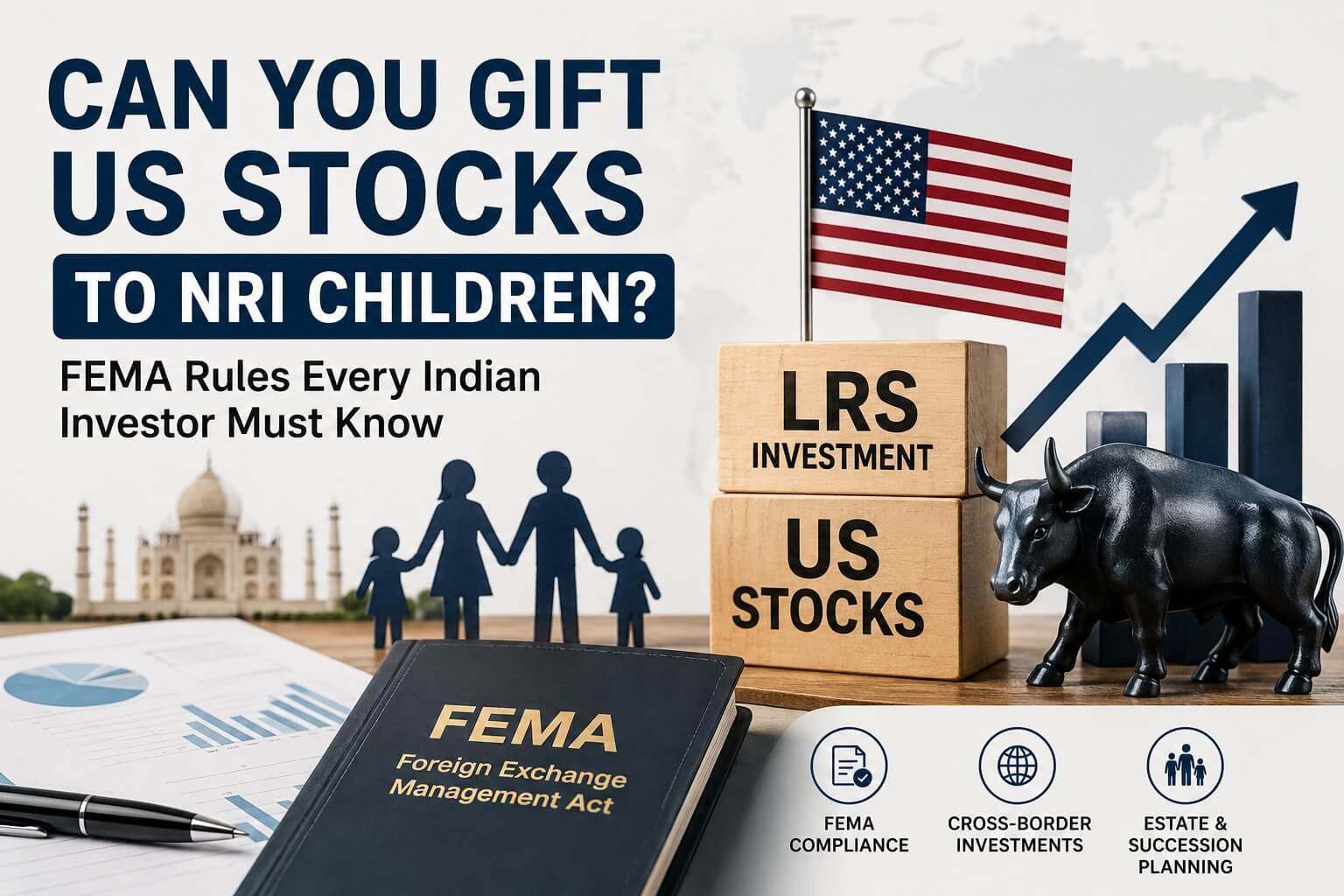


Over the past few years, investing in US stocks from India has become increasingly popular. Thousands of Indian residents now own shares of companies like Apple, Microsoft, Alphabet (Google), Amazon, Nvidia, Tesla, Meta, and Berkshire Hathaway through overseas brokerage accounts using the Liberalised Remittance Scheme (LRS).
However, very few investors realise that buying foreign shares under LRS is only one part of the compliance journey.
A much bigger question often arises later:
Surprisingly, the answer is not as straightforward as many believe.
Under India's Foreign Exchange Management Act (FEMA), the transfer of foreign securities held overseas is subject to specific regulatory restrictions. These rules can significantly impact estate planning, succession planning, inheritance, family wealth transfer, and cross-border tax planning.
If you are an Indian resident investing in US equities or an NRI expecting to inherit such investments this guide explains everything you should know.
Quick Answer
Generally, a resident Indian cannot freely gift overseas foreign securities acquired under LRS to an NRI (a person resident outside India) unless specifically permitted under FEMA.
This often surprises families who assumed overseas investments could simply be transferred to children living abroad.
India has witnessed an unprecedented rise in overseas investing.
Resident Indians now invest globally through:
For many high-net-worth families, overseas investments now form a significant portion of their wealth.
Yet, wealth creation without succession planning can create serious legal complications.
The Liberalised Remittance Scheme (LRS) issued by the Reserve Bank of India (RBI) allows resident individuals to remit up to USD 250,000 per financial year outside India.
Popular uses include:
The investments remain regulated under FEMA even after they are purchased.
Many investors wrongly assume that ownership automatically gives unrestricted transfer rights.
It does not.
This is where FEMA becomes extremely important.
There is a critical distinction between transferring:
Under the present FEMA framework, gifting overseas securities held under LRS to an NRI may not be permissible unless specifically allowed under FEMA regulations. These rules are particularly relevant for any Returning Indian with overseas investments who is planning long-term family wealth transfers.
In simple words:
Example
Rahul lives in Delhi.
Over ten years, he builds a US stock portfolio worth ₹3 crore through LRS.
His daughter later settles permanently in California and becomes an NRI.
Rahul wishes to transfer the shares during his lifetime as part of family wealth planning.
Although this appears to be a private family transaction, FEMA regulations may restrict such gifting because the recipient is no longer a resident of India.
Earlier generations largely invested in:
Today's families often hold substantial international assets including:
Meanwhile, children increasingly migrate to:
The result?
A growing number of Indian families now face cross-border inheritance and FEMA compliance issues.
Yes.
This is perhaps the most misunderstood aspect.
There is an important legal distinction between:
However, actual implementation may involve:
Each case must therefore be evaluated individually.
Many Indian investors focus only on FEMA.
However, US Estate Tax can be an even bigger financial risk.
US-listed stocks are generally treated as US situs assets.
On the death of a non-US investor, these assets may become subject to US Estate Tax.
For many non-resident non-citizens, the exemption threshold is dramatically lower than the exemption available to US citizens.
Without proper planning, families may lose a significant portion of the investment portfolio.
Our international tax team frequently encounters investors who:
These issues usually surface only after a major life event.
Cross-border estate planning requires analysing multiple laws simultaneously.
These include:
Looking at only one jurisdiction can create unexpected compliance problems.
If you own overseas investments, consider the following:
International wealth planning requires expertise in:
International investing has become remarkably simple.
International succession has not.
A portfolio accumulated over decades can become legally complicated overnight because of:
Professional planning today can save years of litigation and substantial tax costs for future generations.
At Dinesh Aarjav & Associates, we advise clients across India and the world on complex cross-border tax and FEMA matters.
Our services include:
With 25+ years of experience, offices in India, USA, Canada and the UK, and clients in 50+ countries, our team helps individuals and families navigate the complexities of international taxation and regulatory compliance.
Owning US stocks is no longer uncommon for Indian investors.
But transferring those investments to the next generation requires careful planning.
Before gifting overseas securities or preparing your estate plan, it is essential to understand the interaction between FEMA, RBI regulations, Indian succession law, US Estate Tax, and cross-border tax rules.
Taking advice early can protect your family's wealth and ensure a smooth transfer across generations.
CA Priyal Goel Jain is a Partner at Dinesh Aarjav & Associates and a leading expert in India–US cross-border taxation, NRI taxation, and international tax advisory. She advises NRIs, OCIs, and global families on complex cross-border transactions, tax planning, foreign asset reporting, and multi-jurisdictional compliance matters.




Stay in the loop, subscribe to our newsletter and unlock a world of exclusive updates, insights, and offers delivered straight to your inbox.

.webp)