WhatsApp
 Call Us
 Email Us
 Whatsapp Community

Would you like to schedule a call back




Last updated 17 September 2026. Position stated as at 17 September 2026, based on the FAST-DS Rules 2026 and the CBDT FAQs
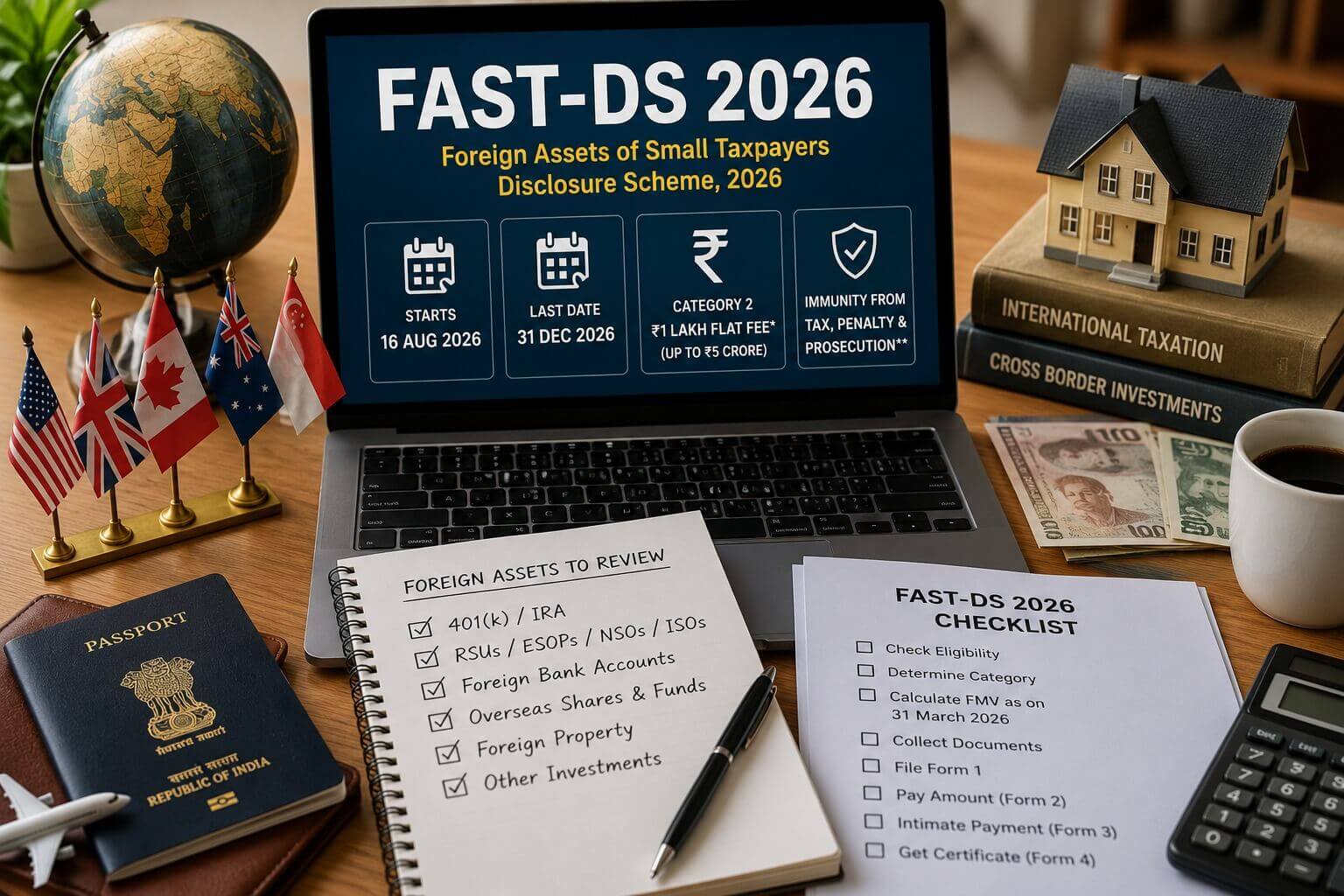
FAST-DS 2026 is a one-time disclosure window that lets eligible taxpayers declare foreign assets and foreign income they never reported on their Indian returns. Officially the Small Taxpayer Foreign Asset Disclosure Scheme 2026, it was notified by the CBDT on 14 August 2026, opened on 16 August 2026, and closes on 31 December 2026. Every asset is valued as on 31 March 2026, and filing happens electronically through Form 1.
Here is the part that decides everything: the scheme runs on two separate tracks. FAST-DS Category 2 costs a flat ₹1,00,000 for assets with a clean source that were simply left out of Schedule FA, up to ₹5 crore. FAST-DS Category 1 costs 60% of the declared value for genuinely undisclosed assets or income, up to ₹1 crore. Pick the wrong track and the difference is enormous.
If you worked for years in the US, Canada, the UK, Singapore or the Gulf, then came home with a 401(k), some RSUs or a house you never listed on an Indian return, this guide is written for your situation.
Before going deeper, here is the whole scheme side by side.
|
Particulars |
Category 1: Undisclosed asset or income |
Category 2: Clean source, not in Schedule FA |
|
Scheme name |
Foreign Assets of Small Taxpayers Disclosure Scheme, 2026 |
Same |
|
Opened |
16 August 2026 |
16 August 2026 |
|
Closes |
31 December 2026 |
31 December 2026 |
|
Valuation date |
31 March 2026 |
31 March 2026 |
|
Filing mode |
Electronically, in Form 1 |
Electronically, in Form 1 |
|
What triggers it |
Source of the foreign asset or income was never explained or taxed in India |
Source already explained or taxed, or asset bought while genuinely non-resident; the only default is missing Schedule FA disclosure |
|
Aggregate ceiling |
₹1 crore as on 31 March 2026 |
₹5 crore as on 31 March 2026 |
|
Amount payable |
30% tax plus 30% additional, so 60% of declared value |
Flat ₹1,00,000, whatever the value within the ceiling |
|
Immunity granted |
From further tax, penalty and prosecution under the Black Money Act |
From the ₹10 lakh-per-year Schedule FA penalty and prosecution under the Black Money Act |
|
Not available if |
A Black Money Act assessment is already complete, or a PMLA matter is pending |
Same |
FAST-DS 2026 is not one flat-rate amnesty. It has two tracks, and most errors come from people assuming they automatically sit in the cheaper one.
Category 1 covers anything where the source was never properly explained or taxed in India. The CBDT FAQ puts it simply: an undisclosed foreign asset is one where the source of the investment cannot be satisfactorily explained.
If the total value of those assets and income stays at or below ₹1 crore as on 31 March 2026, you can settle by paying 30% tax plus an additional amount equal to that tax. That is the FAST-DS 2026 60% tax outcome.
Here is the arithmetic on a real number. Say you have a ₹60 lakh undisclosed foreign bank account and ₹20 lakh of undisclosed foreign income, so ₹80 lakh in total:
This is where most returning NRIs actually land, and it works on a completely different logic. It applies when the source of an overseas asset was already explained or already taxed, or the asset was bought while you were genuinely non-resident, but it never made it into Schedule FA of your Indian return afterwards.
As long as the total stays under ₹5 crore as on 31 March 2026, the whole liability is the FAST-DS 2026 ₹1 lakh flat amount. The size of the asset within that ceiling does not change it.
Picture someone who spent twelve years in California. US salary, US taxes paid, a 401(k), RSUs, a home, a brokerage account. None of it is linked to hidden Indian money. The trouble only starts after they move back, become resident again, and file returns without listing any of it in Schedule FA. That is a very different story from someone who quietly earned foreign income and buried it. Category 2 exists to give the first group a fair way out.
A flat ₹1 lakh only looks cheap once you see what it replaces. The Black Money (Undisclosed Foreign Income and Assets) and Imposition of Tax Act, 2015 works on a different principle from the Income-tax Act. The penalties attach to the asset and to the year, not to the tax.
Section 43 of the Black Money Act allows a penalty of ₹10 lakh for failing to give information about a foreign asset in your return. The sting is that it has nothing to do with whether any tax was owed.
A dormant account with a zero balance, an RSU holding where US tax was fully paid, a pension you cannot even touch: each one is reportable, and each omission can draw the penalty. Section 42 covers the related failure to file a return at all where a foreign asset is held.
It applies per assessment year. Four silent years on one account means four separate exposures.
Since 1 October 2024, the proviso to Sections 42 and 43 leaves out foreign assets other than immovable property where the total value stays at or below ₹20 lakh. Foreign immovable property gets no relief at any value.
Where the asset or income is truly undisclosed rather than just unreported, the numbers get much worse. Tax runs at 30% of the value, and a penalty of three times that tax can follow. Total exposure lands near 120% of fair market value. The asset is effectively gone, and then some.
The Black Money Act carries criminal consequences too. Wilfully failing to file a return connected to a foreign asset, or to report a foreign asset in the return, is punishable with rigorous imprisonment, and a wilful attempt to evade tax attracts a longer term.
Prosecution is not the usual outcome of a paperwork slip, and CBDT instructions have historically said prosecution should not start where penalty under Sections 42 or 43 is not leviable. Still, the exposure sits on the statute book, and a valid FAST-DS declaration is what wipes it out.
|
Situation |
Do nothing |
Under FAST-DS |
|
Clean-source foreign asset left out of Schedule FA for 4 years |
Up to ₹10 lakh per year under Section 43, plus prosecution risk |
Flat ₹1 lakh, one time, all years covered |
|
Undisclosed foreign asset worth ₹80 lakh |
30% tax plus penalty up to three times the tax, roughly 120% of value |
60% of value, with immunity |
For anyone in the Category 2 position, this is not really a tax. It is the price of finality.
Foreign asset disclosure for NRIs under this scheme is broader than people assume. FAST-DS 2026 eligibility is not limited to people currently living in India.
The CBDT FAQ recognises two groups:
Your residential status today is the wrong question. The right question is what your status was in the year the income arose or the asset was bought. So yes, FAST-DS 2026 for NRIs is very much on the table. You just have to establish your status for that specific year.
No. That is where the analysis starts, not where it ends. Buying something while non-resident does not automatically keep it out of Indian disclosure today.
What matters is a chain of facts:
Being an NRI today rules you neither in nor out.
A proper review goes far past the obvious checking account. Work country by country.
Bank and savings accounts, brokerage accounts, 401(k)s, traditional and Roth IRAs, other employer retirement plans, US stocks, ETFs and mutual funds, RSUs, ESOPs, NSOs and ISOs including shares received on exercise and any employer stock, property and rental property, partnership interests, insurance or investment products, and the dividends, interest, capital gains or rent those assets produced.
One warning on equity pay. "My RSUs were already taxed in the US" and "the ESOP came from my employer, so it is not a foreign asset" are not answers. Paying tax on the compensation and disclosing the resulting foreign asset are two entirely separate obligations.
The right analysis turns on whether the award vested, whether shares were actually issued, whether options were exercised, whether anything was later sold, where the custodian account sits, your Indian residential status at each of those moments, and whether the income was reported in India. Review RSU, ESOP, NSO and ISO holdings one at a time.
Bank and brokerage accounts, Canadian shares and ETFs, RRSPs, TFSAs, employer retirement plans, pension interests, property including rental property, other investment accounts, and the usual dividends, interest and capital gains. Do not assume an RRSP sits outside the analysis just because it is labelled a retirement account.
UK returnees should look at bank accounts, ISAs and other investment accounts, brokerage holdings, workplace pensions and SIPPs, other pension interests, UK shares, property and rental property, and related investment income.
Singapore returnees should check bank and brokerage accounts, investment portfolios, shares, CPF-related interests where relevant, insurance or investment products, property, and rental income.
The same logic runs to assets built up in the UAE, Australia, Germany, France, Switzerland, the Netherlands, Ireland, Japan, Hong Kong or New Zealand. This Foreign Asset Disclosure Scheme 2026 is not US-specific. The law is written around foreign assets and foreign income, not the country they sit in.
Category 2 exists because of Schedule FA. Once you understand what that schedule demands, you will know whether you even have a problem.
Schedule FA disclosure applies to individuals who are Resident and Ordinarily Resident (ROR) in India for the year. If you were ROR and held any foreign asset at any point in the relevant period, it goes in. It does not matter whether it earned income, whether it had a positive balance, or whether your total income was taxable at all.
There is no minimum threshold. A dormant student account holding fifty dollars carries the same duty as a half-million-dollar portfolio. That is exactly why so many otherwise careful returning NRIs are technically in default.
Watch the sequence for someone coming home: non-resident, then RNOR for a while, then ROR. The Schedule FA duty switches on when you become ROR, and it then covers assets you may have bought decades earlier while abroad.
Schedule FA does not run on the Indian financial year. It follows the accounting period of the foreign country, which for the US, UK, Canada and UAE is the calendar year, January to December.
So for a return covering FY 2025-26, you generally report the foreign assets held during calendar year 2025, not April 2025 to March 2026. Get this wrong and you end up with a Schedule FA that is filled in, but filled in for the wrong window, which is its own defect.
|
Table |
What goes in it |
Typical examples |
|
A1 |
Foreign depository accounts |
Savings, current and fixed deposits abroad |
|
A2 |
Foreign custodial accounts |
Brokerage accounts holding shares, ETFs, bonds |
|
A3 |
Foreign equity and debt interest |
Directly held foreign shares, ESOP and RSU shares, foreign bonds |
|
A4 |
Cash value insurance or annuity contracts |
Insurance-linked investment and annuity products |
|
A5 |
Financial interest in any entity |
Foreign companies, LLCs, partnerships |
|
A6 |
Immovable property abroad |
Residential, commercial or land holdings overseas |
|
A7 |
Other capital assets abroad |
Assets not captured elsewhere |
|
A8 |
Signing authority, trustee or beneficiary interests |
Accounts you operate but do not own; trust interests |
Schedule FA reports the asset. Two other filings handle the income:
Schedule FA does not exist on ITR-1. If you hold foreign assets, ITR-1 is not available to you, and filing it is itself a reporting default.
A valid declaration settles the past. It does not excuse the asset from future reporting. As long as you hold it and you are ROR, it goes into Schedule FA every year from here, with the income in Schedule FSI and any credit in Form 67.
In most cases, yes, at least partly. An overseas account is not invisible just because it never showed up on an Indian return. India receives foreign account information automatically through two channels.
FATCA. Under the India-US inter-governmental agreement, US financial institutions report details of accounts linked to Indian persons, and Indian tax authorities receive that data every year. If you worked in the US, this is the channel that matters most to you.
CRS. The Common Reporting Standard, built by the OECD, does the same thing across a much wider network. India exchanges information with a long list of partners covering the UK, Canada, Singapore, Australia, the UAE and most of Europe.
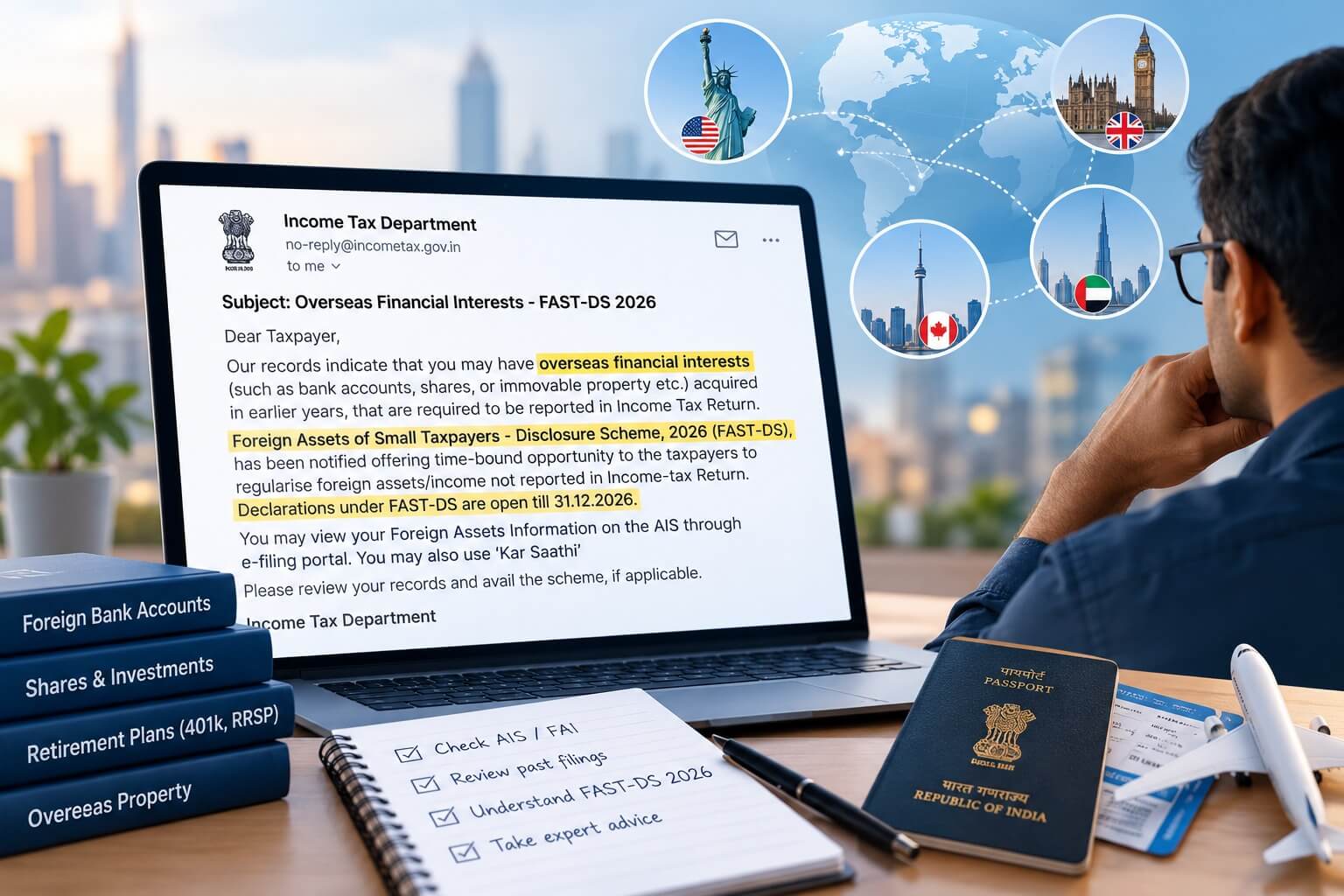
Both feed the department's Foreign Assets Information (FAI) system and, more and more, show up in your Annual Information Statement.
The first mistake is thinking that because nothing has happened yet, nothing will. The data arrives on a yearly cycle and gets matched against returns in batches. The absence of a notice tells you something about processing queues, not about whether the data exists.
The second mistake runs the other way: assuming that if an asset is not in AIS, it is outside the net. AIS only reflects what partner countries have reported. It is a cross-check, not a full inventory, and it has no legal standing as a substitute for Schedule FA. Flip it around too: if something appears in AIS that you never reported, reconcile it right away.
The practical upshot is simple. Voluntary disclosure while the window is open is a decision you control, at a known price. Disclosure after a query lands is neither.
Every declaration is valued on one fixed date: 31 March 2026. This matters more than people expect, because the FAST-DS 2026 valuation rules can produce a very different number from a brokerage statement, an agent's estimate, or a straight market-price conversion.
The general rule for fair market value (FMV) is the higher of the cost of acquisition or what the asset would fetch on the open market on that date, subject to asset-specific rules.
For immovable property, bullion, jewellery, precious stones, artistic works and paintings held abroad, FMV is the higher of:
The open-market figure can optionally be backed by a report from a valuer recognised by the government of that foreign country.
This is the most useful valuation detail in the notified Rules, and it rarely gets mentioned.
For bullion, jewellery, precious stones, immovable property, artistic works and paintings, the Rules carry a proviso: where no formal valuation is carried out, the indexed cost of acquisition, computed using the Cost Inflation Index the same way as under Section 48 of the Income-tax Act, is treated as the FMV instead.
That gives you a real choice, and the right one depends on which number is lower:
A valuation report is not mandatory for these asset classes. It is a lever. Comparing both numbers before paying a valuer can directly change the tax under Category 1 and, just as importantly, whether the asset crosses the ₹1 crore or ₹5 crore ceiling at all.
Shares and securities broadly follow the approach under Section 56(2)(x) of the Income-tax Act. But the indexed-cost proviso does not apply the same way to both types.
|
Share type |
FMV basis |
Indexed cost fallback? |
|
Listed shares |
Higher of cost or the price quoted on the exchange on 31 March 2026 |
No |
|
Unlisted shares |
Net asset value basis, with prescribed adjustments |
Yes |
This gap matters for anyone holding pre-IPO stock, ESOP shares in a private company, or shares of a closely held foreign company bought years ago at a low price. The worked example further down shows just how wide it can get.
Foreign bank accounts are not simply valued at the 31 March 2026 closing balance. The Rules use a method built around deposits made from account opening to the valuation date, with exclusions so the same money is not counted twice.
Every value has to end up in rupees. Where the currency is freely convertible under the FEMA (Deposit) Regulations 2016, the RBI reference rate on 31 March 2026 applies. Where it is not, you convert first into US dollars at the rate set by that country's central bank, then into rupees at the RBI rate.
|
Currency |
RBI reference rate (31 March 2026) |
|
USD (per 1 USD) |
₹94.6543 |
|
GBP (per 1 GBP) |
₹125.6347 |
|
EUR (per 1 EUR) |
₹109.0064 |
|
JPY (per 100 JPY) |
₹59.2500 |
|
AED (per 1 AED) |
₹25.7694 |
|
IDR (per 10,000 IDR) |
₹55.7077 |
At the USD rate, the ₹1 crore Category 1 ceiling is roughly US$1,05,647, and the ₹5 crore Category 2 ceiling roughly US$5,28,238. Useful for a quick gut-check only. The real valuation must follow the prescribed method.
Worth saying plainly: the ₹1 crore and ₹5 crore thresholds are themselves valuation questions. Running the indexed-cost comparison and the listed-versus-unlisted test before filing Form 1 is not a nice-to-have. If you sit anywhere near either ceiling, it can decide whether you qualify for the flat ₹1 lakh or fall outside the scheme entirely.
Property is usually the biggest item on these lists, and it is where the line between the two categories gets drawn most sharply.
If a US house, Canadian home, UK or Dubai property, Singapore apartment or inherited foreign property was bought while you were genuinely non-resident, and the source of funds is clean, the facts may fit the ₹5 crore Category 2 framework.
But if the source was never explained, or the underlying income was taxable in India and never reported, that same property can push you into Category 1. Which is exactly why documenting where the purchase money came from sits at the centre of this whole exercise.
These four situations come up again and again. Each one shows why a quick assumption rarely holds.
Someone worked in the US for a decade, built up US$300,000 in a 401(k) while paying US tax on their salary, came back to India, became resident again, kept the account open, and never mentioned it in Indian disclosures.
The answer is never simply "401(k) equals ₹1 lakh". You have to work through the account's legal nature and ownership, the contribution history, residential status in each year, how it was taxed, whether it was acquired while non-resident, whether Schedule FA duties were met, its value under the scheme's rules, and whether the Category 2 conditions are genuinely satisfied, all before taking any filing position.
A tech employee got RSUs while working in California, watched them vest over several years, sold some, kept others in a US brokerage account, then moved permanently to India without reporting the remaining shares in Schedule FA.
Untangling that means pinning down when the compensation arose, when share ownership began, the Indian residential status at each stage, whether the compensation was reported, whether the brokerage account and any dividends or gains were disclosed, where the investment came from, and whether the facts fit Category 2. RSU, ESOP, NSO and ISO cases usually need a joined-up India-US analysis, not a one-line answer.
An employee bought 100 unlisted shares of a foreign employer in FY 2010-11 at US$10 each, so US$1,000 in total. By 31 March 2026 the shares are worth US$300 each on the open market, making the holding US$30,000. The indexed cost of acquisition, after applying the Cost Inflation Index, comes to roughly US$2,300.
|
Basis |
Value on 31 March 2026 |
|
Open market value |
US$30,000 |
|
Indexed cost of acquisition |
About US$2,300 |
Because these are unlisted shares, the indexed-cost proviso applies. If no formal NAV-based valuation is obtained, the FMV can be pegged to the far lower indexed figure, provided the conditions in the Rules are met. Had they been listed shares, this option would not exist. The same comparison logic applies to bullion and jewellery.
Someone bought a house in New Jersey in 2017 while working and paying tax in the US, returned to India in 2025, became resident, and never listed the property in Schedule FA.
If the source of the purchase money is fully explainable, this is the classic Category 2 case, subject to residential status, acquisition and reporting history, correct valuation including the higher-of-cost-or-market test, and the ₹5 crore ceiling. It also shows why the work has to be done properly before assuming the harsher Black Money Act default applies.
This is not a "pay ₹1 lakh and move on" filing. FAST-DS Form 1 asks for supporting documents showing how the asset was acquired or the income earned, plus valuation papers where a formal valuation was done.
|
Country |
Documents to gather |
|
US |
W-2s, US tax returns, brokerage and 401(k)/IRA statements, RSU vesting statements, ESOP papers, option exercise records, stock sale statements, property closing and mortgage records, bank, dividend and interest statements |
|
Canada |
T4s, Canadian tax returns, RRSP and TFSA statements, brokerage statements, property documents, pension records, bank statements |
|
UK |
P60s or P45s, pension and SIPP statements, brokerage statements, ISA records, property documents, bank statements |
|
Singapore, UAE, others |
Employment records, tax returns, bank and brokerage statements, investment statements, property documents, retirement account statements |
Building this file asset by asset, well ahead of the deadline, is genuinely what separates a smooth filing from a scramble. Historical records from foreign institutions routinely take weeks to arrive.
Everything happens online, and you are not stuck filing one asset at a time. A single Form 1 can carry several assets and income items across several countries through its sections and annexures.
Someone with a US 401(k), a US brokerage account, RSUs, a Canadian RRSP, a UK pension and US property does not face six separate filings. It all maps into one submission. That is the whole FAST-DS 2026 filing process in one line.
Once Form 1 is filed and verified, the tax authority must issue Form 2 stating the amount payable, within one month from the end of the month in which you filed. Then a fixed clock starts.
|
Stage |
Deadline |
|
Pay in full, no interest |
Within 2 months from the end of the month Form 2 is received |
|
Pay with 1% per month interest on the delay |
Within a further 2 months |
|
Absolute outer limit |
4 months from the end of the month Form 2 was issued |
Miss that outer limit and the declaration becomes invalid.
Here is how interest actually builds. If Form 2 arrives on 22 September 2026, you can pay interest-free any time up to 30 November 2026. Pay on 17 December 2026 and interest is charged for that one month past 30 November, not for the whole stretch since Form 2 was issued. Slip to 23 January 2027 and it is two months of interest.
|
Scenario |
Form 2 received |
Pay by (no interest) |
Outer limit (with interest) |
|
Standard case |
End of month following filing |
+2 months |
+2 further months, interest on delay only |
|
Worked example |
22 September 2026 |
30 November 2026 |
31 January 2027 |
|
Filed in December 2026 |
Around 31 January 2027 |
31 March 2027 |
31 May 2027 |
Note what the last row means in practice. A declaration filed close to the 31 December deadline pushes the payment obligation well into 2027. That is legitimate, but it leaves no margin if anything in the valuation or documentation needs revisiting.
After payment, you tell the tax authority in Form 3, within that four-month outer limit. On receiving Form 3, the authority passes an order accepting the declaration in Form 4, within one month.
The Form 4 order is conclusive on the matters stated in it. Once issued:
What you do not get is a second chance. Once payment is made, refunds, rectifications, revisions, set-offs and appeals are all closed for that amount. There is no route back.
So the analysis has to be right before Form 1 goes in, not after the payment clears.
A declaration settles your position under the Income-tax Act and the Black Money Act. It does nothing at all under the Foreign Exchange Management Act, 1999.
That distinction is easy to miss and expensive to miss. Tax regularisation and exchange-control compliance are separate regimes. A disclosure that cleans up your tax position can, at the same time, put facts on record that raise FEMA questions the scheme gives you no immunity from.
A few patterns show up again and again for returning NRIs and resident investors:
Foreign balances kept after return. A person resident in India generally has to surrender foreign exchange received, realised, unspent or unused to an authorised person within 180 days, including from the date of return. Money left sitting overseas beyond that may be a contravention.
Investment into layered structures. A resident individual's overseas direct investment generally is not allowed into a foreign entity that itself has a step-down subsidiary, with carve-outs for inheritance, qualification shares, sweat equity and employee stock schemes.
Investment into financial services entities. ODI by resident individuals into foreign financial services businesses is restricted. Offshore fintech platforms, lending start-ups, trading apps, advisory ventures and crypto exchanges often fall here without the investor noticing, again with ESOP and inheritance carve-outs.
Funding routes. Overseas investment must move through permitted channels. Cash funding through relatives abroad, third-party funding, informal transfers and anything outside recognised banking channels are not allowed.
Reporting lapses. Late Form FC filing and late submission of share certificates or other evidence to the AD bank are common, and they taint an otherwise clean transaction.
Overseas property. Buying on deferred payment or instalments can be read as a financing arrangement creating an obligation outside India, a capital account transaction needing prior approval. Funding property through overseas borrowings or informal channels sits outside the permitted routes.
Section 6(4) of FEMA matters here. It lets a person resident in India hold, own, transfer or invest in foreign currency, foreign security or property outside India where the asset was acquired while they were resident outside India, or inherited from someone resident outside India.
For a returning NRI whose foreign assets were built entirely during genuine non-resident years, which covers most Category 2 cases, Section 6(4) is often the answer. The point is to establish and document it, not assume it.
None of this is a reason to skip filing. A FEMA breach does not bar a declaration, and staying outside the scheme does not cure a FEMA breach. The two regimes run independently, and FEMA has its own fixes, including late submission fees and compounding.
The takeaway: run a parallel FEMA review over the same facts before Form 1 goes in, not after. You want to know what your disclosure puts on record.
Getting a notice is not the same as being disqualified.
A notice, inquiry or information request about a foreign asset does not automatically shut the door. Where assessment proceedings are already pending under the Income-tax Act or the Black Money Act, 2015, the Assessing Officer has to take your declaration into account when finalising that assessment.
The hard line is a completed Black Money Act assessment. Once that is concluded for a particular matter, the scheme is no longer available for it. Pending proceedings and completed assessments are treated very differently, so check which one you are actually facing before assuming the worst.
Two situations fall outside it completely:
Where a proceeding or inquiry is merely pending and no assessment has been completed, you remain eligible, subject to the other conditions.
The scheme is not the only 2026 development worth knowing. There is a separate statutory relief that is easy to confuse with it, and running that analysis first could save you a payment altogether.
A proviso to Section 43 of the Black Money Act provides that no penalty is leviable at all for non-disclosure of certain foreign assets in Schedule FA, completely independent of FAST-DS.
Before the Finance (No. 2) Act, 2024, this was narrow. It applied only where the asset was one or more foreign bank accounts with an aggregate balance not exceeding ₹5 lakh at any point in the previous year. From 1 October 2024, the amended proviso is much wider: no penalty where the non-disclosure relates to any foreign asset other than immovable property, as long as the total value stays at or below ₹20 lakh.
No. Section 43 says the Assessing Officer may direct a penalty of ₹10 lakh. That discretion matters. Several Tribunal decisions have turned on whether the omission was a genuine oversight rather than concealment, especially where the income was fully offered to tax in India.
That is an argument, not a defence you can lean on, and it is exactly the uncertainty Category 2 removes for a flat ₹1 lakh. Still, it is worth knowing the penalty is not mechanical.
There is also a retrospectivity question. Where penalty proceedings started before 1 October 2024 on assets now covered by the ₹20 lakh threshold, there is a reasonable argument, resting on the principle that a relieving amendment can be read retrospectively, that the higher threshold should apply. That is unsettled and fact-specific.
If your only issue is a technical non-disclosure and the asset falls within these thresholds, with a legitimate and otherwise disclosed source, you may not need the scheme at all. That is a separate analysis, and it should be run first.
One caveat: the Section 43 proviso only shields you from the penalty. It does not retire the ongoing duty to report the asset in Schedule FA going forward.
|
Situation |
Where it points |
|
Legitimate foreign asset left out of Schedule FA |
FAST-DS Category 2 |
|
Non-immovable asset worth ₹20 lakh or less (post-Oct 2024) |
Section 43 proviso relief |
|
Foreign bank account with balance ₹5 lakh or less (pre-Oct 2024 years) |
Section 43 proviso relief |
|
Undisclosed foreign income or asset with unexplained source |
FAST-DS Category 1 |
|
Asset value over ₹5 crore |
Outside Category 2 |
|
Undisclosed amount over ₹1 crore |
Outside Category 1 |
|
Completed Black Money Act assessment or live PMLA matter |
Scheme not available |
Get the analysis wrong before filing and there is no way to fix it afterwards. These are the traps worth watching for:
A thorough filing is less like a routine tax return and more like rebuilding your global financial history. Work through each of these before 31 December 2026.
For a returning NRI, the real value here usually is not the arithmetic. It is being able to put a defensible, well-documented position under a legacy overseas asset that was earned honestly abroad but never made it onto an Indian return after residency changed. That is why source documents, residential-status history, valuation and Schedule FA history all carry so much weight.
Aarjav Jain is the Executive Director at Dinesh Aarjav & Associates, specializing in India–US cross-border transactions, NRI taxation, international tax advisory, and global investment structuring. With over 10 years of experience in project financing and cross-border advisory, he assists NRIs and businesses with regulatory compliance, repatriation planning, and international transaction structuring.





Stay in the loop, subscribe to our newsletter and unlock a world of exclusive updates, insights, and offers delivered straight to your inbox.

.webp)