WhatsApp
 Call Us
 Email Us
 Whatsapp Community

Would you like to schedule a call back





There is a moment many Indians living in the US look forward to for years.
The house is sold or rented out. The kids are getting ready for school in India. The resignation is done. The flight is booked.
And then, usually at some point before the move, someone asks:
“Once I move back to India, do I still have to pay US taxes?”
It sounds like it should have a straightforward answer.
It doesn’t.
Moving back to India can change your US tax position, but leaving the United States physically does not automatically mean that your US tax obligations have ended.
The answer depends on what you are in the eyes of US tax law — a US citizen, Green Card holder, H-1B or L-1 visa holder, another type of non-immigrant, or a former US tax resident — and on what happens to your income and assets after you move.
Your US stocks, RSUs, 401(k), IRA, US property, bank accounts and even the Indian accounts you open after returning can all become part of the conversation.
This is why returning to India should be looked at as a US-India tax transition, rather than simply an international relocation.
This is where most of the confusion starts.
People naturally think about immigration status first. Your visa expires. You surrender your Green Card. You leave the US.
But immigration status and tax residency are not necessarily the same thing.
For a US citizen, the answer is relatively straightforward: moving to India does not stop the US tax filing obligation. US citizens generally remain subject to US tax on worldwide income even when they live outside America.
Green Card holders have a different set of rules. A Green Card generally makes you a US resident for tax purposes unless the status has ended or another applicable rule changes the analysis. The IRS’s current guidance specifically recognises the Green Card test as one of the routes to US tax residency.
And then there are people on H-1B, L-1, H-4 and similar visas.
For them, the visa itself doesn’t answer the tax question. The Substantial Presence Test can determine whether they are treated as US residents for tax purposes. For 2026, that test generally looks at whether you were physically present in the US for at least 31 days in the current year and at least 183 weighted days over the current year and the preceding two years.
So, if you’re planning to return to India, don’t start with:
“My visa expires on this date.”
Start with:
“On what date does my US tax residency actually end?”
That date can affect almost everything that follows.
The year of your move is where things can get surprisingly complicated.
Imagine you spend the first half of the year working in California, receive your annual bonus, have some RSUs vest, sell a few shares and then move to Bengaluru in July.
Once you’re in India, you start earning an Indian salary.
At the same time, you still have:
From a tax perspective, that’s not one simple transaction.
It’s a timeline.
You need to establish what happened while you were a US tax resident, what happened after your residency changed, where the income arose, and what reporting obligations continue after the move.
Depending on your circumstances, your US filing may involve Form 1040, Form 1040-NR, a dual-status return and various information returns.
And this is an area where getting the residency date wrong at the beginning can cause problems throughout the rest of the return.
If you’re an Indian-origin US citizen returning to India, don’t assume that your US tax life ends when your Indian life begins.
It doesn’t.
The US generally continues to tax its citizens on worldwide income, regardless of where they live.
That can mean your US tax return continues to include things such as:
You may also have foreign-account reporting requirements.
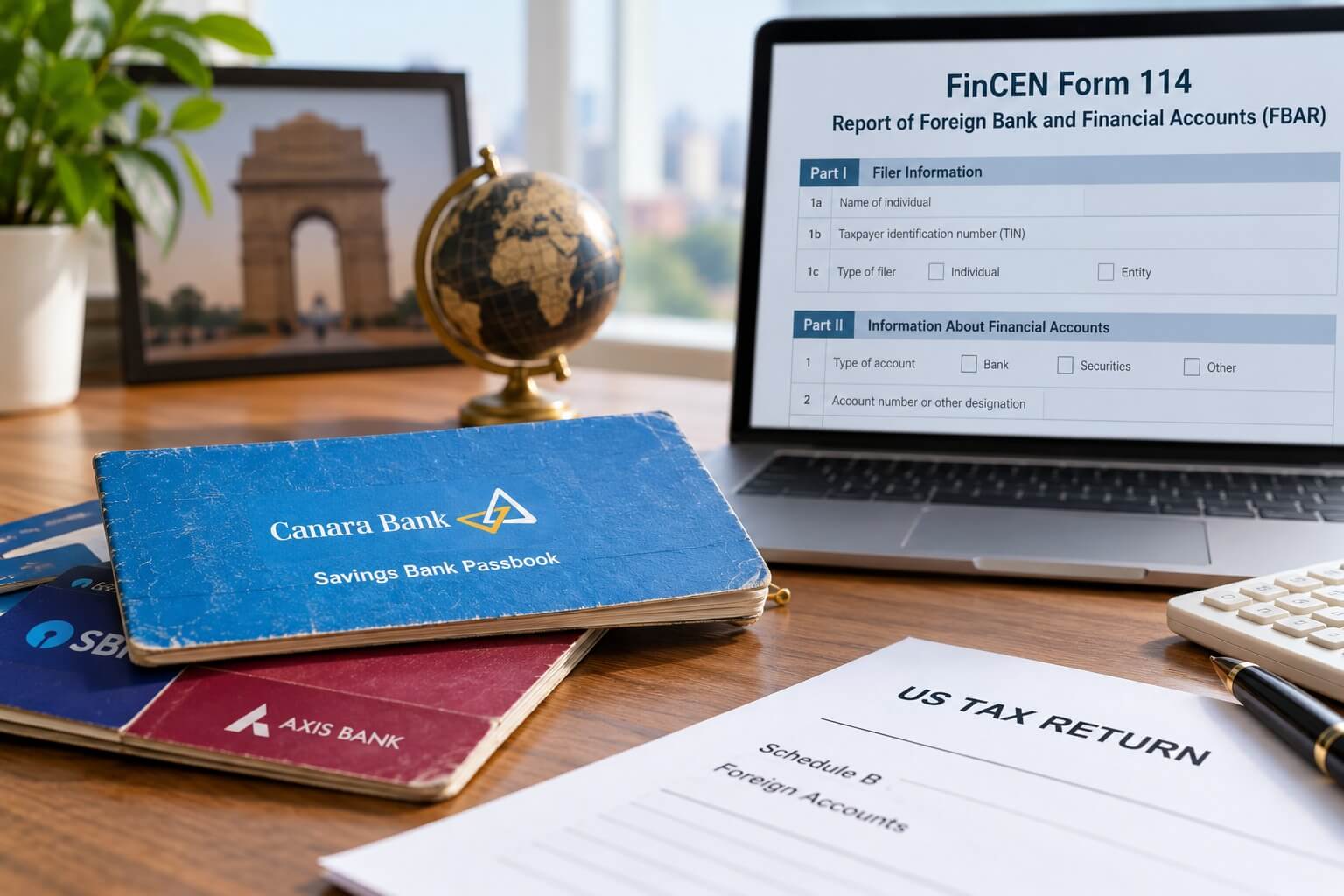
For example, a US person living in India may need to consider FBAR reporting for qualifying Indian financial accounts. The IRS explicitly notes that US taxpayers with foreign financial accounts can have FBAR obligations even when those accounts do not generate taxable income.
So if you’re a US citizen returning to India, the question isn’t:
“Do I still file US taxes?”
It’s usually:
“How do I manage my US and Indian tax obligations without paying tax twice or missing a reporting requirement?”
That’s a much more useful question.
This is one area where we strongly recommend planning before surrendering the Green Card.
A common assumption is:
“I’m moving to India permanently, so I’ll just give up my Green Card and I’m done.”
For tax purposes, it can be considerably more complicated.
Certain long-term Green Card holders who relinquish their status can fall under the US expatriation tax rules. The IRS states that the expatriation provisions can apply to long-term residents who end their US residency, and Form 8854 is used by individuals who have expatriated.
If you have held a Green Card for many years and have built significant wealth in:
then the decision to surrender the Green Card deserves a proper tax review.
Under the expatriation rules, certain individuals who qualify as covered expatriates can be subject to special tax rules, including the mark-to-market regime.
In simple terms, certain assets can be treated as though they were sold immediately before expatriation, potentially bringing unrealised gains into the tax calculation.
That’s why Green Card surrender should not be treated as merely an immigration formality.
The IRS also requires Form 8854 in applicable expatriation situations, including certification relating to compliance with US federal tax obligations for the preceding five years.
If you’re considering surrendering a Green Card, the better time to get tax advice is before you surrender it not afterwards.
This is probably one of the most common questions we hear from returning professionals.
And the short answer is:
You don’t necessarily need to sell them.
If you’ve spent ten years working in the US and built a substantial portfolio of Apple, Microsoft, Amazon, ETFs or other US investments, moving to India doesn’t automatically mean you have to liquidate everything.
But there are several things you should look at.
First, will your brokerage firm allow you to maintain the account with an Indian residential address?
Second, has your tax status changed?
Third, what documentation does the brokerage require?
And fourth perhaps most importantly what is the tax consequence of selling after you become an Indian resident compared with selling while you are still a US tax resident?
There is no universal “sell before moving” or “sell after moving” rule.
The answer can depend on your US tax residency date, Indian residential status, the type of security, the applicable treaty provisions and the size of the unrealised gain.
So if you have a $500,000 or $1 million US investment portfolio, don’t make a large sale simply because you’re moving countries.
Model the tax consequences first.
RSUs are another area where returning employees often get caught off guard.
Suppose you worked in the US for four years, received RSUs from your employer, and then moved to India.
You still have RSUs scheduled to vest after your move.
It would be tempting to say:
“Those shares vested after I moved to India, so they’re Indian income.”
That can be an oversimplification.
The tax treatment of equity compensation can depend on factors including where you performed the underlying services during the relevant vesting period.
That’s why you should keep your:
This becomes particularly important for employees who have worked across multiple countries during the vesting period.
If you have significant unvested RSUs, this is something to discuss with a US-India cross-border tax consultant before relocating.
Moving to India doesn’t automatically mean your 401(k) needs to be cashed out.
And in many situations, there is no reason to make a rushed decision.
Depending on the plan and your circumstances, you may be able to leave the money where it is or consider a rollover.
But there are several questions worth asking before you move money around:
The same thinking applies to an IRA.
A retirement account that was perfectly straightforward while you lived in America can become considerably more complicated once you’re a tax resident of India.
The answer isn’t necessarily “withdraw it” or “leave it.”
It is:
Understand the US and Indian tax consequences before making the decision.
Not everyone sells their US home when they move back to India.
Some people rent it out.
Others keep it because they may return to the US later.
Some simply don’t want to sell a property at that point in their lives.
If you retain US real estate, the property can continue to have US tax implications.
Rental income generally needs to be considered for US tax purposes, and a future sale can bring FIRPTA the Foreign Investment in Real Property Tax Act into the picture for a foreign seller.
So if you’re thinking:
“I’ll just rent out my house and deal with the tax later,”
it’s worth getting the structure right before the first tenant moves in.
This catches many people by surprise.
If you are a US citizen or remain a US tax resident, your Indian financial accounts can become foreign accounts from the US reporting perspective.
That can bring FBAR and potentially Form 8938 considerations into the picture. The IRS confirms that US taxpayers with foreign financial accounts may have reporting obligations, while Form 8938 is a separate foreign-asset reporting regime.
So the account you open in India after moving back isn’t necessarily “outside the US tax system” if you continue to be a US person.
This is a good example of why cross-border tax planning is about more than just income tax.
Reporting matters too.
The US side is only half the story.
Once you return to India, you also need to work out your Indian tax residency status.
For returning Indians, this can mean looking carefully at whether you are:
That distinction can matter enormously when you’re dealing with foreign income and assets.
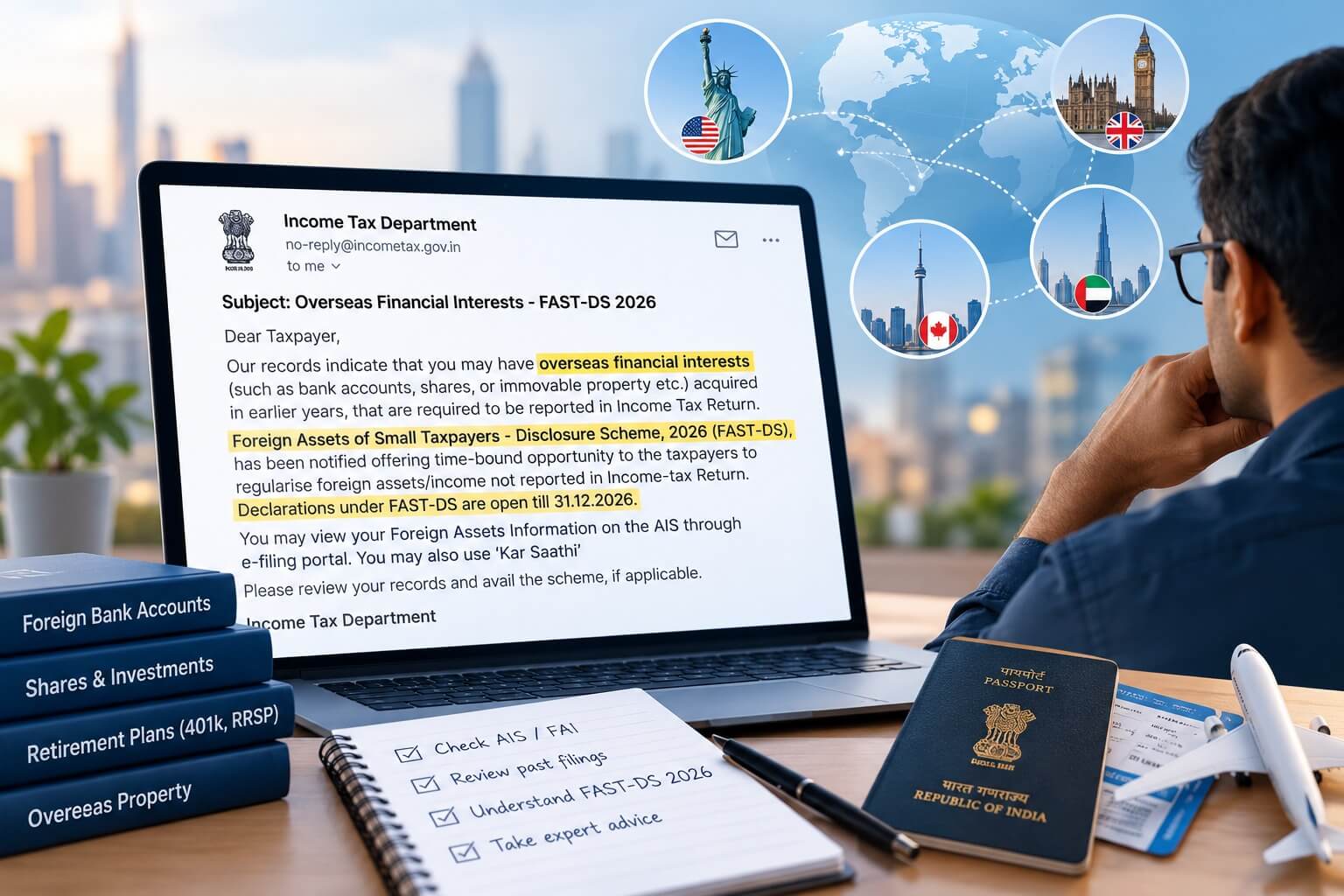
For example, the Income Tax Department’s current guidance says that Schedule FA is used to report specified foreign assets and foreign income for applicable taxpayers, while Schedule FA is not required for taxpayers who are NR or RNOR.
Schedule FSI, meanwhile, deals with foreign-source income and tax relief for residents.
In other words, becoming an Indian resident doesn’t mean you simply copy your US financial statements into your Indian ITR.
Your Indian residential status comes first.
If you’ve spent many years outside India and are now coming back, you may hear your tax advisor mention RNOR Resident but Not Ordinarily Resident.
Don’t dismiss it as technical terminology.
It can be an important part of the tax analysis for returning Indians.
Your residential status can influence how foreign income and foreign assets are treated under Indian tax rules. The exact outcome depends on your circumstances and the applicable rules for the relevant year.
This is one reason we recommend calculating your Indian residential status before making assumptions about what will happen to your US investments once you return.
Yes, it is possible for a person to meet the domestic residency rules of both countries.
That’s when things can get even more complicated.
You may have:
US tax residency rules
plus
Indian tax residency rules
plus
India-US tax treaty considerations
all interacting with each other.
The treaty can become relevant in determining how certain income is taxed and whether relief from double taxation is available.
This is why a good India-US tax consultant doesn’t look at the US return and Indian return as two completely separate assignments.
They need to be looked at together.
There’s another issue that is easy to overlook: state tax.
You may have left the US and become a nonresident for federal tax purposes, but that doesn’t necessarily answer every state-tax question.
If you previously lived in places such as California, New York or New Jersey, you should review whether you have actually broken state residency or domicile under that state’s rules.
This can be particularly important if you retain:
So when planning your move to India, don’t ask only:
“When do I stop being a US federal tax resident?”
Also ask:
“Have I properly ended my state tax residency?”
Income tax isn’t the only US tax that can matter after you move to India.
If you retain significant US assets, US estate tax can become a separate planning consideration.
This is especially relevant for:
Importantly, income-tax residency and estate-tax domicile are not necessarily the same determination.
So even after your US income-tax position changes, don’t automatically assume every US tax exposure has disappeared.
You don’t need to panic.
You also don’t need to sell everything.
What you need is a proper transition plan.
Your status
Your investments
Your retirement savings
Your property
Your tax filings
Your Indian position
And keep copies of your records.
That includes old tax returns, W-2s, brokerage statements, RSU documents, 401(k) statements, immigration documents and cost-basis information.
You’ll be glad you have them later.
One thing we’ve seen repeatedly in cross-border tax situations is that people think about their move as a single date.
“I left America on July 15.”
Tax planning doesn’t always work that way.
There can be several dates that matter:
Those dates can interact.
That’s why the best time to speak to a US tax consultant for NRIs returning to India is often before the move, when you still have the flexibility to make decisions.
Consider an Indian professional who has lived in the US for eight years.
He has:
There isn’t one tax question here.
There are several.
Should he surrender the Green Card before or after certain transactions?
Could expatriation tax become relevant?
Should he sell some US shares before moving?
What happens to the RSUs that vest after he moves?
Should the 401(k) stay where it is?
What happens when the US house is rented out?
What will his Indian residential status be?
Will foreign assets need to be reported in India?
What US reporting continues after the move?
These questions need to be considered together, not one at a time.
And that’s essentially what cross-border tax planning is about.
Moving back to India can be an exciting financial and personal decision.
But if you’ve spent years building a life and wealth in the US, don’t treat the tax side as an administrative task to complete after you land.
Your US citizenship or immigration status, US tax residency, Indian residential status, investments, equity compensation, retirement accounts and property can all affect what happens next.
For some people, the biggest issue is simply completing the correct final US filing.
For others, it may be Green Card surrender and the US exit tax.
For someone else, it may be RSUs, a large US brokerage portfolio, a 401(k), rental property or foreign-asset reporting in India.
There isn’t a single “returning NRI tax rule.”
There is a set of rules that needs to be applied to your particular situation.
If you’re planning to move back to India from the USA, the smartest place to start is with a US-India cross-border tax review before you make major financial or immigration decisions.
CA Priyal Goel Jain is a Partner at Dinesh Aarjav & Associates and a leading expert in India–US cross-border taxation, NRI taxation, and international tax advisory. She advises NRIs, OCIs, and global families on complex cross-border transactions, tax planning, foreign asset reporting, and multi-jurisdictional compliance matters.




Stay in the loop, subscribe to our newsletter and unlock a world of exclusive updates, insights, and offers delivered straight to your inbox.

.webp)