WhatsApp
 Call Us
 Email Us
 Whatsapp Community

Would you like to schedule a call back


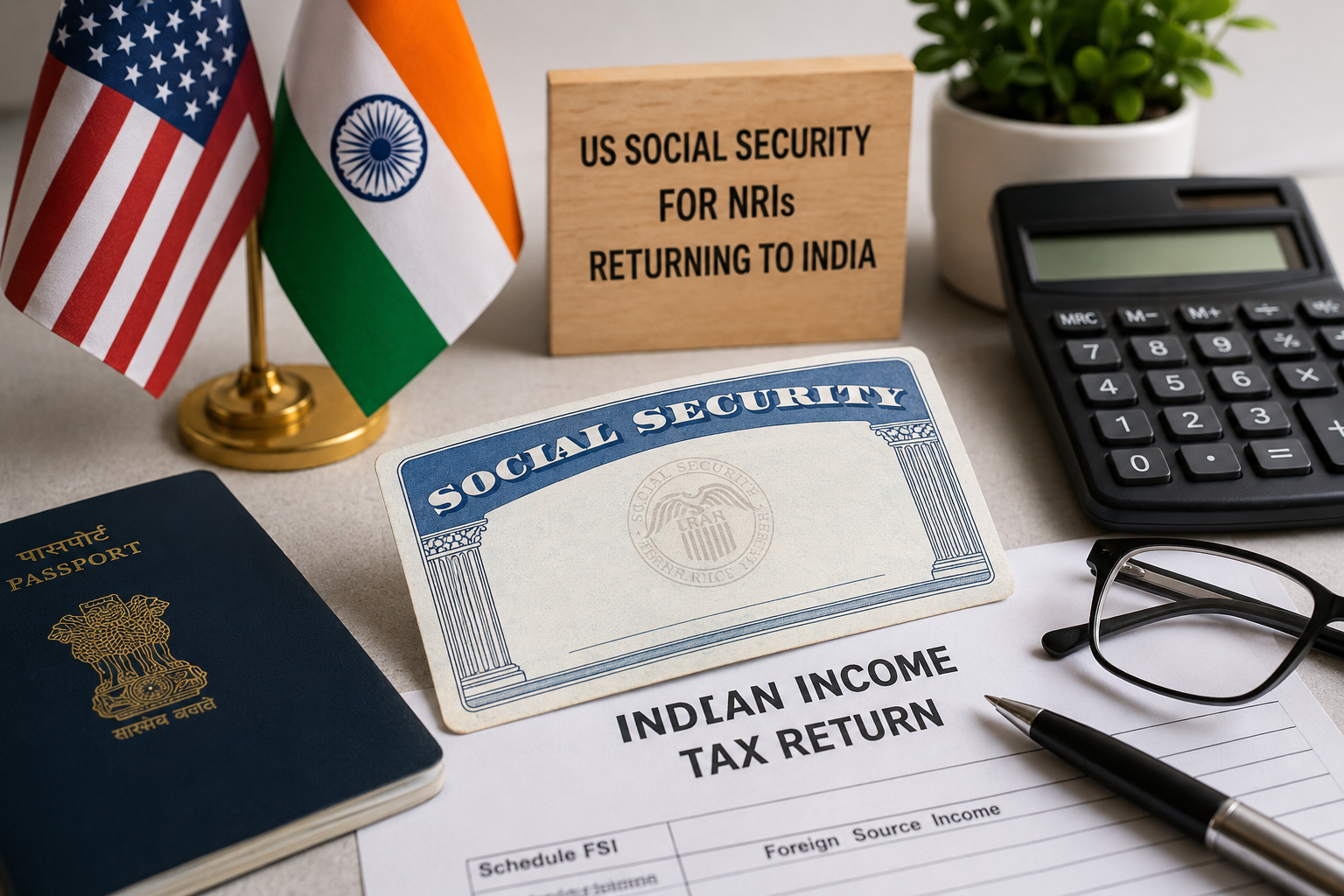


For many Indians returning home after working in the United States, retirement income planning is one of the most overlooked aspects of relocation.
A common misconception is that all foreign retirement income becomes taxable in India once you become a Resident and Ordinarily Resident (ROR). While this may be true for several foreign income streams, US Social Security benefits are treated differently under the India-US Double Taxation Avoidance Agreement (DTAA).
At Dinesh Aarjav & Associates, we regularly advise returning NRIs on cross-border tax matters involving US Social Security, 401(k) withdrawals, IRA distributions, pensions, investment income, and India-US tax compliance. Understanding the distinction between these income streams is essential to avoid double taxation and ensure correct tax reporting.
In this guide, we explain how US Social Security benefits are taxed after returning to India, the role of the India-US DTAA, practical compliance considerations, and the common mistakes that returning NRIs should avoid.
US Social Security is a government-administered retirement and social security program funded through payroll taxes paid during an individual’s employment in the United States. Depending on eligibility, the Social Security Administration (SSA) may provide:
Unlike employer-sponsored retirement plans such as a 401(k) or Individual Retirement Account (IRA), Social Security is a statutory government benefit. This distinction is important because its taxation is governed separately under the India-US DTAA.
|
Residential Status |
General Tax Position in India |
|
Non-Resident (NRI) |
Generally Not Taxable |
|
Resident but Not Ordinarily Resident (RNOR) |
Generally Not Taxable |
|
Resident and Ordinarily Resident (ROR) |
Generally Protected under the India-US DTAA |
Many taxpayers believe that once they become an ROR, every foreign income automatically becomes taxable in India. However, treaty provisions may override domestic tax rules where they are more beneficial to the taxpayer.
Article 20(2) specifically deals with Social Security payments. In general, it provides that Social Security benefits paid by the United States are taxable only in the United States. Consequently, an eligible resident of India receiving such benefits may generally rely on the treaty to prevent taxation of the same income in India, subject to meeting the applicable treaty conditions.
This is one of the key reasons why US Social Security should not be analysed in the same manner as other retirement income.
One of the most common errors we encounter is the assumption that all retirement income receives identical tax treatment.
In reality, each source of retirement income needs to be analysed separately.
|
Type of Income |
Typical Tax Analysis |
|
US Social Security |
Governed by Article 20(2) of the India-US DTAA |
|
401(k) Withdrawals |
Requires separate analysis based on Indian tax law, treaty provisions and residential status |
|
Traditional IRA |
Taxability depends on individual facts and treaty provisions |
|
Roth IRA |
Requires careful analysis due to its unique tax characteristics |
|
Employer Pension |
Depends on the applicable DTAA provisions and nature of the pension |
Applying the same tax treatment to all retirement income can result in either unnecessary tax payments or incorrect tax reporting.
Residential status remains an important aspect of Indian taxation, but its impact differs depending on the type of foreign income.
Foreign income is generally taxed only if it is received or deemed to accrue in India.
Several foreign income streams may continue to enjoy favourable tax treatment under Indian domestic law.
Your global income generally becomes taxable in India. However, where a DTAA allocates exclusive taxing rights to another country, the treaty may provide relief.
This is precisely why a proper treaty analysis becomes important after returning to India.
Even where Social Security benefits are not taxable in India under the DTAA, taxpayers should not assume that no reporting is required.
Depending on the applicable Income Tax Return (ITR) form and individual circumstances, appropriate disclosure may still be necessary.
Professional guidance is particularly important for:
Proper reporting helps minimise the risk of unnecessary notices and future tax disputes.
Based on our experience advising NRIs and returning Indians, some of the most common mistakes include:
Although both relate to retirement, they are fundamentally different products with different tax implications.
Many taxpayers rely solely on domestic tax provisions without considering the treaty benefits available to them.
While Social Security may receive treaty protection, other foreign income such as investment gains, rental income or retirement account withdrawals may require separate tax analysis.
Choosing the wrong ITR form or failing to disclose foreign income appropriately may increase the likelihood of receiving notices from the tax authorities.
The period before relocation often presents valuable planning opportunities that may not be available later.
Mr. Sharma worked in California for more than 28 years before relocating permanently to India after retirement.
Following his return, he began receiving:
Although all three amounts originated from the United States, they did not receive identical tax treatment.
His Social Security benefits were analysed separately under the India-US DTAA, while the 401(k) withdrawals and investment income required an independent review under the applicable provisions of Indian tax law and the treaty.
A coordinated India-US tax review enabled him to comply with both jurisdictions while avoiding unnecessary taxation.
Returning NRIs should ideally review their tax position before changing their residential status.
Some of the areas that deserve attention include:
Early planning often provides greater flexibility than trying to resolve issues after relocation.
Cross-border retirement taxation is rarely straightforward.
A returning NRI may simultaneously receive:
Each category may have a different tax treatment under Indian domestic law and the India-US DTAA.
A comprehensive review ensures that tax positions remain technically correct, properly documented and consistent across both jurisdictions.
At Dinesh Aarjav & Associates, our India-US tax team assists NRIs and returning Indians with cross-border tax planning, India and US tax return filing, DTAA advisory, retirement income taxation and ongoing compliance.
US Social Security occupies a unique position under the India-US Double Taxation Avoidance Agreement. While many foreign income streams become taxable in India depending on an individual’s residential status, Social Security benefits are generally governed by specific treaty provisions that require separate analysis.
However, Social Security is only one part of a returning NRI’s financial profile. Retirement accounts, pensions, investment income, and other foreign assets each have their own tax implications.
A well-planned India-US tax strategy helps ensure compliance, prevents double taxation, and provides clarity before and after your return to India.
If you are planning to relocate from the United States or have already returned to India, obtaining professional advice before filing your tax returns can help you make informed decisions and avoid costly mistakes.
Aarjav Jain is the Executive Director at Dinesh Aarjav & Associates, specializing in India–US cross-border transactions, NRI taxation, international tax advisory, and global investment structuring. With over 10 years of experience in project financing and cross-border advisory, he assists NRIs and businesses with regulatory compliance, repatriation planning, and international transaction structuring.






Stay in the loop, subscribe to our newsletter and unlock a world of exclusive updates, insights, and offers delivered straight to your inbox.

.webp)