WhatsApp
 Call Us
 Email Us
 Whatsapp Community

Would you like to schedule a call back


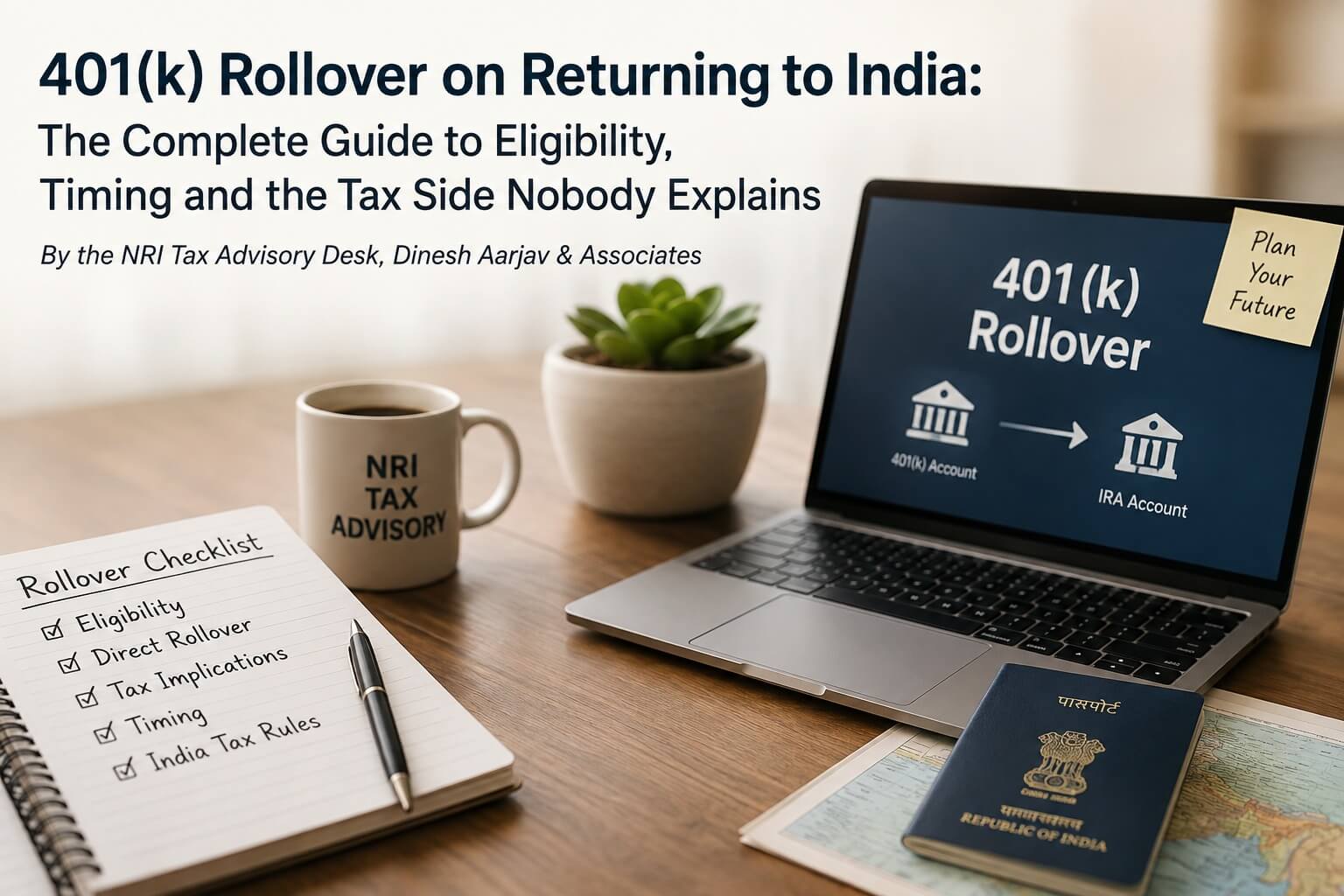


Every returning NRI eventually asks the same question about their 401(k): can I even move it, or am I stuck? The honest answer is that most people are asking the wrong question. “Did I resign?” is not the test a 401(k) plan runs. “Does my new employer maintain this plan?” is. Once you understand that distinction, the 401(k) rollover decision gets a lot simpler and once you add in what actually happens to that money under Indian tax law, which is the part almost every guide on this topic skips entirely, you can plan the whole move properly instead of reacting to it after the fact.
A direct 401(k) rollover transfers your retirement savings directly from your former employer’s 401(k) plan to an eligible Traditional IRA without paying the money to you first. For returning NRIs, this is generally the cleaner option because no distribution is made to you, helping avoid mandatory withholding and preserving the retirement account’s tax-deferred status.
A 401(k) becomes eligible for rollover the moment you have a “severance from employment” under Treasury Regulation Section 1.401(k)-1(d)(2). That happens when you stop being an employee of the specific entity that maintains the plan and it happens whether or not you personally resigned.
This is where an internal transfer confuses people. If your US employer moves you onto the payroll of its India subsidiary, same company brand, same manager, same corporate family, your employment contract now sits with an Indian legal entity. A US-sponsored, ERISA-governed 401(k) plan almost never lists that Indian entity as a “participating employer” in its plan document, because Indian labour and retirement law governs that entity's benefits instead. The day your India contract takes effect, you have severed from the plan's perspective, which can make a 401(k) rollover possible, even though nothing about your day-to-day work changed.
Compare that to someone who simply works remotely from Bangalore while staying on their original US employer's payroll. No new legal employer, no severance, no rollover eligibility yet. The distinction is entirely about which entity issues your paycheck and whether that entity is named in the plan, not about your job title, your visa status, or whether HR called it a “transfer.”
For NRIs moving from US employment to India, determining severance is critical before initiating a 401(k) rollover. Your plan documents, employer entity, and employment status ultimately determine eligibility.
| Your situation | Rollover-eligible? |
|---|---|
| Internally transferred to a separate India payroll entity within the same corporate group | Yes, in almost every case |
| Working remotely from India, still paid by and employed under the original US entity | No no employer change means no severance |
| Transferred to an India entity that is separately listed as a participating employer in the plan (rare) | No verify against the Summary Plan Description before assuming either way |
| Resigned from the US employer outright before moving to India | Yes this is the classic, unambiguous case |
| Green card holder or US citizen on an internal transfer to an India entity | Yes, same test applies citizenship changes the tax treatment later, not the eligibility |
The only document that settles this with certainty is your Summary Plan Description (SPD). It lists every participating employer by legal name. If your India entity isn't on that list, treat yourself as severed and start the rollover conversation with your plan administrator in writing. Don't rely on a verbal answer from HR.
Once you're eligible, the money can move in one of two ways, and the difference between them can be worth thousands of dollars if you get it wrong. A 401(k) rollover can generally be completed through either a direct or indirect method.
A direct rollover moves your balance trustee-to-trustee from the 401(k) custodian straight to your new IRA custodian. No cheque is ever issued to you, and nothing is withheld. An indirect rollover pays the money to you first, and the plan is required to withhold tax before it ever reaches your account.
| Direct Rollover | Indirect Rollover | |
|---|---|---|
| How it moves | Custodian to custodian, you never touch the funds | Paid to you first; you deposit it into an IRA yourself |
| Withholding if still a US taxpayer | None | Mandatory 20% federal withholding under Section 3405 |
| Withholding if already a nonresident alien | None | Withholding under Section 1441, typically around 30% unless a treaty provision applies |
| Deadline | Not applicable | Full original balance must land in the IRA within 60 days, or the withheld amount is treated as a taxable distribution |
Most people who get caught in an indirect rollover didn't choose it; the plan defaults to it when nobody explicitly requests a direct, trustee-to-trustee transfer. That means you'd need to make up the withheld 20-30% out of your own pocket within 60 days just to roll over the full original balance, which is an avoidable, self-inflicted cash crunch. Before you initiate anything, put three questions to your plan administrator in writing: is this coded as a severance event, is a direct rollover available, and is the account already flagged because of a foreign address on file.
This is the part that gets left out of most 401(k) rollover guides, and it's the part that matters most once you're actually sitting in India. A rollover is a non-event for US tax purposes: no distribution, no withholding, no change in deferred status. Indian tax law does not automatically see it the same way, and the gap between those two positions is exactly where returning NRIs get caught out.
Under the Income-tax Act, a resident who has become Resident and Ordinarily Resident (ROR) is taxed on worldwide income on an accrual basis. Left unaddressed, that means the annual gains inside your 401(k) or IRA dividends, interest, capital appreciation would be taxable in India every year as they accrue, even though the US treats the same account as fully tax-deferred until withdrawal. That mismatch was significant enough that the government legislated a specific fix for it.
Section 89A, introduced by the Finance Act 2021, lets a “specified person” broadly, a resident who held a foreign retirement account while classified as non-resident or RNOR in earlier years elect to defer Indian taxation on income from a “specified account” held in a notified country until the year money is actually withdrawn from it. The United States is a notified country, so a 401(k) or Traditional IRA held there is capable of qualifying. The relief isn't automatic: it has to be claimed by filing Form 10-EE, and once filed, the account is taxed in India in the same year and to the same extent that the country where it's held taxes the withdrawal keeping the US and Indian tax timelines in sync instead of India taxing phantom accrued gains a decade before you ever touch the money. This makes the 401(k) rollover strategy especially important for returning NRIs planning their long-term retirement tax position.
Two practical points we flag with every client doing this rollover:
If you can sequence the 401(k) rollover while you're still Non-Resident or Resident but Not Ordinarily Resident (RNOR) under Indian residency rules, none of the Section 89A machinery needs to come into play at all foreign retirement income sitting outside India isn't taxed in India for NRIs or RNORs in the first place. That makes your RNOR window, typically the first two to three financial years after your return depending on your prior years abroad, the cleanest possible time to complete a direct rollover, confirm your IRA custodian, and get your paperwork in order before residency rules start pulling that account into India's tax net. We've covered how to plan and extend that window in detail in our guide to the RNOR status for returning NRIs, and the Section 158 and DTAA mechanics of 401(k) taxation once you are taxed in India are covered in our companion piece on 401(k) taxation under Section 158 and the India-US DTAA.
Eligibility and tax treatment are only half the problem. The other half is practical: not every US brokerage is willing to hold an IRA for someone with an Indian residential address, and several will restrict trading, freeze new purchases, or push you toward closing the account once your address changes. This isn't a footnote it derails more rollovers than the tax rules do.
For NRIs returning to India, completing a 401(k)-to-IRA rollover requires careful coordination of employer rules, custodian eligibility, direct rollover procedures, Indian tax elections, reporting, and ongoing compliance.
A 401(k) rollover when returning to India as an NRI is not simply an account transfer. Your severance status, direct rollover method, RNOR window, Section 89A eligibility, and Indian reporting obligations can all affect the outcome. Planning these steps before the move helps avoid unnecessary withholding, tax surprises, and compliance issues while preserving the long-term value of your US retirement savings.
At Dinesh Aarjav & Associates, we specialise in assisting with NRI advisory services and NRI tax planning in India, including:
Our team helps with:
CA Priyal Goel Jain is a Partner at Dinesh Aarjav & Associates and a leading expert in India–US cross-border taxation, NRI taxation, and international tax advisory. She advises NRIs, OCIs, and global families on complex cross-border transactions, tax planning, foreign asset reporting, and multi-jurisdictional compliance matters.




Stay in the loop, subscribe to our newsletter and unlock a world of exclusive updates, insights, and offers delivered straight to your inbox.

.webp)