WhatsApp
 Call Us
 Email Us
 Whatsapp Community

Would you like to schedule a call back


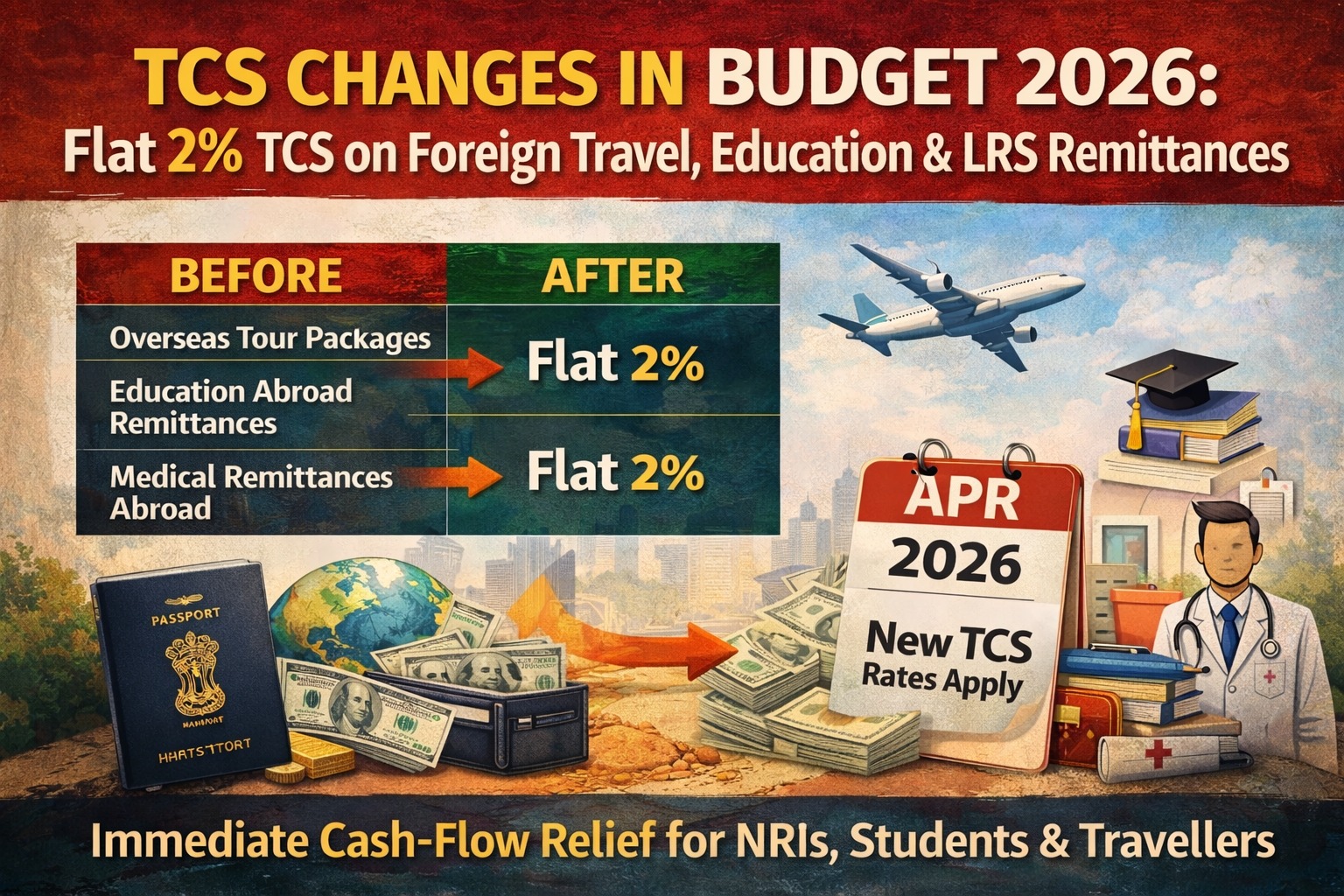


If you’re planning to send money abroad for foreign education, overseas travel, medical treatment, investments, or other purposes, Budget 2026 brings significant relief.
The Government has reduced the Tax Collected at Source (TCS) rate to a flat 2% for eligible foreign remittances and increased the threshold for TCS collection from ₹7 lakh to ₹10 lakh under the Liberalised Remittance Scheme (LRS). These changes reduce the upfront cash outflow for taxpayers while continuing to ensure tax compliance.
Whether you’re a student planning to study overseas, a parent paying university fees, or a traveller booking an international holiday, understanding these revised TCS provisions can help you avoid surprises and plan your finances better.
The amount collected is deposited with the Income Tax Department against the PAN of the remitter.
Many taxpayers mistakenly believe TCS is an extra tax. In reality, TCS is generally an advance tax credit, which can be adjusted against your final tax liability or claimed as a refund while filing your Income Tax Return, subject to applicable tax provisions.
The Liberalised Remittance Scheme (LRS) allows resident individuals to remit money abroad for permitted current and capital account transactions within the limits prescribed by the Reserve Bank of India.
Common purposes include:
Important: LRS applies to resident individuals. NRIs are governed by separate FEMA regulations for remittances.
Budget 2026 introduces a major rationalisation of TCS rates on foreign remittances.
|
Particulars |
Earlier |
Budget 2026 |
|
TCS Rate on eligible foreign remittances |
Higher rates depending on purpose |
Flat 2% |
|
Threshold for TCS |
₹7 lakh |
₹10 lakh |
|
Upfront tax outflow |
Higher |
Significantly lower |
|
Cash flow impact |
Significant |
Reduced |
These changes particularly benefit families making large overseas payments for education, travel or medical treatment.
The objective behind reducing TCS is to:
Parents funding overseas education often remit substantial amounts towards:
Lower TCS means less money gets blocked until the tax return is filed.
Medical emergencies often require immediate remittances.
The revised TCS provisions reduce the upfront financial burden during such situations.
Families booking expensive foreign holidays or international tour packages will benefit from reduced TCS collection, improving overall cash flow.
Professionals relocating overseas often incur initial expenses such as accommodation deposits, education costs for children and settlement expenses. Lower TCS reduces the initial financial burden.
Suppose a family books an overseas vacation costing ₹18 lakh.
Earlier, the upfront TCS outflow could be substantial.
Under Budget 2026, the TCS rate is reduced to 2%, resulting in a significantly lower amount being collected upfront, improving liquidity for travellers.
A parent remits ₹25 lakh towards university tuition.
Instead of a larger upfront TCS collection under earlier provisions, the revised 2% rate substantially reduces the amount blocked until the Income Tax Return is filed.
If ₹15 lakh is remitted for medical treatment abroad, the revised provisions reduce the immediate cash outflow, allowing families to preserve liquidity during emergencies.
No.
This is one of the biggest misconceptions.
TCS is generally not an additional tax.
Instead:
Check your Form 26AS.
Verify the amount in your Annual Information Statement (AIS).
Match the remittance details with your bank records.
Report the income correctly while filing your Income Tax Return.
Claim credit for the TCS collected.
If the TCS exceeds your tax liability, the excess amount may be refunded after processing of the return.
This is another frequently asked question.
Generally, the TCS provisions under Section 206C(1G) relating to the Liberalised Remittance Scheme apply to resident individuals remitting money under LRS.
NRIs are governed by FEMA regulations applicable to NRE, NRO and FCNR accounts, and different tax provisions may apply depending on the nature of the transaction.
If you have recently changed your residential status or are returning to India, it is advisable to seek professional guidance before making large foreign remittances.
Foreign remittances are commonly made for:
Maintain the following records:
Proper documentation helps in claiming tax credit and responding to any future tax queries.
Avoid these common errors:
Budget 2026 marks a welcome step towards easing the cash-flow burden for individuals making genuine foreign remittances. While the reduction in TCS provides immediate financial relief, taxpayers should remember that compliance remains equally important.
Proper reporting of foreign remittances, reconciliation with Form 26AS and AIS, and timely filing of the Income Tax Return are essential to ensure that the TCS collected is correctly claimed as tax credit.
As highlighted by Dinesh Aarjav & Associates in its commentary featured by Outlook Money, taxpayers should view TCS as a compliance mechanism rather than an additional tax burden and maintain complete documentation for all overseas remittances.
Whether you’re sending money abroad for education, travel, investments or medical treatment, understanding the latest TCS provisions is essential for effective tax planning.
At Dinesh Aarjav & Associates, our team assists resident individuals and NRIs with foreign remittance taxation, TCS compliance, Income Tax Return filing, FEMA advisory, and cross-border tax planning. We also advise taxpayers on claiming TCS credits, reconciling Form 26AS and AIS, and ensuring compliance with the latest tax provisions to help avoid unnecessary tax demands or delays in refunds.
Aarjav Jain is the Executive Director at Dinesh Aarjav & Associates, specializing in India–US cross-border transactions, NRI taxation, international tax advisory, and global investment structuring. With over 10 years of experience in project financing and cross-border advisory, he assists NRIs and businesses with regulatory compliance, repatriation planning, and international transaction structuring.






Stay in the loop, subscribe to our newsletter and unlock a world of exclusive updates, insights, and offers delivered straight to your inbox.

.webp)