WhatsApp
 Call Us
 Email Us
 Whatsapp Community

Would you like to schedule a call back


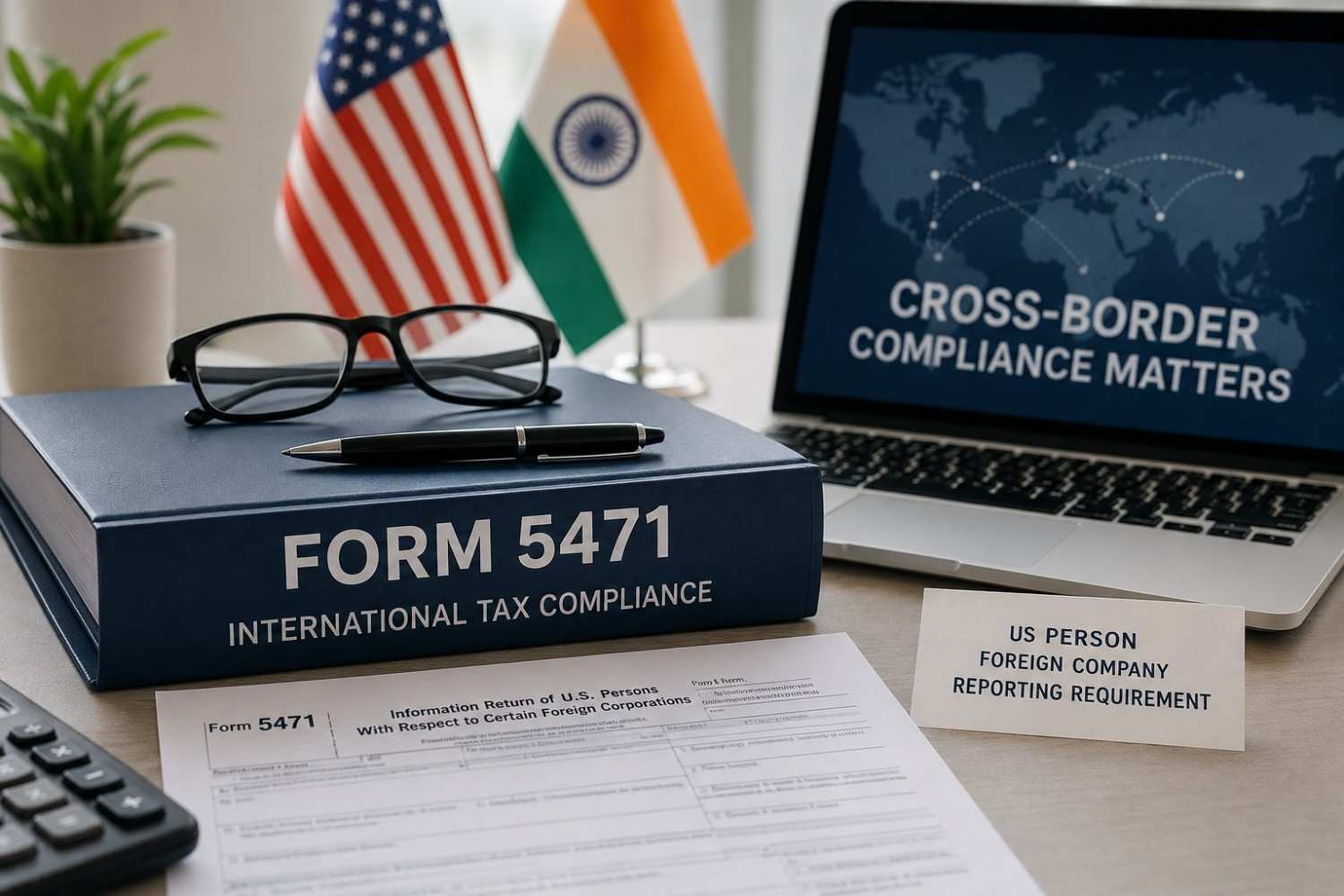


If you are a US citizen, Green Card holder, NRI, OCI, startup founder, or business owner with ownership in an Indian or foreign company, IRS Form 5471 may be one of the most important international tax reporting forms applicable to you.
Many individuals living in India assume that filing taxes and ROC compliances in India is sufficient. However, if you are a US person for tax purposes, the Internal Revenue Service (IRS) may require additional reporting for your ownership in a foreign corporation, including an Indian Private Limited Company.
Failure to file Form 5471 can lead to significant penalties, compliance notices, and additional scrutiny from the IRS, even if no tax is payable.
In this guide, we explain what Form 5471 is, who needs to file it, applicability for Indian companies, penalties, and key India–US cross-border tax considerations.
Form 5471 – Information Return of U.S. Persons With Respect to Certain Foreign Corporations is an international information return required by the IRS from certain US taxpayers having ownership, control, or significant interest in a foreign corporation.
A foreign corporation simply means a company incorporated outside the United States. Therefore, Indian Private Limited Companies, foreign holding companies, overseas startups, consulting entities, and family-owned businesses outside the US may all fall under Form 5471 reporting requirements.
The form is generally filed along with your US Federal Income Tax Return (Form 1040) and provides the IRS with detailed information regarding:
For many US citizens owning businesses in India, this becomes a mandatory annual compliance requirement.
The United States follows a citizenship-based taxation system, unlike India, which generally taxes based on residency.
This means US citizens and Green Card holders may continue to have US tax reporting obligations regardless of where they reside.
As a result:
Even if your company operates entirely in India and pays taxes in India, IRS reporting obligations may still apply in the US.
This creates a major compliance issue for:
US Citizens Living in India
Many US citizens relocate to India for employment, family business, or entrepreneurial opportunities and unknowingly miss Form 5471 filings.
Green Card Holders Running Indian Businesses
Even after moving to India, Green Card holders often continue to have US filing obligations.
Startup Founders
Founders of Indian startups with US citizenship frequently overlook foreign corporation reporting.
Returning NRIs
Returning Indians who retain US citizenship or permanent residency status may still have US reporting obligations.
Family Business Owners
Ownership in Indian family businesses may also trigger reporting—even where no active business management exists.
Form 5471 applicability depends on ownership percentage, control, and specific filing categories prescribed by the IRS.
You may need to file if:
1. You Own 10% or More in an Indian or Foreign Company
A US person owning 10% or more shareholding or voting power in a foreign corporation may become subject to reporting requirements.
This includes ownership through:
2. You Become an Officer or Director in a Foreign Company
In certain cases, becoming an officer or director in an Indian company with US shareholder involvement may trigger reporting obligations.
3. You Own Shares in a Controlled Foreign Corporation (CFC)
A Controlled Foreign Corporation (CFC) generally exists where more than 50% ownership is held by US shareholders collectively.
If your Indian company qualifies as a CFC, additional compliance and taxation provisions may apply.
This is especially relevant for:
In many cases, yes.
A common misconception among NRIs and US persons is:
“My company is incorporated in India, so US reporting should not apply.”
Unfortunately, that assumption is often incorrect.
If you are a US citizen, Green Card holder, or US tax resident owning shares in an Indian Private Limited Company, Form 5471 may become applicable.
Example 1: Indian Startup Founder
A US citizen owns 35% shares in a Delhi-based SaaS startup.
Even though taxes are paid in India and ROC filings are complete, Form 5471 reporting may still be required.
Example 2: Family-Owned Manufacturing Business
A Green Card holder owns shares in a family manufacturing company in Punjab.
US disclosure requirements may continue despite residing in India.
Example 3: Consulting Business
A US citizen operates an Indian consulting or IT services company.
Foreign corporation reporting may apply annually.
One of the most important concepts linked to Form 5471 is the Controlled Foreign Corporation (CFC) regime.
Where a foreign company qualifies as a CFC, the IRS may require reporting of certain undistributed profits, even if money has not been withdrawn personally.
This becomes important because:
Improper structuring can sometimes lead to double taxation or unexpected US tax exposure.
Many startup founders and business owners are unaware of GILTI (Global Intangible Low-Taxed Income) provisions.
In certain cases, profits retained in an overseas company may still become taxable in the US under anti-deferral tax rules.
This becomes especially relevant for:
A proper India–US tax planning strategy can help optimize taxation while remaining compliant.
Assuming Indian Tax Filing Is Enough
Indian compliance does not replace US reporting requirements.
Missing Form 5471 for Multiple Years
Many taxpayers discover non-compliance only during IRS notices or tax reviews.
Incorrect Ownership Analysis
Indirect ownership and attribution rules are often misunderstood.
Ignoring GILTI and CFC Implications
Business profits retained overseas may still require US analysis.
Filing Late Without Professional Review
Improper corrections can sometimes worsen tax exposure.
Penalty for Non-Filing of Form 5471
Failure to file Form 5471 can lead to significant IRS penalties.
Penalties may start at:
USD 10,000 Per Form Per Year
Additional penalties may apply for continued non-compliance after IRS notification.
In certain situations:
At Dinesh Aarjav & Associates, we specialize in India USA taxes, NRI tax advisory, and international reporting compliance.
Our team assists clients with:
Form 5471 Applicability Review
Determining whether filing obligations exist.
Cross-Border Tax Planning
Managing India and US tax implications efficiently.
CFC & GILTI Analysis
Understanding overseas company taxation.
US Tax Compliance for NRIs & Founders
Managing annual reporting requirements.
Past Non-Compliance Review
Helping taxpayers regularize missed filings.
With 25+ years of experience, offices across India, USA, UK, Canada, and UAE, and expertise in cross-border tax advisory, we assist NRIs, startup founders, expatriates, and global business owners with end-to-end international tax compliance.
If you own an Indian company while holding US citizenship, Green Card status, or US tax residency, it is important to evaluate your Form 5471 compliance obligations carefully.
Dinesh Aarjav & Associates provides specialized NRI advisory services for India–US cross-border taxation, IRS international reporting, NRI tax planning, foreign asset disclosures, and US tax compliance for business owners and founders.
CA Sanyam Goel, CPA (USA), FCA, and CISA, specializes in India–US cross-border taxation, NRI tax advisory, US tax compliance, transfer pricing, and international regulatory matters. He assists clients with US and Indian tax obligations, cross-border reporting requirements, and strategic tax planning for global investments and transactions.




Stay in the loop, subscribe to our newsletter and unlock a world of exclusive updates, insights, and offers delivered straight to your inbox.

.webp)