whatsappWhatsApp callCall Us wmailEmail Us whatsapp CommunityWhatsapp Community
Indian PPF taxable in US Indian PPF taxable in US
  • Home /
  • Blog Details
Blog Details
May 01, 2026
  • facebook
  • twitter
  • linkdien

Is Indian PPF Taxable in the US? (2026 Guide for NRIs, Green Card Holders & Global Mobility Professionals)

If you are an NRI, H1B visa holder, Green Card holder, or US tax resident, and you hold a Public Provident Fund (PPF) account in India, this is something you cannot afford to ignore.

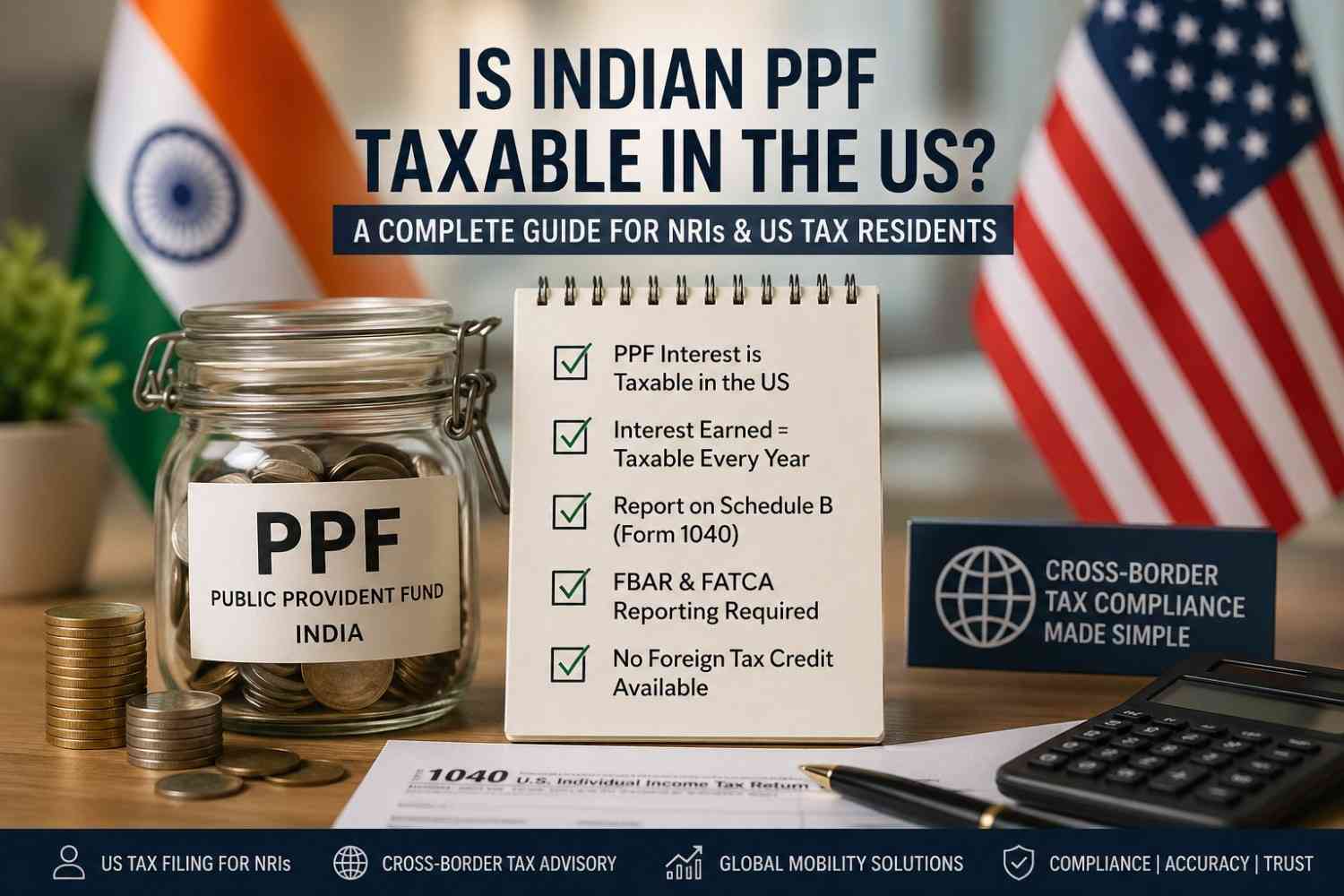
Yes — Indian PPF is taxable in the US.

Even though PPF enjoys EEE (Exempt-Exempt-Exempt) tax status in India, the IRS taxes it annually as foreign income.

This guide explains:

  • How PPF taxation in the US works
  • IRS reporting requirements (Schedule B, FBAR, FATCA)
  • Common mistakes NRIs make
  • Cross-border tax planning strategies

Quick Answer

  • Is PPF taxable in the US? → Yes
  • What is taxable? → Annual interest (not principal)
  • When is it taxed? → Every year (accrual basis)
  • Foreign tax credit available? → No
  • Where to report? → Schedule B (Form 1040), FBAR, FATCA

Why PPF is Taxable in the US (IRS Perspective)

The United States taxes worldwide income, regardless of:

  • Where you live
  • Where the income is earned
  • Whether it is tax-free in another country

IRS Classification of PPF

The IRS does NOT treat PPF as a qualified retirement account.

Instead, it is viewed as:

  • A foreign financial account
  • A passive investment / savings instrument

Why PPF fails as a retirement plan under IRS rules:

  • No mandatory employer contribution
  • Not linked to employment
  • Flexible contributions (voluntary deposits)
  • No strict retirement withdrawal framework

Result: PPF interest is taxed as ordinary income in the US

How PPF is Taxed in the US 

1. Annual Interest is Taxable
Interest is taxed every year, even if:

  • Not withdrawn
  • Reinvested

This follows the accrual method of taxation used by the IRS.

2. Principal Contribution is NOT Taxed

  • Contributions are made from already taxed income
  • No double taxation on principal

3. Reporting in US Tax Return

You must report PPF income under:

  • Schedule B (Form 1040) → Interest Income
  • Convert INR to USD using IRS yearly average exchange rate

Example: PPF Taxation for US Residents

  • PPF Balance: ₹25,00,000
  • Interest Rate: 6.9%
  • Annual Interest: ₹1,72,500

Convert to USD (IRS exchange rate)
Report as taxable interest income in your US return

No Foreign Tax Credit (FTC) – Key Risk

Under Indian tax law:

  • PPF falls under EEE regime → No tax in India

Under US tax law:

  • Taxable annually

Since no tax is paid in India, you:

  • Cannot claim Foreign Tax Credit (FTC)
  • Pay full tax in the US

Mandatory US Reporting for PPF (Critical Compliance Area)

Holding a PPF account may trigger multiple reporting obligations:

1. FBAR (FinCEN Form 114)
Required if total foreign accounts exceed $10,000
2. FATCA (Form 8938)
Required if foreign assets exceed thresholds (higher than FBAR)
3. Schedule B Disclosure
Must disclose foreign accounts and interest income

Non-compliance risks:

  • Heavy IRS penalties
  • Financial account scrutiny
  • Notices and audits

PPF Rules for NRIs (Important Update)

  • NRIs cannot open new PPF accounts
  • Existing accounts:
    • Can continue till maturity
    • Continue earning interest
    • Remain taxable in the US annually

Common Mistakes NRIs & Expats Make

  • Assuming PPF is tax-free globally
  • Not reporting annual interest in US return
  • Ignoring FBAR and FATCA filing
  • Incorrect currency conversion
  • Missing disclosure of foreign accounts

These errors often lead to:

  • IRS penalties
  • Amended returns
  • Compliance notices

Impact on NRIs, H1B Holders & Returning Indians (R2I Cases)

If you are:

  • Moving to the US
  • Already a US tax resident
  • US Citizen/GC Holder Planning Return to India (R2I)

Then PPF creates:

  • Annual tax reporting burden in the US
  • Compliance complexity
  • Inefficient tax structure

It must be reviewed as part of your global mobility tax planning

India–US DTAA: Does It Help?

  • DTAA does NOT exempt PPF interest
  • No relief because:
    • Income is not taxed in India
    • No FTC available

Result: Full US taxation remains

Strategic Tax Planning for NRIs with PPF

Key considerations:

  • Evaluate continuation vs maturity strategy
  • Align PPF with US tax compliance
  • Integrate with global asset reporting
  • Plan for R2I transition

US Tax Filing from India for NRIs – How We Help

At Dinesh Aarjav & Associates, we specialize in:

US Tax Filing Services (India-based)

  • Form 1040 preparation
  • Schedule B reporting (PPF interest)
  • FBAR (FinCEN 114) filing
  • FATCA (Form 8938) compliance

Cross-Border Tax Advisory

  • India–US tax planning
  • DTAA Consultancy
  • Foreign asset disclosure
  • Global income structuring

Global Mobility & NRI Advisory

  • H1B / L1 / Green Card taxation
  • R2I (Returning to India) planning
  • Investment structuring for NRIs
  • Multi-country compliance

With 25+ years of experience, presence across India, US, UK, UAE, Canada & Australia, and 2600+ clients globally, we offer end-to-end cross-border NRI taxation solutions.

Final Conclusion

While PPF is tax-free in India, it is:

  • Fully taxable in the US
  • Reportable under multiple IRS forms
  • A compliance risk if ignored

Understanding this difference is critical for NRIs, expats, and global professionals managing finances across India and the US.

Need Help with PPF Reporting or US Tax Filing?

If you:

  • Hold a PPF account for NRI in India
  • Are a US tax resident / NRI
  • Need help with FBAR, FATCA, or Schedule B reporting

We can assist you with accurate, compliant, and optimized US tax filing from India.

Also Read: 

NRI Financial Guide: Essential Questions on PPF and Savings Accounts

PPF Investments for NRIs - A Guide to Tax-Saving Opportunities

If you are an NRI and want to invest in PPF in India? Then this is for you!!

NRI Tax Filing in India FY 2025-26: New ITR Forms (AY 2026-27) and Presumptive Taxation Disclosure Requirements