WhatsApp
 Call Us
 Email Us
 Whatsapp Community

Would you like to schedule a call back


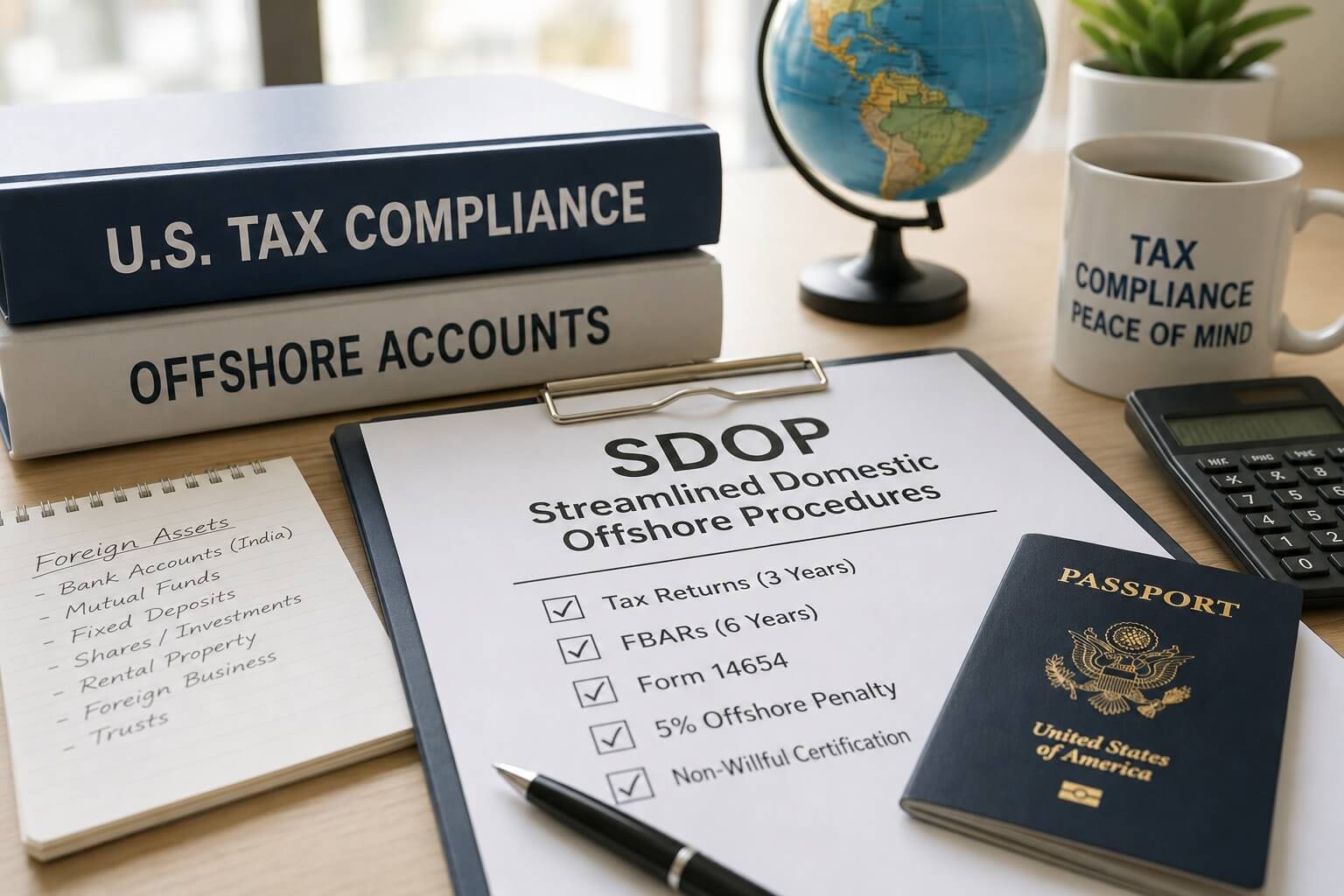


If you are a U.S. citizen, green card holder, or U.S. tax resident and have unreported foreign bank accounts, investments, property income, or other foreign financial assets, you may have significant U.S. tax and information-reporting obligations.
Failing to report foreign income or file forms such as the FBAR (FinCEN Form 114), Form 8938, Form 5471, Form 8621, Form 3520 or other international information returns can result in substantial penalties.
However, if the failure was non-willful, the IRS may provide a compliance route through the Streamlined Domestic Offshore Procedures (SDOP).
This guide explains who may qualify for SDOP, the 5% miscellaneous offshore penalty, Form 14654, FBAR requirements, the filing process, common mistakes and how U.S. taxpayers with Indian or other foreign assets can become compliant.
The Streamlined Domestic Offshore Procedures (SDOP) are an IRS compliance procedure for certain U.S. taxpayers residing in the United States who previously failed to properly report foreign financial assets, foreign income or related international information returns because of non-willful conduct.
The streamlined procedures allow eligible taxpayers to correct past filing failures under prescribed procedures rather than simply making an informal “quiet disclosure.”
The IRS describes non-willful conduct as conduct resulting from negligence, inadvertence, mistake or a good-faith misunderstanding of the requirements of the law.
SDOP is particularly relevant to U.S. taxpayers who have assets or financial relationships outside the United States, including:
SDOP is not automatically available to every taxpayer with an unreported foreign account.
The taxpayer must satisfy the IRS eligibility requirements.
Generally, an individual seeking SDOP treatment must:
The IRS specifically states that SDOP applies to individual U.S. taxpayers, including estates of individual taxpayers.
One of the most important questions is whether the taxpayer qualifies as a U.S. resident or non-U.S. resident for streamlined-procedure purposes.
Broadly:
|
Situation |
Potential procedure |
|
U.S. taxpayer residing in the United States and meeting SDOP requirements |
Streamlined Domestic Offshore Procedures |
|
U.S. taxpayer meeting the foreign-residency requirements |
Streamlined Foreign Offshore Procedures |
|
Conduct potentially involving willfulness |
Streamlined procedures may not be appropriate |
|
Taxpayer under certain IRS civil examination or criminal investigation |
Streamlined procedures generally unavailable |
The IRS states that taxpayers using streamlined procedures must certify that the failure to report income, pay tax and submit required information returns was non-willful.
This is one of the most important parts of an SDOP submission.
A taxpayer should not assume that simply saying “I did not know about FBAR” automatically establishes non-willfulness.
The taxpayer must provide a credible explanation of the facts and circumstances that resulted in the non-compliance.
Examples may include:
The facts must be considered carefully because non-willful certification is a substantive part of the streamlined submission, not merely an administrative formality.
U.S. taxpayers are generally taxed on worldwide income, and certain foreign assets can trigger additional information-reporting obligations.
For an Indian-American or U.S. taxpayer with assets in India, common issues include:
A U.S. taxpayer may have FBAR reporting obligations for qualifying Indian bank accounts, including:
Indian mutual funds can create additional U.S. tax and reporting considerations, potentially including PFIC (Passive Foreign Investment Company) reporting.
An ownership interest in an Indian company may potentially trigger Form 5471 or other U.S. international reporting requirements depending on the taxpayer’s ownership and circumstances.
Certain interests in Indian or other foreign partnerships may require Form 8865 reporting.
Foreign trusts and certain gifts from foreign persons can potentially trigger Form 3520 and related reporting requirements.
Additional reporting may arise under Form 8938 (Statement of Specified Foreign Financial Assets) depending on the taxpayer’s circumstances and applicable thresholds.
Therefore, FBAR compliance alone does not necessarily resolve all U.S. international tax reporting obligations.
A major feature of the Streamlined Domestic Offshore Procedures is the 5% miscellaneous offshore penalty for eligible taxpayers.
However, it is important to understand that the penalty is not simply 5% of every foreign asset owned by the taxpayer.
The calculation is based on the IRS rules governing the highest year-end aggregate balance/value of the relevant foreign financial assets during the applicable covered period, with specific rules determining which assets are included in the penalty base.
The taxpayer must maintain supporting documentation for the calculation and be able to provide it to the IRS if requested.
Example
Suppose a U.S. taxpayer has:
The taxpayer cannot simply take today’s account balances and multiply them by 5%.
The SDOP penalty calculation requires a careful review of the applicable years, account balances, asset values and the IRS rules governing the penalty base.
This is one of the areas where professional review can materially reduce the risk of an incorrect SDOP submission.
For SDOP, the taxpayer generally addresses the most recent three years for which the U.S. tax return due date has passed, subject to the specific IRS rules applicable to the submission.
The taxpayer may need to file amended returns and/or applicable information returns to report previously omitted income and international tax information.
This can include, depending on the facts:
The exact forms depend on the taxpayer’s foreign assets and transactions.
SDOP generally requires delinquent FBARs for the most recent six years for which the FBAR filing deadline has passed.
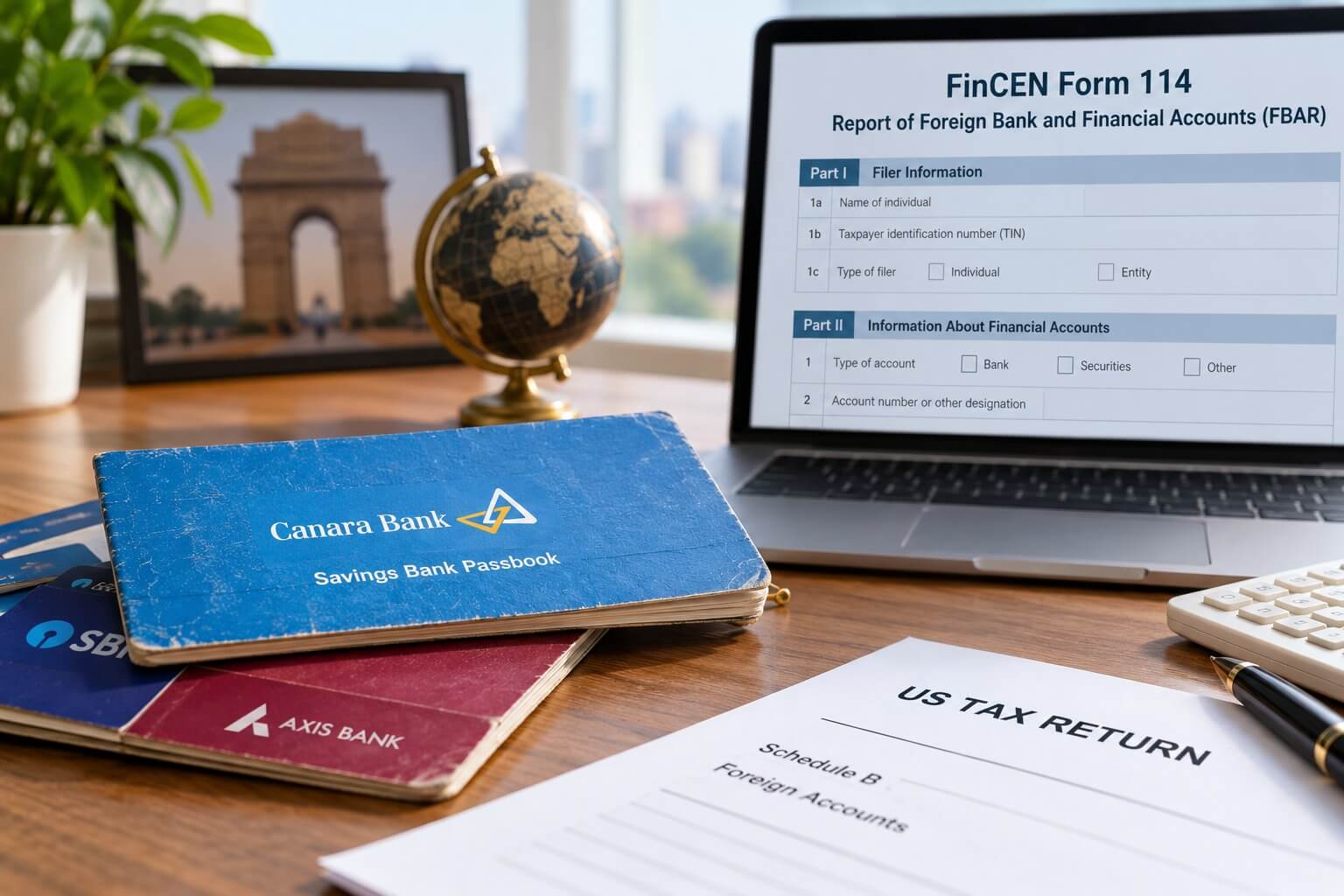
The FBAR is filed electronically with FinCEN using FinCEN Form 114.
The IRS currently instructs SDOP taxpayers to file the delinquent FBARs electronically through the FinCEN BSA E-Filing System and identify that they are being filed as part of the streamlined compliance procedures.
A U.S. person generally has an FBAR filing obligation when the aggregate value of foreign financial accounts exceeds $10,000 at any time during the calendar year.
Importantly, the $10,000 threshold applies to the aggregate of qualifying foreign financial accounts, rather than separately to each account.
Form 14654 – Certification by U.S. Person Residing in the United States for Streamlined Domestic Offshore Procedures is a central component of an SDOP submission.
The taxpayer uses Form 14654 to certify, among other matters, that:
The taxpayer must retain supporting documentation for the penalty computation.
Because the certification is made under penalties of perjury, the form should not be treated as a routine checkbox.
A typical SDOP engagement involves the following steps.
Review:
Step 2: Reconstruct Foreign Assets
Prepare a comprehensive inventory of:
Step 3: Identify Unreported Income
Reconstruct foreign:
Step 4: Review International Information Returns
Determine whether forms such as:
or other filings were required.
Step 5: Prepare Amended Tax Returns
Correct the applicable U.S. tax returns and report previously omitted income and information.
Submit the required FBARs electronically through FinCEN.
Step 7: Prepare Form 14654
Prepare the non-willful certification and calculate the applicable miscellaneous offshore penalty.
Step 8: Assemble the SDOP Submission
The IRS currently requires the SDOP submission package to be sent in paper form to the designated IRS address. Electronic submission of the SDOP package is not currently accepted.
A taxpayer who discovers previously unreported foreign income may be tempted to simply amend an old tax return and file missing FBARs.
This is commonly referred to as a quiet disclosure.
That approach should not automatically be assumed to be an appropriate substitute for the IRS streamlined procedures.
The correct compliance route depends on:
A proper analysis should be performed before submitting amended returns or delinquent information returns.
This distinction is particularly important for Indian-origin U.S. citizens and NRIs.
|
Factor |
SDOP |
SFOP |
|
Full name |
Streamlined Domestic Offshore Procedures |
Streamlined Foreign Offshore Procedures |
|
Intended taxpayer |
U.S. taxpayers residing in the U.S. |
U.S. taxpayers meeting foreign-residency requirements |
|
Non-willful requirement |
Yes |
Yes |
|
Tax returns |
Generally 3 years |
Generally 3 years where required |
|
FBARs |
Generally 6 years |
Generally 6 years |
|
Offshore penalty |
Generally 5% |
Generally no miscellaneous offshore penalty |
|
Form |
Form 14654 |
Form 14653 |
The residency test is therefore extremely important. A taxpayer should not select SDOP merely because the taxpayer has foreign assets.
The IRS maintains separate procedures for U.S. taxpayers residing outside the United States.
The penalty computation requires an analysis of the applicable assets and IRS rules.
FBAR filing does not necessarily resolve U.S. income-tax or other international information-reporting obligations.
Indian mutual funds and certain other foreign investments can create separate U.S. tax and reporting issues.
FBAR and Form 8938 are separate reporting regimes with different rules and thresholds.
The non-willful certification should accurately explain the taxpayer’s actual facts and circumstances.
A taxpayer who meets the foreign-residency requirements may need to consider SFOP rather than SDOP.
The 5% calculation requires careful historical balance and asset-value analysis.
Interest, dividends, capital gains, rent and other foreign income may need to be included on the U.S. return.
Ownership of an Indian company, partnership or trust can create additional U.S. reporting requirements.
The IRS states that streamlined returns are processed like other returns and can still be selected for examination.
This point requires particular care.
SDOP should not be described as providing an absolute guarantee against criminal prosecution or IRS enforcement.
The streamlined procedures are designed for taxpayers whose conduct was non-willful. Taxpayers concerned that their conduct may have been willful should obtain professional advice regarding the appropriate disclosure route.
The IRS separately maintains a Voluntary Disclosure Practice for taxpayers whose conduct may involve willfulness.
Therefore, a taxpayer should not submit Form 14654 without first carefully evaluating the facts supporting the non-willful certification.
If you are a U.S. citizen or green card holder living in India, do not automatically assume that SDOP applies or does not apply.
The relevant question is whether you satisfy the IRS residency requirements for the streamlined procedures.
A U.S. citizen living in India may potentially qualify for the Streamlined Foreign Offshore Procedures (SFOP) if the applicable foreign-residency test is satisfied.
On the other hand, a taxpayer who does not satisfy the foreign-residency requirement may need to consider SDOP or another compliance option, depending on the facts.
This is particularly important for:
The IRS provides separate eligibility rules for domestic and foreign streamlined procedures.
For Indian-origin U.S. taxpayers, offshore compliance can become particularly complicated because a single financial portfolio may involve multiple U.S. reporting regimes.
For example, a taxpayer could have:
Each category may have different U.S. tax and reporting consequences.
Simply filing an FBAR is therefore not necessarily enough.
A complete review should consider the taxpayer’s entire foreign asset portfolio, income, ownership interests and historical filing position.
Dinesh Aarjav & Associates provides U.S.-India cross-border tax advisory and international tax compliance services for U.S. citizens, green card holders, NRIs, returning Indians and taxpayers with foreign assets.
Our SDOP advisory can include:
Our objective is not simply to prepare forms, but to understand why the non-compliance occurred, identify every applicable reporting obligation and determine the most appropriate compliance strategy based on the taxpayer’s facts.
If you are a U.S. citizen, green card holder, NRI or U.S. tax resident with unreported Indian or other foreign financial assets, proper NRI Tax Planning is essential. Do not assume that filing a late FBAR or amended tax return is the correct solution.
The appropriate compliance route can depend on:
Residency + filing history + nature of foreign assets + amount of unreported income + non-willful facts + prior IRS activity + applicable international information returns.
A professional review before filing can help identify the appropriate IRS compliance procedure and reduce the risk of submitting an incomplete or inappropriate disclosure.
Contact Dinesh Aarjav & Associates for U.S.-India cross-border tax and offshore compliance assistance.
Disclaimer: This article is intended for general informational purposes and does not constitute legal, tax or financial advice. Streamlined procedure eligibility and reporting requirements depend on the taxpayer’s individual facts and circumstances. Current IRS guidance and applicable U.S. tax law should be reviewed before making a submission.
CA Sanyam Goel, CPA (USA), FCA, and CISA, specializes in India–US cross-border taxation, NRI tax advisory, US tax compliance, transfer pricing, and international regulatory matters. He assists clients with US and Indian tax obligations, cross-border reporting requirements, and strategic tax planning for global investments and transactions.




.webp)