WhatsApp
 Call Us
 Email Us
 Whatsapp Community

Would you like to schedule a call back


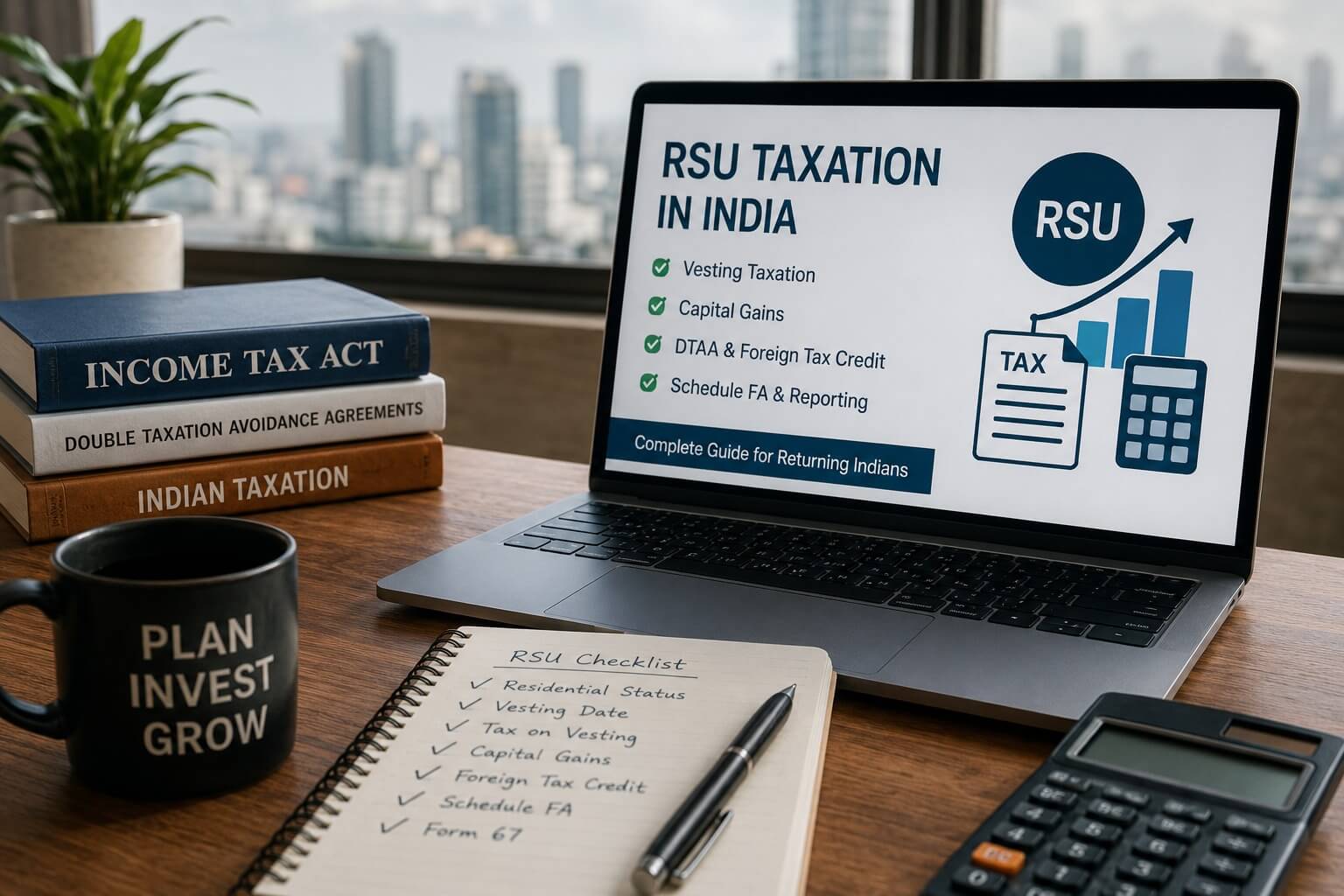


This comprehensive guide explains everything you need to know about RSU taxation in India, especially if you have recently relocated to India or become an Indian tax resident.
Restricted Stock Units (RSUs) are a form of equity compensation provided by employers, particularly multinational corporations such as Google, Microsoft, Amazon, Meta, Apple, and other global companies.
Under an RSU plan:
Unlike ESOPs, employees generally do not pay an exercise price to acquire RSUs.
Yes.
If you qualify as an Indian tax resident, your global income becomes taxable in India, including income arising from RSUs granted by a foreign employer.
The taxation depends primarily upon:
When RSUs vest, the Fair Market Value (FMV) of shares received becomes taxable as perquisite income under salary.
Taxable Value:
Number of Shares Vested × FMV on Vesting Date
The amount is added to your salary and taxed according to your applicable slab rate.
Example:
Suppose:
100 RSUs vest
FMV on vesting = USD 250 per share
USD-INR exchange rate = ₹85
Taxable salary income:
100 × USD 250 × ₹85
= ₹21,25,000
This ₹21.25 lakh becomes part of your taxable salary.
Several authorities confirm that RSUs are generally taxed as salary upon vesting.
When vested shares are eventually sold, capital gains taxation applies.
Capital Gain Calculation:
Sale Price
Less:
FMV considered during vesting
= Capital Gain
Only appreciation occurring after vesting is subject to capital gains tax.
Foreign shares are generally treated as unlisted shares under Indian tax provisions.
Holding Period Rules
Short-Term Capital Gains (STCG)
Holding period:
24 months or less
Tax Rate:
Taxed at applicable slab rates.
Long-Term Capital Gains (LTCG)
Holding period:
More than 24 months
Tax Rate:
12.5% (subject to applicable provisions). Recent guidance continues to describe a 24-month threshold with concessional LTCG treatment for foreign unlisted shares.
Example of Capital Gains
At vesting:
FMV = USD 200/share
At sale:
Sale price = USD 300/share
Capital gain:
USD 300 − USD 200
= USD 100 per share
Only USD 100 per share is subject to capital gains tax.
Returning to India with Unvested RSUs: Special Considerations
This is where many returning NRIs make mistakes.
The taxation may depend upon:
Cross-border allocation analysis often becomes essential.
Yes.
India and the United States have a Double Taxation Avoidance Agreement (DTAA).
If US taxes have been withheld on RSU income, Indian residents may generally claim Foreign Tax Credit (FTC) while filing their Indian tax returns.
Several practitioners highlight FTC availability under India-US DTAA for RSU income.
Foreign Tax Credit (FTC): How to Claim Relief
To claim FTC in India:
Step 1: Obtain Evidence of US Tax Paid
Examples include:
Form 67 must generally be submitted before filing the Indian tax return to claim FTC.
Step 3: Report Foreign Income Correctly
Disclose:
Failure to comply may result in denial of FTC claims.
If you qualify as:
Resident and Ordinarily Resident (ROR)
Yes.
Common disclosures include:
Many taxpayers miss Schedule FA reporting requirements, leading to defective filings.
Generally:
Resident but Not Ordinarily Resident (RNOR)
Foreign income may not always be taxable unless derived from a business controlled in India.
Schedule FA obligations are also typically relaxed for RNOR individuals.
Common RSU Tax Mistakes Returning Indians Make
1. Ignoring Foreign Asset Disclosure
Failure to disclose foreign shares in Schedule FA.
2. Missing Foreign Tax Credit
Not filing Form 67.
3. Incorrect Residential Status Determination
Many returning NRIs incorrectly assume they remain NRIs indefinitely.
4. Reporting Entire Sale Value as Capital Gains
Only appreciation after vesting should be taxed.
5. Ignoring Tax on Vested but Unsold RSUs
Even if shares are not sold, vesting itself triggers taxation.
6. Assuming Employer Withholding Covers Indian Taxes
Foreign withholding often differs from Indian tax liability.
Additional Indian taxes may still arise.
There is no universal answer.
Consider:
Immediate Sale
Pros:
Cons:
Pros:
Cons:
The decision should align with:
Maintain:
Foreign tax withholding details
Before filing your return this tax season, confirm:
RSU taxation involves the intersection of:
Errors can result in:
At Dinesh Aarjav & Associates, we specialise in assisting:
Our team helps with:
Whether you have vested RSUs, unvested stock awards, foreign brokerage accounts, or complex US tax withholdings, obtaining timely advice can help minimise tax exposure and ensure full compliance.
Schedule a consultation with Dinesh Aarjav & Associates to navigate your India-US RSU tax obligations confidently.
CA Priyal Goel Jain is a Partner at Dinesh Aarjav & Associates and a leading expert in India–US cross-border taxation, NRI taxation, and international tax advisory. She advises NRIs, OCIs, and global families on complex cross-border transactions, tax planning, foreign asset reporting, and multi-jurisdictional compliance matters.






Stay in the loop, subscribe to our newsletter and unlock a world of exclusive updates, insights, and offers delivered straight to your inbox.

.webp)