WhatsApp
 Call Us
 Email Us
 Whatsapp Community

Would you like to schedule a call back


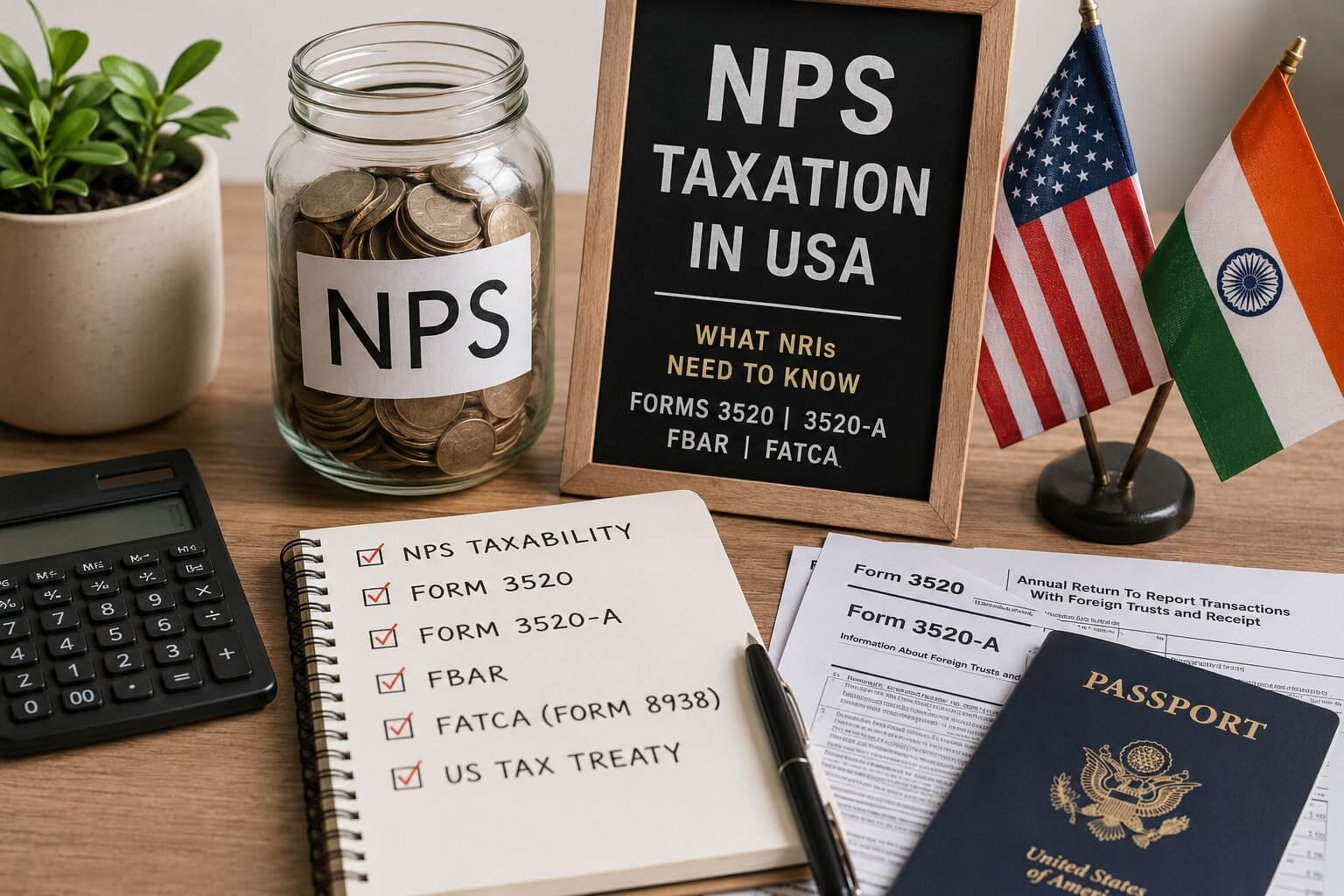


If you are a US tax resident and own a National Pension System (NPS) account in India, the account may create US tax reporting obligations even if no withdrawals have been made.
The US tax treatment of NPS remains one of the most misunderstood areas of India-US cross-border taxation.
This guide explains how NPS is taxed in the United States, what reporting obligations may arise, and the common mistakes NRIs make when filing US tax returns.
National Pension System (NPS) is India's government-regulated retirement savings scheme administered by the Pension Fund Regulatory and Development Authority (PFRDA).
The scheme allows long-term retirement savings through investments in:
NPS is available to:
Yes.
NRIs and OCI cardholders can continue maintaining and contributing to an NPS account subject to FEMA and PFRDA regulations.
Many Indians who move to:
continue to hold NPS accounts created while residing in India.
The challenge begins when these individuals become tax residents of another country, particularly the United States.
Short Answer
Potentially yes.
A US person generally includes:
Individuals meeting the Substantial Presence Test
Unlike India, the US tax system does not automatically recognize every foreign retirement arrangement as tax-deferred.
Consequently, income and growth within an NPS account may become relevant for US tax purposes.
Many NRIs assume:
NPS is a retirement account in India, therefore it must automatically be treated like a 401(k) in the United States.
The IRS has never issued specific comprehensive guidance confirming that NPS receives treatment identical to a US-qualified retirement plan.
As a result, tax professionals often analyze NPS under multiple possible frameworks.
There is no direct IRS ruling specifically addressing NPS.
This creates uncertainty.
Possible interpretations often include:
The correct position depends upon facts, legal interpretation and reporting methodology.
This uncertainty is precisely why NPS remains one of the most debated India-US tax issues.
This is arguably the most important question for US taxpayers.
Historically, many international tax professionals evaluated whether NPS could fall within the foreign trust framework under US tax rules.
If an arrangement is treated as a foreign trust, additional reporting obligations may arise.
The analysis requires consideration of:
There is no universal answer applicable to every taxpayer.
Possibly
Form 3520 is an IRS information return often associated with foreign trusts and certain foreign transactions.
The answer depends upon:
Because penalties for non-filing can be significant, professional review is strongly recommended.
Potentially
Form 3520-A is generally associated with foreign trust reporting.
If a taxpayer adopts a position that NPS falls within the foreign trust regime, Form 3520-A analysis becomes relevant.
Failure to evaluate this issue properly can expose taxpayers to substantial penalties.
One of the most important developments affecting foreign retirement arrangements is Revenue Procedure 2020-17.
The Revenue Procedure provides relief from Forms 3520 and 3520-A reporting for certain tax-favored foreign retirement trusts and non-retirement savings trusts.
Whether an NPS account falls within the scope of this relief requires careful analysis.
A blanket assumption that all NPS accounts are exempt can be risky.
Likewise, assuming every NPS account requires Forms 3520 and 3520-A may also be incorrect.
Professional evaluation is essential.
Frequently Yes
FBAR (FinCEN Form 114) generally becomes relevant when aggregate foreign financial accounts exceed USD 10,000 during the year.
When calculating the threshold, taxpayers often include:
Failure to file FBAR can lead to severe penalties.
Often Yes
Form 8938 filing depends on:
Many Indian-origin taxpayers residing in the United States exceed the applicable thresholds.
As a result, NPS disclosure often becomes part of broader FATCA reporting.
The US treatment of NPS withdrawals may differ significantly from Indian tax treatment.
Questions commonly arising include:
The answer depends on:
Many NRIs assume the treaty automatically prevents US Taxation.
This is not necessarily correct.
The India-US Double Taxation Avoidance Agreement (DTAA) contains provisions dealing with pensions and retirement income.
However, the treaty must be read alongside the saving clause and domestic US tax provisions.
The interaction between:
creates significant complexity.
Mistake 1
Assuming NPS is not reportable because it is a retirement account.
Mistake 2
Ignoring FBAR reporting.
Mistake 3
Ignoring FATCA Form 8938 reporting.
Mistake 4
Failing to evaluate Form 3520 exposure.
Mistake 5
Failing to evaluate Form 3520-A exposure.
Mistake 6
Assuming Indian tax treatment applies automatically in the US.
Mistake 7
Relying on internet forums instead of professional advice.
The answer depends upon the facts, treaty interpretation and taxpayer position.
Many taxpayers properly report:
Because NPS sits at the intersection of:
it deserves separate analysis.
Dinesh Aarjav & Associates assists:
with:
Aarjav Jain is the Executive Director at Dinesh Aarjav & Associates, specializing in India–US cross-border transactions, NRI taxation, international tax advisory, and global investment structuring. With over 10 years of experience in project financing and cross-border advisory, he assists NRIs and businesses with regulatory compliance, repatriation planning, and international transaction structuring.






.webp)