WhatsApp
 Call Us
 Email Us
 Whatsapp Community

Would you like to schedule a call back


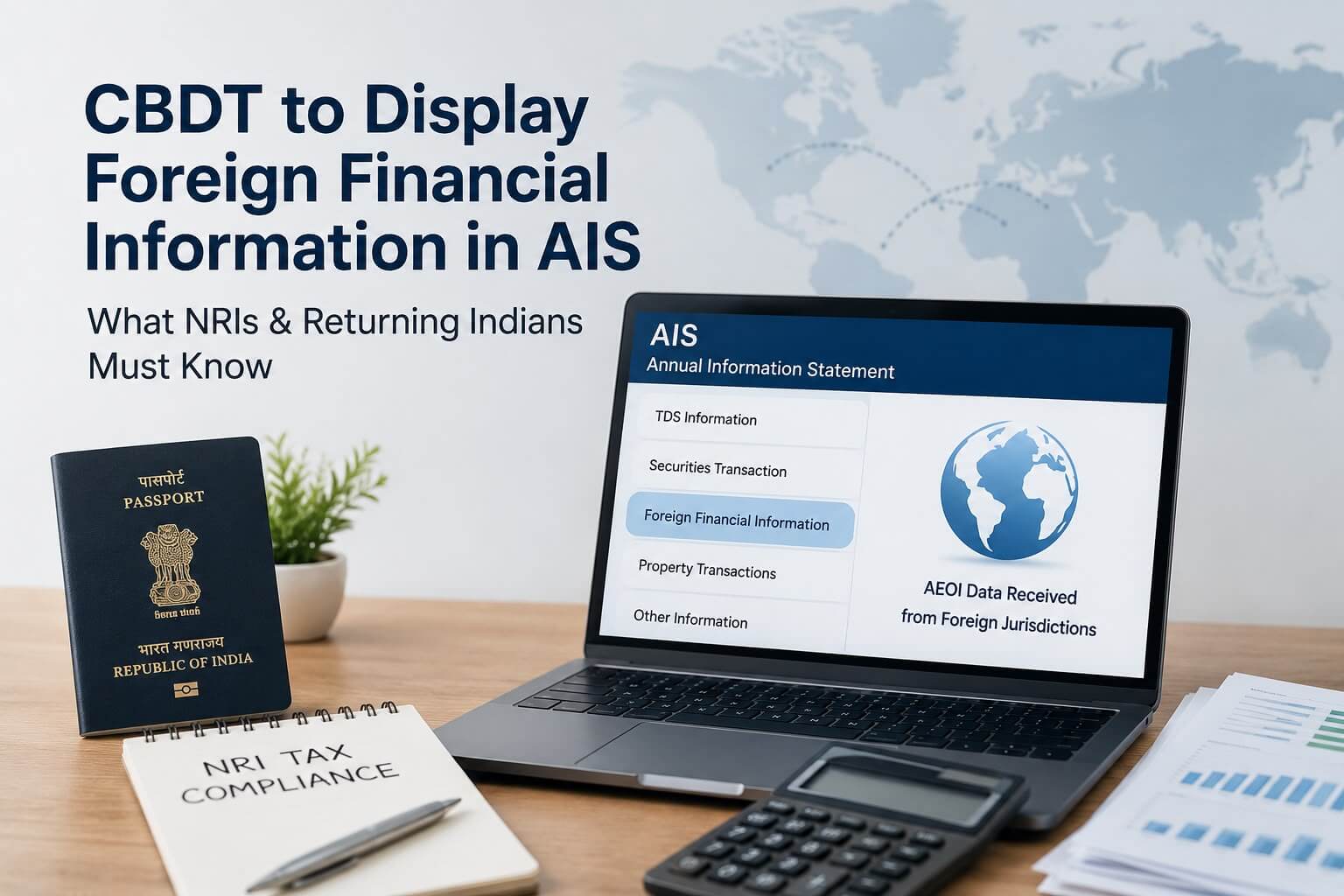


If you are an NRI, OCI, Returning Indian (R2I), RNOR, expatriate, or a resident with overseas investments, this is one of the most important tax developments of 2026.
The Central Board of Direct Taxes (CBDT) has issued an order under Section 119 of the Income-tax Act, 1961, authorising the Income Tax Department to upload financial information received from foreign tax authorities under the Automatic Exchange of Information (AEOI) framework into taxpayers' Annual Information Statement (AIS).
While India has been receiving such information from various countries for several years, this order operationalises its display in the AIS, enabling taxpayers to view the information available with the Income Tax Department.
For taxpayers with foreign bank accounts, overseas investments, foreign pensions, dividend income, interest income or other cross-border financial assets, this makes reviewing the AIS before filing the Income Tax Return (ITR) more important than ever.
The CBDT has authorised the Director General of Income-tax (Systems) to upload information received under international information exchange agreements into taxpayers' Annual Information Statement (AIS).
The order covers foreign financial information received for:
The information will be uploaded according to the procedures prescribed by the Income Tax Department.
This is another significant step towards a technology-driven and data-backed tax administration.
The Automatic Exchange of Information (AEOI) is a global framework through which participating countries automatically exchange financial account information of tax residents every year.
India receives information under:
These international frameworks help tax authorities improve transparency, detect tax evasion and ensure proper reporting of cross-border income and financial assets.
Depending on the information received from overseas tax authorities, AIS may include details relating to:
The exact information displayed will depend on what is shared by the relevant foreign jurisdiction under applicable international agreements.
If you have recently moved back to India or are planning to return, this update deserves your immediate attention.
Many returning NRIs continue to hold:
A common misconception is:
These assumptions can expose taxpayers to unnecessary compliance risks.
As your residential status changes from Non-Resident to RNOR or Resident, your tax obligations in India may also change. The latest CBDT order strengthens the visibility of foreign financial information by enabling its display in the AIS.
Returning Indians should therefore evaluate their residential status carefully, understand the taxability of overseas income, review their foreign asset reporting obligations and reconcile the information reflected in AIS before filing their Income Tax Return.
Even if you continue to qualify as an NRI, this development is still relevant.
Many NRIs have income connected with India, including:
With increased use of global financial information and advanced data analytics, tax authorities are better equipped to verify disclosures wherever applicable.
Maintaining proper records and ensuring accurate reporting can help avoid unnecessary notices and compliance issues.
The display of foreign financial information in AIS marks another milestone in India's evolving international tax compliance framework.
For NRIs, Returning Indians, RNORs, OCIs and resident taxpayers with overseas assets, obtaining professional guidance through an NRI Returning to India Consultancy can help navigate tax reporting, which is becoming increasingly integrated with global information-sharing systems
AIS should no longer be viewed as a statement containing only domestic tax information. It is evolving into a comprehensive compliance document that may include financial information received from overseas jurisdictions under CRS, FATCA and other international agreements.
Accordingly, taxpayers with foreign financial interests should:
With increasing use of technology and international information exchange, accurate reporting of foreign income and overseas financial assets is becoming an integral part of tax compliance.
Before filing your Income Tax Return, consider the following checklist:
Being proactive today can help prevent notices, reassessments and prolonged litigation in the future.
CBDT has authorised the display of foreign financial information in AIS.
Information received under AEOI, CRS and FATCA may increasingly become visible in taxpayers' Annual Information Statement.
The update is particularly significant for Returning NRIs, RNORs, residents with overseas assets and taxpayers having foreign financial interests.
Reviewing AIS before filing your Income Tax Return is now an important compliance step.
Correct determination of residential status, proper reporting of foreign income and appropriate DTAA planning can help minimise future tax disputes.
Managing overseas income, foreign investments and changing residential status can be complex especially for NRIs and Returning Indians.
At Dinesh Aarjav & Associates, we have advised 10,500+ NRIs across 70+ countries on cross-border taxation, Returning to India planning, DTAA advisory, Foreign Tax Credit, FEMA compliance and Indian income tax filings.
If you have foreign bank accounts, overseas investments, RSUs, ESOPs, pensions, rental income or other global assets, our team can help you understand your Indian tax obligations and ensure accurate compliance.
Aarjav Jain is the Executive Director at Dinesh Aarjav & Associates, specializing in India–US cross-border transactions, NRI taxation, international tax advisory, and global investment structuring. With over 10 years of experience in project financing and cross-border advisory, he assists NRIs and businesses with regulatory compliance, repatriation planning, and international transaction structuring.






.webp)