WhatsApp
 Call Us
 Email Us
 Whatsapp Community

Would you like to schedule a call back


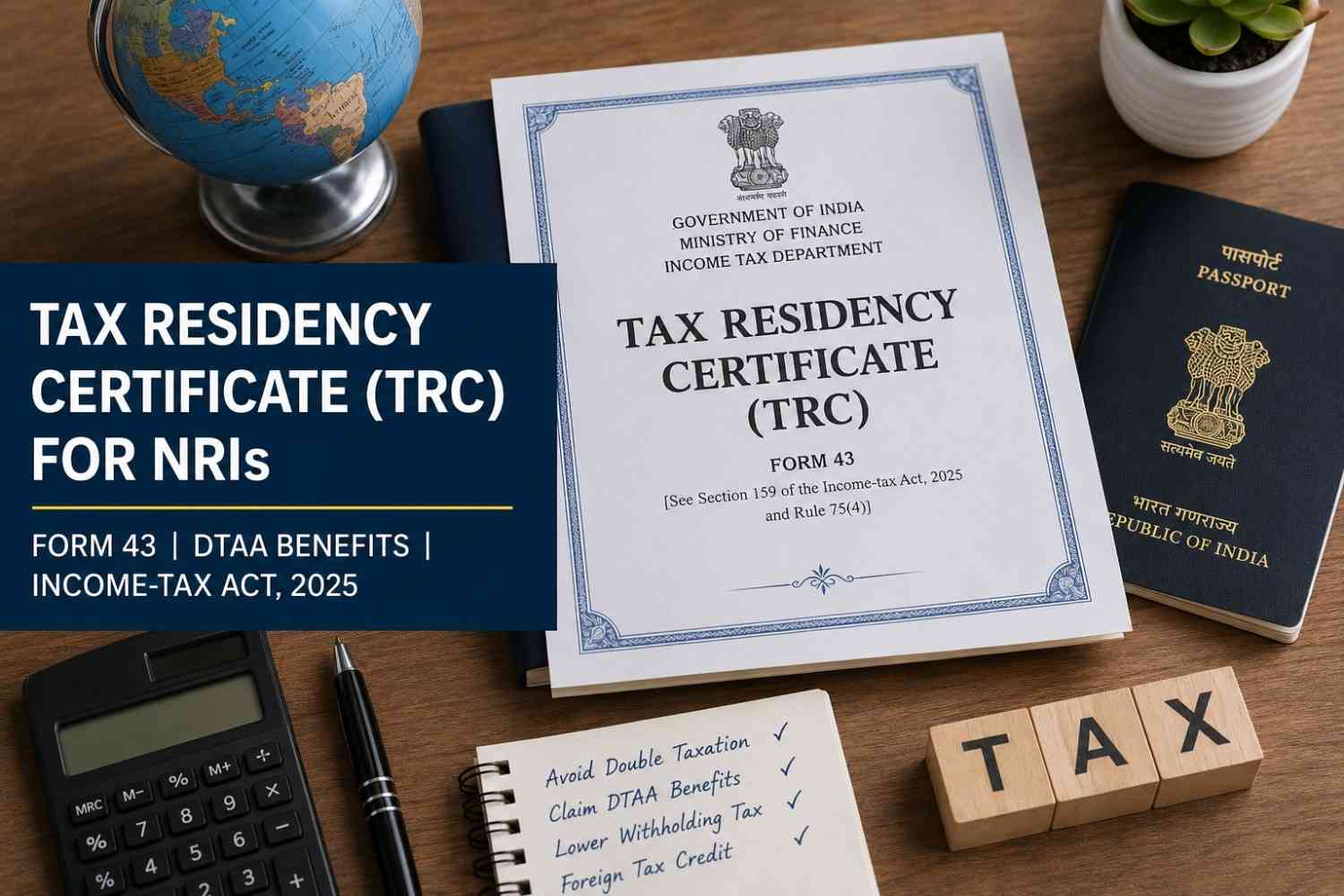


If you are an NRI, OCI, expatriate, returning Indian, or global professional earning income across countries, understanding a Tax Residency Certificate (TRC) is crucial for avoiding double taxation and claiming tax treaty benefits.
Whether you earn income from the USA, UK, Canada, UAE, Singapore, or Australia, a Tax Residency Certificate in India can help establish tax residency and reduce tax exposure under a Double Taxation Avoidance Agreement (DTAA).
With the implementation of the Income-tax Act, 2025, the legal framework governing TRC has been updated. The certificate is now governed by Section 159 of the Income-tax Act, 2025, and issued in Form 43.
In this guide, we explain:
A Tax Residency Certificate (TRC) is an official document issued by the tax authority of a country certifying that a person is a tax resident of that country during a specific period.
In India, the TRC helps taxpayers claim benefits under Double Taxation Avoidance Agreements (DTAA) and prevents the same income from being taxed twice.
Under the Income-tax Act, 2025, India issues the certificate in Form 43 under Section 159.
A Tax Residency Certificate acts as documentary proof of your tax residency status.
In simple terms, if you are considered a tax resident of India, a TRC may help you claim treaty benefits in another country where your income is taxed.
For example:
You live in India but receive:
In such situations, foreign authorities may ask for proof that you are an Indian tax resident before granting treaty benefits.
This is where a Tax Residency Certificate (TRC) becomes important.
The Income-tax Act, 2025 reorganized various tax provisions and forms.
One important update relates to the Certificate of Residence framework.
Earlier Position (Income-tax Act, 1961)
Previously:
Position Under Income-tax Act, 2025
Under the new law, Form 43 is now the Certificate of Residence issued for the purpose of Section 159 of the Income-tax Act, 2025.
Many NRIs assume:
“If tax is already paid in one country, there will be no tax elsewhere.”
Unfortunately, cross-border taxation does not work that way.
Without proper treaty documentation, the same income may be taxed in multiple countries.
A TRC helps reduce this risk.
1. Claim DTAA Benefits
India has signed Double Taxation Avoidance Agreements (DTAA) with several countries including:
A TRC helps claim treaty relief available under these agreements.
2. Avoid Double Taxation
The biggest purpose of a TRC is to ensure the same income is not taxed twice.
Example:
An NRI earning salary in the USA while also earning rental income in India may face overlapping tax exposure.
A TRC can support treaty claims and tax credits.
3. Reduce Withholding Taxes
Without treaty documentation:
Foreign jurisdictions may deduct taxes at higher domestic rates.
With a TRC:
Taxpayers may be eligible for reduced treaty withholding rates.
4. Support Foreign Tax Credit Claims
Taxes paid abroad may sometimes be claimed as credit in India (or vice versa), depending on treaty provisions.
Proper residency documentation becomes important in such cases.
A TRC may become relevant for:
NRIs & Overseas Professionals
Individuals earning:
Returning Indians
Returning Indians often face tax overlap during transition years.
Cross-Border Consultants & Freelancers
Professionals receiving foreign payments may need treaty documentation.
Business Owners with International Income
Companies and entrepreneurs with overseas income streams may require a TRC.
TRC for NRIs in USA
Indian-origin professionals in the United States commonly hold:
A TRC may assist in claiming treaty benefits under the DTAA India USA.
TRC for NRIs in Canada
Canadian residents with Indian investments often need clarity regarding:
Proper residency documentation may help avoid tax duplication.
TRC for NRIs in UAE
Many UAE residents assume:
“No tax in UAE means no reporting.”
However, Indian-source income may still have tax implications.
A TRC may help establish treaty eligibility where relevant.
Professionals in UK and Singapore frequently require residency documentation for:
Assuming Nationality Equals Tax Residency
Being an Indian citizen does not automatically make someone an Indian tax resident.
Tax residency depends on residential status rules.
Ignoring DTAA Rules
Every country treaty works differently.
Treaty benefits should not be assumed automatically.
Not Evaluating Residential Status Properly
Many NRIs and returning Indians incorrectly classify residency status.
This can result in tax notices and denial of treaty relief.
Cross-border taxation can become complicated — especially for NRIs in USA, UK, Canada, UAE, Singapore and Australia dealing with foreign income, tax credits, RSUs, rental income, capital gains, and DTAA claims.
At Dinesh Aarjav & Associates, we help NRIs and global Indians with:
Need help with TRC, Form 10F, or Double Taxation? Reach out to our NRI Consultants today.
CA Priyal Goel Jain is a Partner at Dinesh Aarjav & Associates and a leading expert in India–US cross-border taxation, NRI taxation, and international tax advisory. She advises NRIs, OCIs, and global families on complex cross-border transactions, tax planning, foreign asset reporting, and multi-jurisdictional compliance matters.






Stay in the loop, subscribe to our newsletter and unlock a world of exclusive updates, insights, and offers delivered straight to your inbox.

.webp)