WhatsApp
 Call Us
 Email Us
 Whatsapp Community

Would you like to schedule a call back


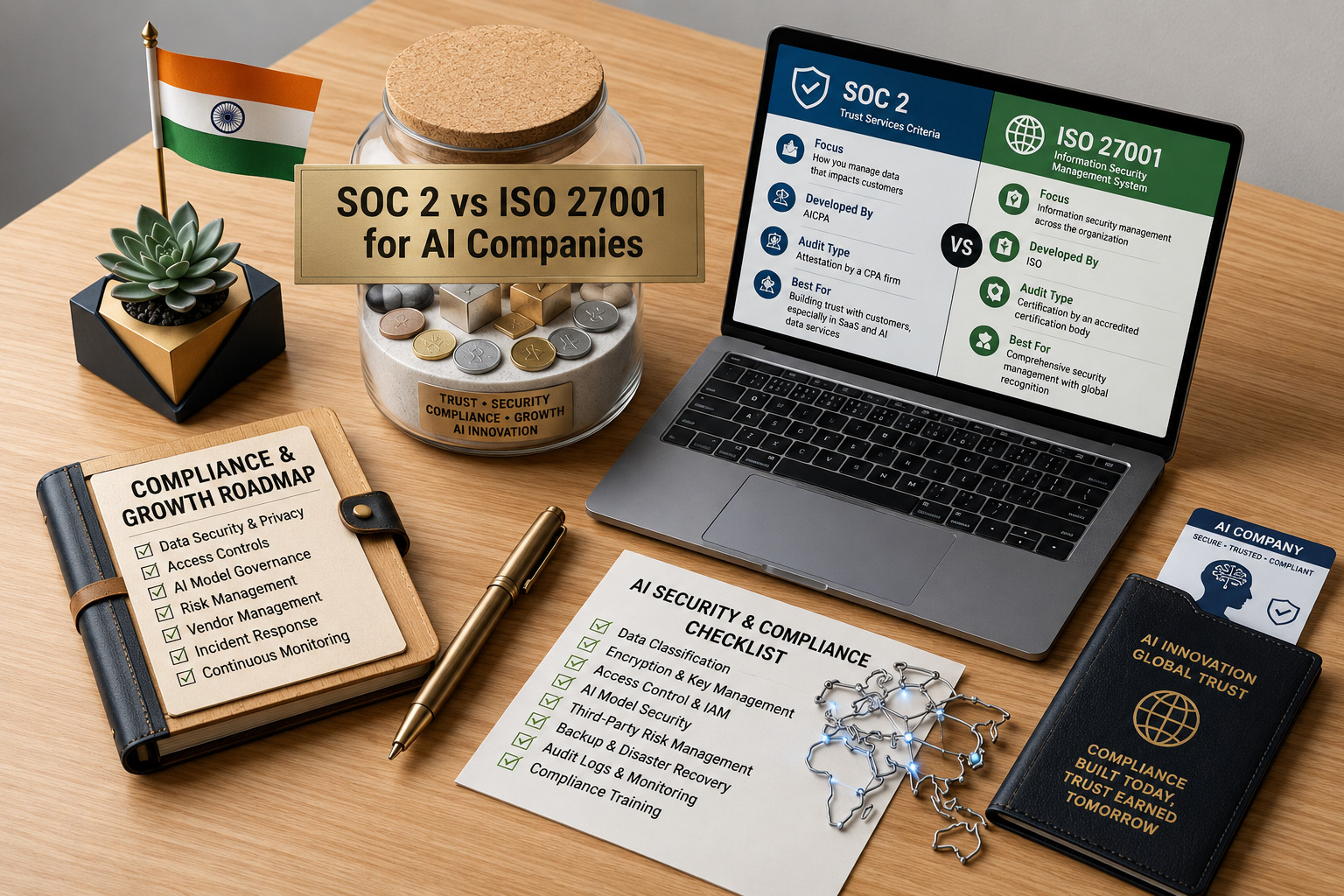


Most AI startups eventually need both. The question that actually matters is which one closes deals faster — and that depends on who's buying.
Every AI founder eventually gets the same email from a prospect's security team: "Can you share your SOC 2 report or ISO 27001 certificate?" The email rarely explains why one or the other, and the founder is left guessing which framework to prioritize when budget and engineering time are both limited.
This isn't a trivial decision. SOC 2 and ISO 27001 solve similar problems — proving that an organization manages security risk responsibly — but they differ in structure, audience, and what an audit actually produces. Picking the wrong one first can mean redoing work six months later, or worse, losing a deal because the buyer's procurement checklist required a certificate you don't have.
Traditional SaaS companies have had years to settle into a default answer: SOC 2 for US-based enterprise buyers, ISO 27001 for companies selling into Europe or working with multinational procurement teams. AI companies don't get to inherit that default cleanly.
Two things complicate it:
This means the "SOC 2 first, ISO later" convention doesn't automatically hold for an AI startup with a Series A that already has customers in the US, UK, and EU simultaneously
SOC 2 is an attestation report, not a certification. An independent CPA firm examines an organization's controls against the AICPA Trust Services Criteria — Security, Availability, Processing Integrity, Confidentiality, and Privacy — and issues an opinion on whether those controls are suitably designed (Type 1) or operating effectively over time (Type 2).
For AI companies, SOC 2 tends to be the faster route to a sellable artifact because:
ISO 27001 is a certification, issued by an accredited certification body, confirming that an organization has implemented a full Information Security Management System (ISMS) — a structured, ongoing program covering risk assessment, asset management, supplier relationships, and continual improvement, not just a fixed set of controls.
For AI companies expanding internationally, ISO 27001 carries specific weight:
Rather than treating this as "which framework is better," the more useful exercise is mapping the decision against four factors.
1. Where your revenue actually comes from. If the majority of current and near-term pipeline is US enterprise, SOC 2 first is almost always correct. If EU or UK enterprise and public-sector deals make up a meaningful share of pipeline, ISO 27001 deserves equal priority, not a "later" slot.
2. What your existing deals are stalled on. If security review is already the reason a deal is sitting in legal, look at the specific document being requested. Founders often assume it's SOC 2 by default and later find out the buyer's checklist explicitly required ISO 27001.
3. Internal readiness. SOC 2 Type 1 can often be achieved faster because it evaluates control design at a point in time. ISO 27001 requires a functioning ISMS with documented risk assessments and management review cycles already running before the certification audit — which typically takes longer to stand up from zero.
4. Whether you're planning to pursue both eventually. Most AI companies that scale past 50-100 enterprise customers end up holding both. If that's the trajectory, building controls in a way that satisfies both frameworks from the start — rather than building for one and retrofitting for the other — saves significant audit and engineering time later.
The good news is that SOC 2 and ISO 27001 aren't built on incompatible foundations. Both expect:
For an AI company, this overlap means the underlying control work — data encryption for training data, access reviews for model infrastructure, logging around model outputs and prompts — is largely reusable across both frameworks. The certification and audit processes differ, but the control implementation work is not duplicated from scratch.
For an AI startup without an existing report or certificate, a reasonable sequencing looks like this:
Companies with EU-heavy pipeline from day one should reverse steps 2 and 4 — there's no rule that SOC 2 has to come first if it isn't where the deals are.
Pursuing both frameworks in parallel with separate, uncoordinated audit tracks. This duplicates evidence collection effort and confuses internal teams about which control documentation applies where.
Treating either framework as a one-time project. Both SOC 2 Type 2 and ISO 27001 require ongoing operation — continuous monitoring, periodic access reviews, and annual surveillance audits for ISO 27001. A company that stops maintaining controls after the initial audit will fail the next cycle.
Underestimating ISO 27001 timeline. Founders sometimes assume ISO 27001 takes roughly the same time as SOC 2 Type 1. In practice, the ISMS build-out phase before the certification audit is usually the longer part of the process.
Picking based on internal preference rather than buyer requirements. The right first framework is the one your actual and near-term pipeline is asking for — not the one that's faster or cheaper to implement.
SOC 2 and ISO 27001 aren't competing options so much as they are two answers to the same underlying question — can this organization be trusted with sensitive data and, increasingly, with sensitive AI systems. For an AI company deciding where to start, the right first move is dictated less by which framework is "standard" and more by where the revenue and the security reviews are actually coming from.
Companies that build their control environment with both frameworks in mind from the outset tend to move through the second certification significantly faster than those that treat each as a separate project. Getting that sequencing right early saves both audit cost and engineering time down the line.
Explore our SOC 2 Compliance Services to strengthen your security and compliance program.
Accorp Partners works with AI companies and technology startups navigating exactly this decision — helping map current and target markets against the right compliance framework, building control environments that satisfy SOC 2 and ISO 27001 requirements simultaneously rather than sequentially from scratch, and managing the full audit lifecycle from readiness assessment through Type 1, Type 2, and ISO certification.
Our risk assurance team also supports AI-specific governance work, including alignment with ISO 42001, so that security and compliance investments made today hold up as enterprise buyer expectations around AI systems continue to evolve
CA Sanyam Goel, CPA (USA), FCA, and CISA, specializes in India–US cross-border taxation, NRI tax advisory, US tax compliance, transfer pricing, and international regulatory matters. He assists clients with US and Indian tax obligations, cross-border reporting requirements, and strategic tax planning for global investments and transactions.



Stay in the loop, subscribe to our newsletter and unlock a world of exclusive updates, insights, and offers delivered straight to your inbox.

.webp)