WhatsApp
 Call Us
 Email Us
 Whatsapp Community

Would you like to schedule a call back




If you are a:
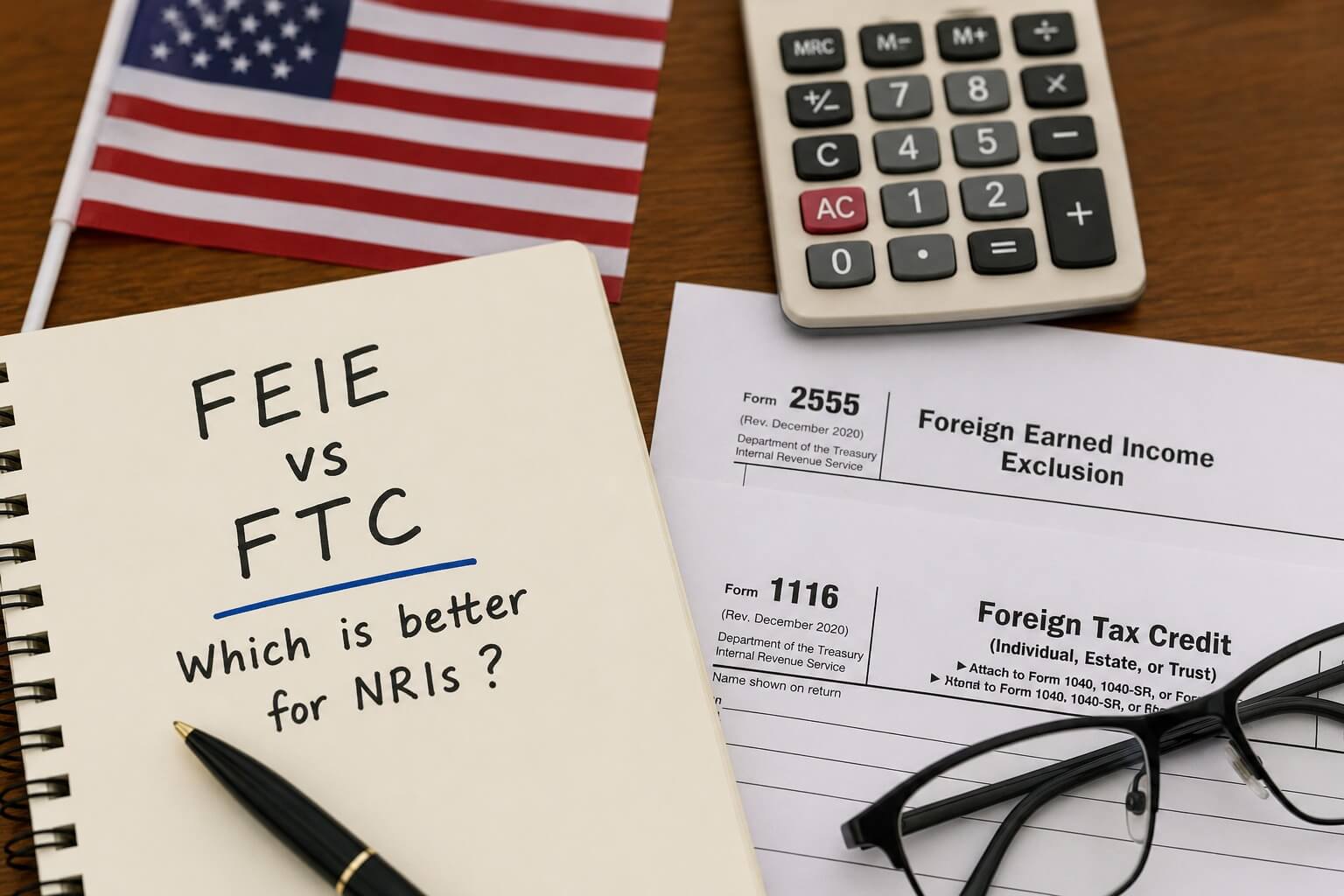
one of the most important tax decisions you will make each year is whether to claim the Foreign Earned Income Exclusion (FEIE) or the Foreign Tax Credit (FTC).
A wrong decision can result in:
Unfortunately, most online articles discussing FEIE vs FTC are written from a general expat perspective and fail to address the unique tax realities faced by US citizens in India, Green Card holders living in India, and returning NRIs with cross-border income.
This guide provides a detailed India-focused analysis of FEIE and FTC and explains why the answer for taxpayers living in India is often very different from taxpayers living in low-tax jurisdictions such as the UAE, Singapore, Qatar, or Saudi Arabia.
The United States is one of the few countries that taxes its citizens and Green Card holders on worldwide income regardless of where they reside.
Even after moving to India, you may still be required to report:
Without proper planning, the same income may potentially be exposed to taxation in both India and the United States.
To prevent double taxation, the Internal Revenue Code provides two major relief mechanisms:
Foreign Earned Income Exclusion (FEIE)
and
Foreign Tax Credit (FTC)
Choosing the right strategy requires an understanding of both US tax law and Indian tax law.
The Foreign Earned Income Exclusion allows qualifying taxpayers to exclude a portion of foreign earned income from US taxation.
For tax year 2026, the exclusion amount is expected to exceed $130,000 per qualifying taxpayer.
FEIE is claimed using:
To qualify, taxpayers generally must satisfy one of the following tests:
The taxpayer must remain outside the United States for at least 330 full days during a 12-month period.
The taxpayer must establish genuine tax residence in a foreign country for an uninterrupted tax year.
FEIE applies primarily to earned income, including:
FEIE generally does not apply to:
This limitation becomes extremely important for taxpayers living in India because many returning NRIs and Green Card holders derive substantial income from investments rather than salary alone.
The Foreign Tax Credit allows taxpayers to claim a credit for income taxes paid to a foreign government.
Instead of excluding income, FTC directly reduces US tax liability.
FTC is claimed through:
Unlike FEIE, FTC allows taxpayers to continue reporting their worldwide income while receiving credit for taxes already paid overseas.
This often creates significant advantages for taxpayers living in countries with relatively high tax rates such as India.
FTC may be available for taxes paid on:
FTC therefore provides a broader solution than FEIE for many taxpayers residing in India.
| Parameter | FEIE | FTC |
| IRS Form | Form 2555 | Form 1116 |
| Primary Benefit | Income exclusion | Tax credit |
| Salary Income | Eligible | Eligible |
| Interest Income | Not eligible | Eligible |
| Rental Income | Not eligible | Eligible |
| Capital Gains | Not eligible | Eligible |
| Dividend Income | Not eligible | Eligible |
| Foreign Tax Carryforward | No | Yes |
| Child Tax Credit Impact | May reduce benefits | Usually favorable |
| Retirement Planning | Potential restrictions | Generally favorable |
| Best for Low-Tax Countries | Often yes | Depends |
| Best for India | Usually no | Frequently yes |
This is the most important point that many generic expat blogs fail to address.
India is not a low-tax jurisdiction.
Indian tax rates frequently exceed effective US federal tax rates, especially for:
Because Indian taxes are often higher, taxpayers may generate substantial foreign tax credits that can eliminate or significantly reduce US tax liability.
Example
A US citizen residing in Bengaluru earns:
Assume the corresponding US federal tax liability is approximately $24,000.
Under FTC:
Under FEIE:
For many taxpayers living in India, FTC creates a more powerful and flexible outcome.
Returning NRIs often have multiple income streams simultaneously.
Examples include:
A simple FEIE election without comprehensive analysis can lead to:
This is one of the biggest mistakes we see among returning NRIs who prepare their US tax returns without cross-border tax advice.
Many US taxpayers living in India overlook the interaction between FEIE and Child Tax Credit benefits.
In certain situations, using FEIE can reduce access to valuable tax credits available under US tax law.
For families with children, the tax savings generated through FTC can sometimes exceed the apparent benefits of FEIE.
The analysis becomes even more important when multiple children are involved.
Retirement planning is another area often ignored in online discussions.
Using FEIE may affect certain retirement contribution strategies because excluded income receives different treatment under US tax rules.
Taxpayers contributing to:
should evaluate whether FTC provides a more favorable long-term outcome.
Yes.
However, they generally cannot be claimed on the same income.
A taxpayer may:
The interaction between these provisions is highly technical and often requires detailed calculations.
Ignoring Foreign Tax Credit Carryforwards
Unused foreign tax credits may be carried forward, creating significant future tax savings opportunities.
Many taxpayers fail to claim credits on taxes paid relating to:
Indian mutual funds often trigger PFIC reporting obligations.
Neither FEIE nor FTC eliminates PFIC compliance requirements.
Differences between Indian and US tax years can create timing mismatches that require careful planning.
Many Green Card holders believe that moving back to India ends US tax filing obligations.
This is incorrect.
Until Green Card status is formally relinquished or abandoned under US immigration and tax rules, worldwide income reporting generally continues.
For Green Card holders living in India, FTC often provides a stronger solution because:
Returning NRIs face unique challenges because they often maintain financial connections in both countries.
Common issues include:
The FEIE vs FTC decision should never be viewed in isolation.
It must be integrated into a broader India-US tax strategy.
For most taxpayers residing in India, the Foreign Tax Credit frequently delivers superior long-term results because:
However, every case requires individual analysis.
The optimal choice depends on:
At Dinesh Aarjav & Associates, our India-US cross-border tax team assists:
Our services include:
For taxpayers searching:
the answer is rarely one-size-fits-all.
While FEIE receives significant attention online, the reality is that Foreign Tax Credit planning is often the more powerful strategy for US citizens, Green Card holders and returning NRIs living in India because of India's comparatively higher tax rates and the broader coverage FTC provides across multiple income categories.
A properly structured India-US tax strategy can reduce double taxation, preserve valuable tax attributes, improve compliance, and create significant long-term tax savings.
CA Sanyam Goel, CPA (USA), FCA, and CISA, specializes in India–US cross-border taxation, NRI tax advisory, US tax compliance, transfer pricing, and international regulatory matters. He assists clients with US and Indian tax obligations, cross-border reporting requirements, and strategic tax planning for global investments and transactions.





Stay in the loop, subscribe to our newsletter and unlock a world of exclusive updates, insights, and offers delivered straight to your inbox.

.webp)