WhatsApp
 Call Us
 Email Us
 Whatsapp Community

Would you like to schedule a call back


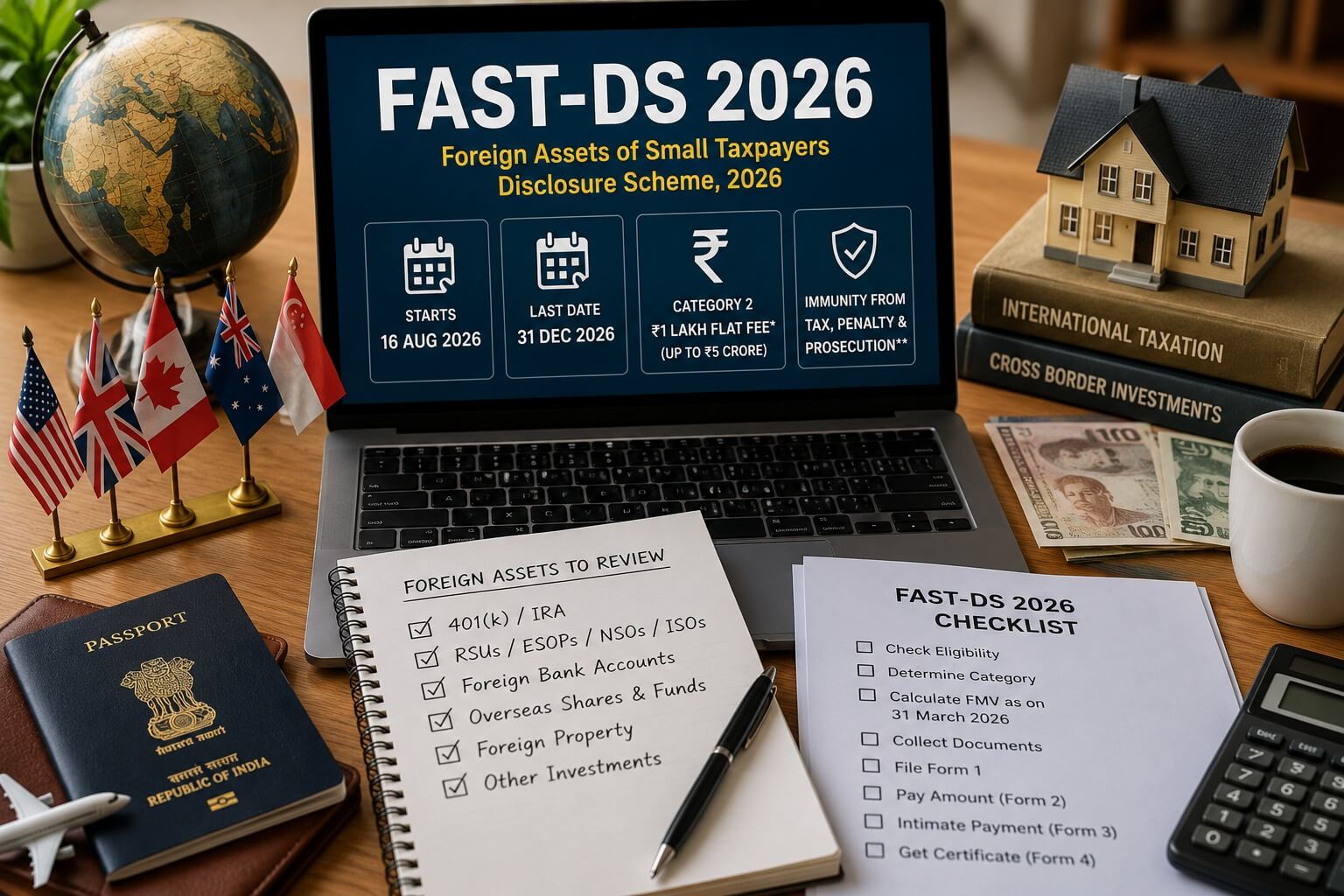


The Government has now issued detailed FAQs clarifying how the Foreign Assets of Small Taxpayers – Disclosure Scheme, 2026 (FAST-DS 2026) will actually work.
And there is one clarification that returning NRIs should pay particular attention to:
An asset can potentially fall within the lower-cost ₹1 lakh fee route even where it was acquired when the taxpayer was a non-resident, provided the conditions of the scheme are satisfied and the asset was not declared in the relevant return.
That can be highly relevant to people returning from the US, UK, Canada, Australia, UAE, Singapore and other jurisdictions with legacy foreign wealth accumulated while they were living abroad.
If you are a returning NRI and have ever thought:
The correct answer depends on your residential status in the relevant year, how and when the asset was acquired, whether the underlying income was offered to tax, whether the asset was reported in the relevant return, the nature of the asset and its value as on 31 March 2026.
This guide explains the new FAST-DS FAQs specifically from the perspective of NRIs, returning NRIs, ROR taxpayers and globally mobile professionals.
The Foreign Assets of Small Taxpayers Disclosure Scheme, 2026 is a one-time voluntary disclosure scheme under Chapter IV of the Finance Act, 2026.
It covers specified cases involving:
The second category is particularly important for returning NRIs.
The official FAQ expressly recognises these two broad categories under Section 133.
|
Particular |
Date / Limit |
|
Scheme starts |
16 August 2026 |
|
Last date to file declaration |
31 December 2026 |
|
Valuation date |
31 March 2026 |
|
Category 1 aggregate threshold |
₹1 crore |
|
Category 2 aggregate asset threshold |
₹5 crore |
|
Category 2 fee |
₹1 lakh |
|
Category 1 tax + additional amount |
30% + 30% = 60% |
The valuation date is especially important because the FAQs require the fair market value of assets proposed to be declared to be determined as on 31 March 2026.
Potentially, yes.
This is one of the most important clarifications in the new FAQs.
The eligibility provisions specifically cover a person who is currently a non-resident or RNOR but was resident in India either:
The FAQ separately confirms that a person who is presently non-resident can still make a declaration if the relevant residency conditions are satisfied.
This matters enormously for a person who followed this journey:
India → US/UK/Canada → accumulated foreign assets → returned to India → became ROR → discovered old foreign assets were never correctly disclosed.
The fact that the asset was acquired while you were living abroad does not by itself end the analysis.
That is why FAST-DS should not be analysed merely by asking:
The correct questions are:
That fact pattern determines which FAST-DS route may be relevant.
This is arguably the most commercially important clarification in the FAQs.
FAST-DS recognises a second category covering an asset located outside India which was already offered to tax or was acquired when the assessee was a non-resident, but was not declared in the relevant Schedule of the return.
For this category, the official FAQ provides:
provided the aggregate value of the foreign assets does not exceed ₹5 crore.
This can create a dramatically different outcome from a case involving genuinely undisclosed foreign income or assets.
Example
Suppose a returning NRI has:
Total foreign assets:
₹4 crore
If the facts establish that these assets fall within Section 133 Table Sl. No. 2, and all other conditions are satisfied, the FAQ states that the amount payable is a flat ₹1 lakh because the aggregate value does not exceed ₹5 crore.
That is why classification is everything.
You should not simply assume:
“Foreign asset = 60% FAST-DS payment.”
That is wrong.
There are two fundamentally different FAST-DS categories, with very different financial consequences.
Category 1 Undisclosed Foreign Asset / Undisclosed Foreign Income
This category covers an undisclosed asset located outside India or undisclosed foreign income that was not offered to tax.
The aggregate value of the undisclosed foreign asset and undisclosed foreign income must not exceed ₹1 crore for this category.
The FAQ states:
In practical terms, that is:
The official FAQ illustrates this with a foreign bank account of ₹60 lakh and foreign income of ₹20 lakh, resulting in total payment of ₹48 lakh.
Example
Undisclosed foreign asset:
₹80 lakh
30% tax:
₹24 lakh
Additional amount equal to tax:
₹24 lakh
Total FAST-DS payment:
₹48 lakh
This is very different from Category 2.
This is the category that returning NRIs should investigate extremely carefully.
The FAQ covers an overseas asset that:
but was not declared in the relevant Schedule of the return.
The aggregate value of assets under this category must not exceed ₹5 crore.
Amount payable
₹1 lakh flat fee.
Not 60% of the asset value.
Not 30% tax plus another 30%.
A flat ₹1 lakh, subject to the scheme’s conditions and the ₹5 crore aggregate threshold.
This is why every returning NRI with a historical foreign asset reporting issue should have the facts reviewed before assuming the worst-case FAST-DS cost.
This is one of the most common situations we expect returning Indians to face.
Consider this example:
You worked in the United States for eight years.
During that period:
The answer cannot be:
The foreign asset reporting analysis must consider the nature of the account, the year of acquisition/holding, residential status, applicable Schedule FA disclosure requirements and the FAST-DS facts.
That makes residential-status analysis critical.
A 401(k) is one of the classic assets that returning US-based Indians should put on their foreign-asset review list.
But do not make the mistake of treating every 401(k) identically.
You need to establish:
Do not assume that “retirement account” means “outside the FAST-DS framework.”
The scheme’s definition of an undisclosed foreign asset expressly refers to an asset, including a financial interest in any entity, located outside India.
A 401(k) therefore deserves a proper technical review rather than a yes/no assumption.
RSUs create a different set of questions.
A returning employee may have:
The crucial mistake is to treat all of those events as one single “RSU issue.”
They may involve different tax and disclosure events.
For FAST-DS purposes, the review should separate:
What foreign shares did you own?
When did you acquire the relevant interest?
Was the value already taxed as employment income?
Did the shares generate dividends?
Were shares sold? If yes, what were the capital gains?
Was the foreign asset correctly reported in the relevant Indian return?
Does the omission fall into Category 1 or Category 2?
The official FAQ provides specific FMV methodologies for quoted shares and securities, including reference to the lowest and highest quoted prices on the valuation date.
Therefore, RSU cases should not be valued casually from an old brokerage statement or today’s share price.
This is another major returning-NRI trap.
Foreign employee equity can include:
The FAST-DS FAQ does not provide a separate line item saying “RSU,” “NSO” or “ISO.”
That does not mean those arrangements can simply be ignored.
The correct analysis is to identify the underlying legal/economic interest and determine how it fits within the scheme’s categories and valuation rules.
For example, the FAQ separately addresses:
That makes private-company ESOPs and unlisted foreign equity particularly important cases for professional valuation and classification.
And the FAQs expressly state that supporting acquisition/income documents must be uploaded with Form 1, together with a valuation report where valuation is carried out for relevant assets such as unquoted shares and securities.
Suppose you bought:
while you were living outside India.
Years later you returned to India and became resident.
You then discovered that the property had never been correctly reported in an Indian return when disclosure was applicable.
The FAQ specifically addresses immovable property located outside India.
Its FMV is generally the higher of:
supported by a valuation report from a valuer recognised by the government or relevant agency of the country where the property is located.
Where such market valuation is not carried out, the indexed cost of acquisition is deemed to be the FMV.
This means your 2026 FAST-DS property calculation is not simply:
“What did I pay for the property?”
Nor is it necessarily:
“What is Zillow/Rightmove/online property website saying today?”
The valuation methodology in the FAST-DS Rules needs to be followed.
If you lived overseas, do a complete foreign-asset inventory.
Do not limit your review to bank accounts.
The FAQ expressly provides valuation approaches for bullion, jewellery, precious stones, artistic works, quoted shares, unquoted shares, immovable property, bank accounts and partnership/LLP interests.
This is another important FAQ clarification.
For a foreign bank account, the value is generally determined by adding deposits made into the account from the date it was opened up to the valuation date, subject to specified exclusions.
For example, the FAQ says that deposits funded from withdrawals from the same account are excluded to prevent double counting.
The FAQ provides a detailed example where historical deposits and withdrawals are tracked and the resulting foreign-currency amount is then converted into Indian rupees as on 31 March 2026.
If you have an old US bank account, do not simply send your accountant:
“31 March 2026 balance = $35,000.”
The FAST-DS valuation methodology may require a much more detailed reconstruction.
That is particularly important for:
The FAQ specifically addresses this situation.
If the proceeds of one asset were used to acquire another asset, the rules are designed to prevent the same value from being counted twice.
For example:
Foreign house sold → proceeds deposited in foreign bank → part of bank balance used to buy another property.
The value attributed to the bank account is reduced by the amount reinvested in the new asset, while the new property is separately valued.
This is exactly why FAST-DS should not be treated as a simple “fill the form and pay ₹1 lakh” exercise.
Asset tracing matters.
The FAQ requires values to be reported in Indian rupees.
For designated currencies, conversion is based on the RBI reference rate on the valuation date.
For currencies that are not designated, the FAQ provides a two-step conversion mechanism involving conversion into US dollars and then into Indian rupees using the RBI reference rate.
For a taxpayer with multiple foreign assets across several countries, this becomes an important part of the computation.
Here is another important protection in the FAQ.
For assets other than a bank account, a variance of not more than 20% between the FMV declared and the FMV subsequently determined by the Assessing Officer will not, by itself, make the declaration invalid on grounds such as misrepresentation, suppression of facts or furnishing false particulars.
That does not mean taxpayers can use arbitrary valuations.
The correct approach remains:
proper valuation + proper documentation + defensible methodology.
Yes.
This is particularly relevant to returning NRIs because a foreign-asset problem is rarely limited to one account.
A taxpayer may have:
The FAQ confirms that multiple assets and multiple types of assets/income can be included in a single Form 1, with relevant portions and annexures repeated as required.
That makes a consolidated foreign-asset reconstruction extremely important before filing.
This is where many DIY FAST-DS filings can go wrong.
The FAQ expressly states that Form 1 requires documents evidencing:
and valuation reports where valuation has been carried out.
Examples specifically mentioned include:
For a returning NRI, we would therefore recommend assembling a foreign asset evidence file before deciding the FAST-DS category.
That file may include:
The process is not complete merely because Form 1 has been submitted.
According to the FAQ:
Step 1 - Form 1
The declaration is filed electronically.
Step 2 - Form 2
After electronic verification, the income-tax authority communicates the amount payable through Form 2.
The FAQ states this is to be communicated within one month from the end of the month in which the declaration was made.
Step 3 - Payment
The amount determined in Form 2 must generally be paid within two months from the end of the month in which the order is received.
Step 4 - Additional payment window
A further period of up to two months is permitted with simple interest at 1% for every month or part of a month of delay.
Step 5 - Form 3
The taxpayer must electronically intimate the payment and provide proof of payment, including interest where applicable, through Form 3.
Step 6 - Form 4
Once the payment intimation is found to be in accordance with Form 2, the authority issues the payment certificate electronically in Form 4.
The FAQ states that, upon a valid declaration and payment, immunity is provided from:
The FAQ also states that the income or amount of investment in the declared asset will not be included in the taxpayer’s total income under the Income-tax Act or Black Money Act, subject to the scheme’s provisions.
This is one of the central reasons the scheme is important.
But the protection is linked to a valid declaration.
That is why incorrect categorisation, incomplete asset tracing or poor documentation should not be taken lightly.
The FAQ specifically addresses this.
If assessment proceedings under the Income-tax Act or Black Money Act are pending in relation to the declared income or asset, the Assessing Officer is required to take the declaration into account while finalising the assessment order.
This is another reason why a taxpayer who has already received a notice should obtain professional advice rather than assuming FAST-DS is automatically unavailable.
The FAQ identifies circumstances where the scheme is not available.
It does not apply to:
Therefore:
Eligibility needs to be tested against the actual facts.
If you have returned to India from the US, UK, Canada, Australia, UAE, Singapore or another country, ask yourself these questions:
The Income Tax Department has introduced the Foreign Assets Information (FAI) facility on the AIS Compliance Portal, allowing taxpayers to review foreign financial information received by Indian tax authorities through international information-exchange mechanisms.
Your FAI review should therefore be part of your foreign-asset compliance exercise.
However, FAI should not be treated as your complete foreign-asset inventory.
A taxpayer may have foreign assets or interests that require analysis even if they do not appear in the information available through the FAI report.
Your own historical records remain critical.
This distinction is extremely important.
Schedule FA is the foreign-asset disclosure schedule in the Indian income-tax return where applicable.
Schedule FSI deals with foreign-source income and is relevant for residents in the applicable return framework.
FAST-DS is a special one-time disclosure mechanism for specified historical foreign-asset/foreign-income situations.
FAI is information available to taxpayers through the Income Tax Department’s compliance system relating to foreign financial information received from overseas jurisdictions.
These are related but they are not interchangeable.
The Income Tax Department’s current ITR-2 guidance separately identifies Schedule FSI, Schedule FA and Schedule AL.
Consider Mr. A, who worked in the US for 10 years and returned to India.
His foreign assets are:
|
Asset |
Value as on 31 March 2026 |
|
US 401(k) |
₹1.50 crore |
|
US brokerage account |
₹1.00 crore |
|
RSU shares |
₹60 lakh |
|
Foreign bank account |
₹40 lakh |
|
Overseas property |
₹1.00 crore |
|
Total |
₹4.50 crore |
Mr. A initially assumes:
“My foreign assets are ₹4.5 crore, so FAST-DS will cost me 60%.”
That assumption may be completely wrong.
If the facts establish that the assets fall under the Section 133 Table Sl. No. 2 category, including the relevant conditions relating to assets acquired while non-resident or already offered to tax, the FAQ provides a ₹1 lakh flat fee where the aggregate value does not exceed ₹5 crore.
But if the facts instead fall under Category 1, the financial consequence can be dramatically higher.
This is why FAST-DS is a classification exercise before it is a filing exercise.
Not necessarily.
The FAQ expressly deals with non-residents and RNORs who satisfy the historical residency conditions.
Taxation of compensation and disclosure of the foreign asset are separate questions.
Your vesting, acquisition, holding, dividends, sale and Schedule FA history may all need to be reviewed.
Do not make that assumption without analysing the specific account and the relevant Indian reporting rules.
The FAST-DS eligibility provisions specifically contemplate assets acquired in years when the taxpayer was non-resident, subject to the scheme’s conditions.
FAI is an important reconciliation tool, not a substitute for reconstructing your complete foreign-asset history.
No.
The ₹1 lakh amount relates to Category 2, subject to the scheme’s conditions and the ₹5 crore threshold. Category 1 has a different tax/amount payable structure.
The scheme requires:
The FAQ specifically requires acquisition/income evidence and valuation reports where applicable.
A mistake at the classification or valuation stage can therefore have consequences far beyond the filing fee.
If you are a returning NRI or Indian resident with historical foreign assets, do not wait until December.
Prepare a year-by-year matrix:
Year → NR / RNOR / ROR → country of residence → Indian ITR filed → foreign assets held
Include everything:
Bank + Brokerage + 401(k) + Pension + RSUs + ESOPs + NSOs + ISOs + Shares + Property + Partnerships + Other foreign assets
Check every relevant year’s:
Compare the information available with the Income Tax Department against your own records.
Category 1 - undisclosed foreign income/assets
or
Category 2 - tax-paid / acquired while non-resident / disclosure omission
Do not simply use today’s value.
Especially for:
Do not file first and search for evidence later.
Multiple assets can be included in one declaration, subject to the scheme’s requirements.
Form 2 → payment → Form 3 → Form 4.
The filing deadline is 31 December 2026.
But a December filing does not mean your work starts in December.
For a returning NRI with a decade of foreign financial history, the real work may involve:
10 years of ITRs + multiple countries + several brokerage accounts + 401(k) + RSUs + ESOPs + foreign bank accounts + property + foreign tax records.
Some foreign institutions may take time to provide historical statements.
Valuations may take time.
Old ITRs need to be retrieved.
Residential status needs to be reconstructed.
Foreign currency values need to be calculated.
Asset movements may need to be traced.
And the correct FAST-DS category needs to be determined before the declaration is filed.
The deadline is 31 December 2026. Your preparation deadline should be much earlier.
Q1. What is the ₹1 lakh FAST-DS rule?
For the relevant Category 2 declaration, the FAQ provides a flat ₹1 lakh fee where aggregate foreign assets do not exceed ₹5 crore.
Q2. What is the Category 1 FAST-DS limit?
The aggregate undisclosed foreign asset and undisclosed foreign income must not exceed ₹1 crore.
Q3 How much is payable under Category 1?
30% tax plus an additional amount equal to that tax — effectively 60% of the declared value/income.
Q4. Does FAST-DS cover foreign property?
Foreign immovable property is specifically addressed in the valuation FAQs.
Q5. Does FAST-DS cover foreign shares?
The FAQ provides valuation rules for quoted and unquoted shares/securities, subject to the scheme’s applicability and facts.
Q6. What about RSUs, ESOPs, NSOs and ISOs?
These require a fact-specific analysis of the underlying foreign interest, acquisition/exercise/vesting history, taxation and reporting. They should not be automatically treated as either included or excluded.
Q7. What about a US 401(k)?
A foreign retirement account should be specifically reviewed as part of the taxpayer’s foreign-asset history. Do not assume that its retirement character automatically removes the need for analysis.
Q8. Can multiple foreign assets be declared together?
Yes. Form 1 and its annexure allow multiple assets or types of income to be included.
Q9. Are supporting documents required?
Yes. Form 1 requires evidence relating to acquisition of the asset or earning of income and valuation reports where applicable.
Q9. What happens after Form 1?
The authority issues Form 2 determining the amount payable, followed by payment, Form 3 intimation and Form 4 certification.
Q10. Does a valid declaration provide immunity?
The FAQ states that a valid declaration and payment provide specified immunity from further tax/penalty and prosecution under the Black Money Act in respect of the declared income or asset, subject to the scheme.
If you returned to India after working abroad and have any foreign assets that were not properly disclosed, now is the time to investigate.
Especially if you have:
401(k) + RSUs + ESOPs + NSOs + ISOs + foreign brokerage + foreign bank accounts + overseas property.
The most important question is not:
“How much will FAST-DS cost me?”
The first question should be:
“Which FAST-DS category actually applies to my facts?”
Because the difference between Category 1 and Category 2 can be enormous.
For some taxpayers, the issue may involve the 60% tax/amount structure applicable to Category 1.
For eligible Category 2 cases, the FAQ provides a ₹1 lakh flat fee for aggregate foreign assets up to ₹5 crore.
And for a returning NRI who acquired assets while non-resident but later became resident in India, the historical residential status and acquisition history can be critical to the analysis and should be carefully considered as part of NRI tax planning.
And do not wait until the final weeks of 2026 to reconstruct years of international financial history.
Our FAST-DS review can cover:
Our objective is not simply to “file FAST-DS.”
The objective is to identify the correct legal category, calculate the correct value, document the historical facts and complete the disclosure correctly.
If you are a returning NRI and have even one foreign asset you are unsure about, this is the right time to get the facts reviewed.
1. When did you acquire the foreign asset?
2. What was your Indian residential status in that year and in the relevant income years?
3. Was the asset actually disclosed in your Indian income-tax return when required?
If you cannot answer all three confidently, your foreign-asset history deserves a professional review before 31 December 2026.
This article is for general information and educational purposes only and is based on the FAST-DS 2026 FAQs, applicable legislation and publicly available Income Tax Department material available at the time of publication. Eligibility, valuation, tax treatment, disclosure requirements and immunity depend on the taxpayer’s individual facts, residential status, asset history and applicable law. This article should not be treated as a substitute for professional tax advice or a determination of eligibility for FAST-DS 2026.
Aarjav Jain is the Executive Director at Dinesh Aarjav & Associates, specializing in India–US cross-border transactions, NRI taxation, international tax advisory, and global investment structuring. With over 10 years of experience in project financing and cross-border advisory, he assists NRIs and businesses with regulatory compliance, repatriation planning, and international transaction structuring.






Stay in the loop, subscribe to our newsletter and unlock a world of exclusive updates, insights, and offers delivered straight to your inbox.

.webp)