WhatsApp
 Call Us
 Email Us
 Whatsapp Community

Would you like to schedule a call back





We get some version of this question every planting season: an NRI client wants to buy a few acres near the family village half sentiment, half investment and is surprised to learn it isn't a simple registration and a sale deed. The first question is often, can NRI purchase agricultural land in India, and the answer depends on the route through which the land is being acquired. Agricultural land sits in its own compartment under Indian foreign exchange law, with specific FEMA rules for NRI agricultural land, separate from the flats and offices NRIs buy freely. Before you sign anything, it helps to know exactly where that compartment's walls are, and where the genuine gaps in it lie.
No, not directly. Under the Foreign Exchange Management Act (FEMA), 1999 and the RBI's Acquisition and Transfer of Immovable Property Regulations, an NRI or OCI cannot buy agricultural land, plantation property, or a farmhouse in India in the ordinary course, the way they could buy a residential flat. The restriction exists to keep farmland in the hands of resident cultivators and to prevent it from being treated as a speculative asset class.
That said, "cannot buy" is not the same as "can never own." Three routes exist, and clients often conflate them which is usually where the compliance trouble starts.
| Route | Allowed for NRIs? | Key condition |
|---|---|---|
| Inheritance from a resident Indian | Yes | No RBI permission needed; must be reported to RBI; land stays agricultural-use only |
| Land held from before becoming an NRI | Yes | You may continue to hold it; no fresh permission required to retain it |
| Fresh purchase | Only with RBI's specific approval | Case-by-case; genuine agricultural use must be demonstrated; rarely granted |
| Gift from a resident or another NRI | No | Agricultural land cannot be received as a gift by an NRI, even from a relative |
Inheritance is where most NRIs actually acquire farmland, and it's the one route the law makes relatively straightforward. In other words, an NRI can buy agricultural land in India through inheritance, subject to the applicable FEMA and state land laws. A few points we always flag to clients:
A direct purchase isn't impossible, but it is genuinely uncommon. The RBI evaluates these applications on a case-by-case basis, and approval typically depends on:
We tell clients not to sign an agreement to purchase before this approval comes through sale deeds executed in anticipation of a permission that never arrives, create a real mess to unwind, and can attract penalties under FEMA for the resident seller as well.
Even where RBI approval is granted, several states impose their own restrictions on land ownership by outsiders, agricultural or otherwise. Himachal Pradesh, Jammu & Kashmir, and parts of the North-East restrict non-domiciles resident Indians included from buying land freely, and other states impose bona fide cultivator or residency conditions specifically for agricultural land. A green light from RBI on the FEMA side doesn't automatically clear the state land-revenue side; the two need to be checked independently for the specific state where the land sits.
This is where we field the most confused calls. If you've inherited agricultural land, you can sell it but only to a person resident in India who is an Indian citizen. You cannot sell it to another NRI or to a foreign national of Indian origin without separate RBI authorisation. The sale proceeds must be credited to your NRO account, and repatriation out of India is subject to the applicable limits and full tax compliance not automatic just because the money is now in an NRO account.
The single biggest tax question we get on this topic is whether the sale is even taxable at all and the answer turns entirely on one classification: rural or urban.
| Aspect | Rural agricultural land | Urban agricultural land |
|---|---|---|
| Capital asset status | Not treated as a capital asset outside the scope of capital gains tax entirely | Treated as a capital asset capital gains tax applies on sale |
| Typical test | Located beyond specified distance from municipal/cantonment limits, per population-based thresholds | Within or near municipal limits as defined by the applicable notification |
| Tax on sale | No capital gains tax | LTCG or STCG depending on holding period, with exemptions available (e.g., reinvestment in another agricultural land) if conditions are met |
| Documentation to retain | Revenue records showing rural classification, distance certificates if the boundary is close | Cost of acquisition/improvement records, holding period proof |
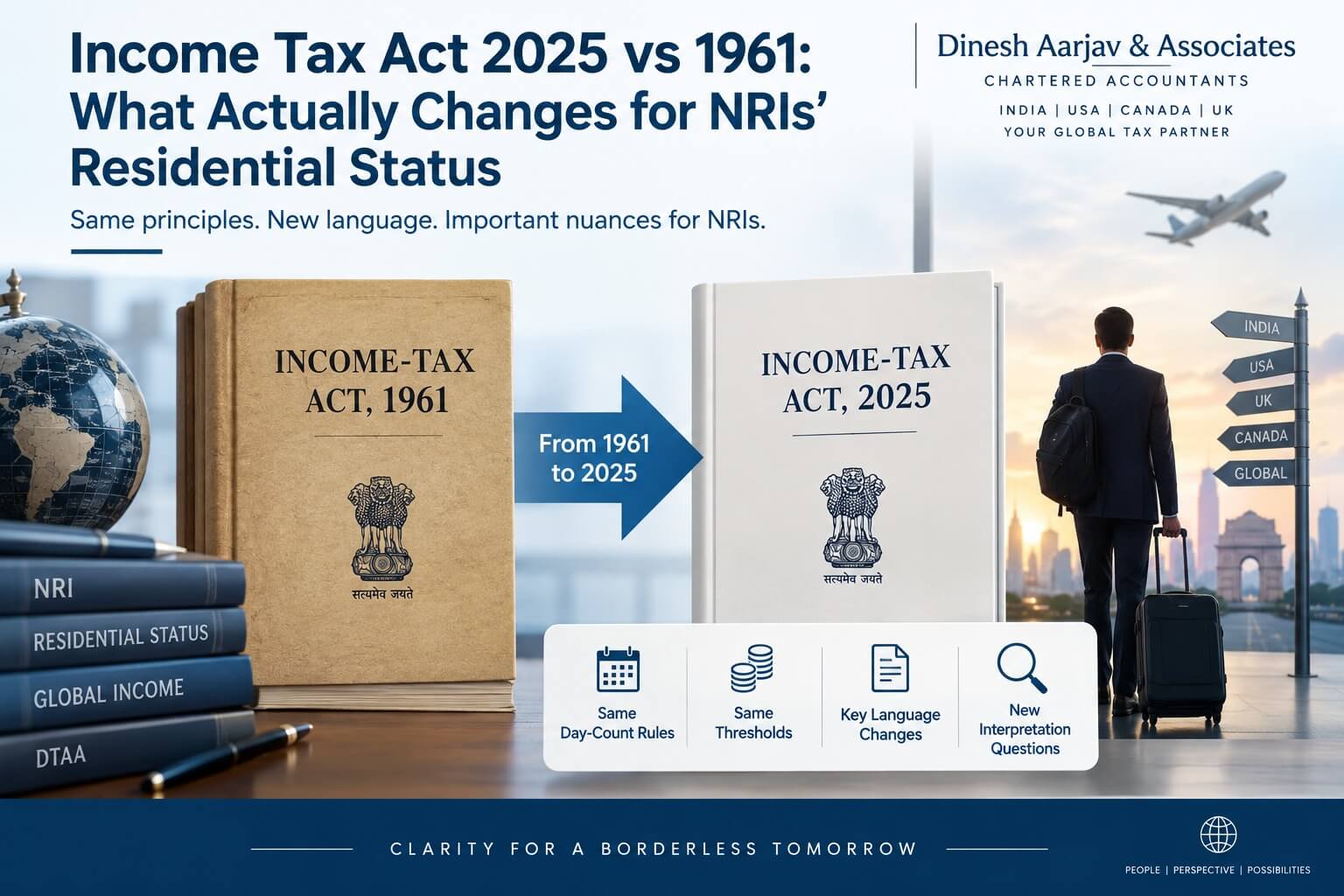
A practical note for anyone planning a sale in 2026: the Income-tax Act, 1961 has been replaced by the Income-tax Act, 2025, effective from 1 April 2026, and the provisions on capital assets, capital gains and TDS on property sales now sit under renumbered sections of the new law. The underlying rural/urban distinction is intended to carry through, but we'd always recommend confirming the current section references and any CBDT clarifications before relying on this for a live transaction rather than treating pre-2026 section numbers as still current.
Repatriation: Once tax is settled, sale proceeds from inherited property (including agricultural land sold to an eligible resident buyer) can generally be repatriated up to USD 1 million per financial year from the NRO account, subject to submission of Form 15CA/15CB and proof that all applicable taxes have been paid.
This Act is relevant here because agricultural land restrictions sometimes tempt NRIs toward workarounds buying in a resident relative's or friend's name while funding it themselves. That structure is a benami transaction, and it's prohibited except in narrow exceptions such as property held for the immediate benefit of a spouse or child, funded through disclosed, traceable sources. Violations carry confiscation of the property and, in serious cases, imprisonment; this isn't a paperwork technicality, it's a criminal-law exposure.
Agricultural land is one of the few asset classes where an NRI's options are genuinely narrower than a resident's and where the state and central rules operate as two separate filters, not one. Understanding how NRIs can buy agricultural land in India is important because inheritance remains the practical route for most NRIs; a fresh purchase is possible only in narrow, well-documented circumstances. Before you sign anything or list an inherited parcel for sale, it's worth having the FEMA position, the state land-law position, and the tax classification checked together, since getting any one of the three wrong can undo the other two.
Dinesh Aarjav & Associates provides NRI advisory services and advises NRIs on the full compliance chain for agricultural land from RBI permission applications and inheritance reporting to structuring a compliant sale and repatriation. Connect with our team before your next step so your documentation holds up if it's ever questioned.
Aarjav Jain is the Executive Director at Dinesh Aarjav & Associates, specializing in India–US cross-border transactions, NRI taxation, international tax advisory, and global investment structuring. With over 10 years of experience in project financing and cross-border advisory, he assists NRIs and businesses with regulatory compliance, repatriation planning, and international transaction structuring.






Stay in the loop, subscribe to our newsletter and unlock a world of exclusive updates, insights, and offers delivered straight to your inbox.

.webp)