WhatsApp
 Call Us
 Email Us
 Whatsapp Community

Would you like to schedule a call back


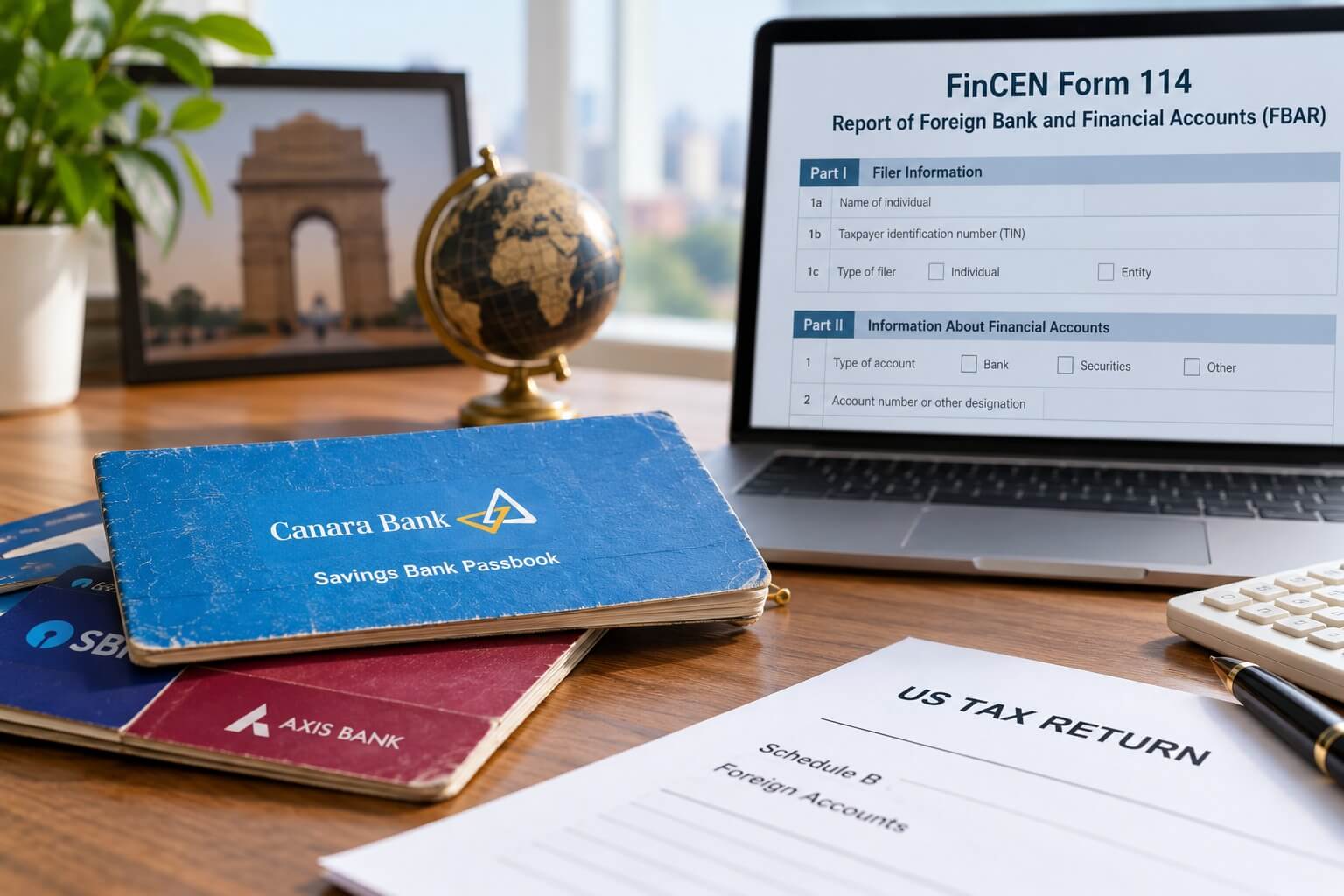


Yes, forgotten Indian bank accounts usually still go on your FBAR. If you own an Indian account (or can sign on it) and it held any money during the year, it counts. It doesn't matter if it's inoperative, untouched for years, or closed partway through the year.
Let's start with a real-life example, because this comes up all the time.
A client in Austin called us last week, a little panicked. While visiting home, she found an old Canara Bank passbook in her mom's cupboard. The account was in both their names. They'd opened it in 2011 so her mom could deposit rent, and nobody had used it since 2022. Her question was simple: "Is this going to be a problem with the IRS?"
The honest answer? It depends far less on whether the account is being used and much more on what it was worth during the year. The US cares about ownership and value, not about when you last logged in.
Timing matters too. FBARs for calendar year 2025 are due by 15 October 2026 with the automatic extension. Below, we'll walk through how idle and closed Indian accounts fit into FinCEN Form 114, the Indian-side issues hiding underneath most of these cases, and how to fix past years in the right order. If you need the basics first (who files and which accounts count), our FBAR filing guide for NRIs covers that.
Here's the whole thing in a nutshell, so you can see where we're heading.
Not using an account doesn't take it off the FBAR. If an Indian account you own or can sign on held any money during the calendar year, its highest value that year goes into the $10,000 total. If you end up filing, you list it. An account closed during the year still belongs in that year's report. Only an account that sat at zero for all twelve months adds nothing to the total. And separately, Schedule B of your Form 1040 asks about foreign accounts with no minimum value at all.
Yes, it does. "I haven't touched it in years" sadly isn't an exemption.
The FBAR really only asks two questions:
Notice that neither question mentions activity. You can own an account you never use, and ownership is what triggers reporting.
Words like "dormant", "inoperative" or "frozen" come from Indian banking rules. They tell the bank how to treat the account internally, like asking for fresh KYC before you can withdraw. They mean nothing under the Bank Secrecy Act, which is the US law behind the FBAR.
So if your bank sends a letter saying your account is inoperative, read it as "please update your KYC." It says nothing about your US filing.
It helps to know how RBI rules handle an account that's been left alone. Each stage raises slightly different questions on the US side.
| Stage | What RBI says | What it means for you | US reporting |
|---|---|---|---|
| Inoperative | No customer transaction for 2+ years (bank interest and charges don't count) | You'll need fresh KYC to withdraw. Interest keeps getting added. | No change. Report it at its peak value. |
| Matured but uncollected | An FD or FCNR deposit matures and isn't renewed or paid out | Banks usually pay savings-rate interest (or the contract rate, if lower) | Still your deposit. Report it. |
| Unclaimed, moved to DEA Fund | Untouched for 10 years, so the bank moves it to RBI's Depositor Education and Awareness Fund | Not lost. You or your legal heir can claim it anytime through the bank. | No official guidance. We take a cautious view (more below). |
| Closed | You closed it, or the bank did at your request | Nothing left to manage once you get the money | Reported for the year it closed, then drops off |
Before you even think about the FBAR, look at the interest. In our experience, that's usually the bigger issue with forgotten Indian bank accounts.
An idle NRO savings account, an FD that keeps auto-renewing, or a matured FCNR deposit sitting on the bank's books all keep earning. If you're a US tax resident, that interest is taxable in the year it's credited. It should show up on Schedule B of your Form 1040.
On NRO interest, the Indian bank deducts TDS at 30% plus surcharge and cess. This now falls under Section 393 of the Income-tax Act, 2025, which replaced Section 195.
Here's the catch:
Our India-US DTAA guide walks through how all this fits together.
NRE and FCNR interest is tax-free in India. That's exactly why people forget it. The US gives no such break, so an untouched NRE deposit can quietly create taxable US income year after year, with no Indian tax to offset it.
We bring this up first for a practical reason. Whether you reported this interest decides which IRS fix is open to you. Get it wrong, and a simple late FBAR can turn into a much harder conversation.
Now for the math. It's simpler than it looks once you know the rules.
For each foreign account:
Year-end balances don't matter here. Neither does India's April to March financial year.
Meera has a Green Card and lives in Texas. Here's what she held in India during 2025. We're using ₹88 to the dollar just to keep the example simple.
| Account | Situation | Peak in 2025 | In USD |
|---|---|---|---|
| Canara Bank NRO savings (joint with mom) | Inoperative since 2022, interest still credited | ₹2,64,000 | $3,000 |
| SBI FCNR(B) deposit | Matured in 2023, never collected | USD 2,800 | $2,800 |
| ICICI NRE savings | Closed August 2025 after moving funds to the US | ₹4,40,000 | $5,000 |
| Total | $10,800 |
Meera is over the line, so she files and reports all three. What makes this example useful is how easy it would've been to talk herself out of each one:
One more thing that surprises people. If money moved from one foreign account into another foreign account before reaching the US, it shows up in both accounts' peaks. The FBAR doesn't cancel out transfers between your own accounts. Overstating the total this way isn't an error. Dropping an account to avoid it would be.
It all comes down to the calendar year. If you held the account on any day in 2025, it goes on your 2025 FBAR, valued at its peak up to the closing date. From 2026 on, it disappears.
An account you closed in 2023 has nothing to do with 2025. But it still matters for any earlier year you haven't reported yet.
FinCEN Form 114 doesn't ask you to flag an account as closed. You just list it with its maximum value like any other.
Form 8938, if you also need to file it, does have a box for accounts closed during the year. Make sure the two forms line up so they don't look like they contradict each other.
Here's a warning we give everyone who wants to "clean up" before calling us. Closing an account today doesn't fix unfiled years when it was open. The IRS can assess a civil FBAR penalty for up to six years after the original due date.
What closing does do is make the bank harder to deal with when you need old statements later. So collect the statements first, then decide what to close.
Real life is messier than the rules, so here are the cases that come up most often.
If it sat at zero from January to December, it adds nothing to the threshold. But this group is smaller than you'd think, because even a few rupees of interest give the account a positive peak.
If you're filing anyway, we still list zero-balance accounts with a value of zero. FinCEN accepts that, and a complete list is easier to defend than a picky one.
Lots of people now find old deposits through RBI's UDGAM portal, which searches unclaimed balances across participating banks. So if the money's already gone to the DEA Fund, is it still a reportable account?
Honestly, neither FinCEN nor the IRS has said. What we do know is that your right to the money survives. You claim it through the original bank, which pays you and gets reimbursed by RBI. The account can even be revived after KYC.
Because of that, our view is to report the deposit at its last known value once you know about it, until it's claimed or closed. The extra line costs you nothing. Leaving out something you knew about is a lot harder to explain later. The cleanest fix? Claim the money and close the account.
Accounts often go quiet after a parent dies, simply because nobody's using them.
An inheritance of more than $100,000 in a year from a non-US person also brings in Form 3520. Indian family trusts raise their own questions, covered in our Form 3520-A guide.
Banks usually want updated KYC before they'll release statements for an inoperative account. The good news is that many now offer Video-KYC or let you update at any branch.
If you truly can't get the records, FinCEN allows a reasonable estimate of the maximum value. Write down how you worked it out and keep that note with your records.
The right fix depends mostly on one question: was all the income from these accounts already on your US returns?
| Your situation | Route | What you file | Penalty |
|---|---|---|---|
| All interest reported, just no FBARs, no IRS contact | Delinquent FBAR Submission Procedures | Late FBARs with a short explanation | IRS says no penalty if you qualify |
| Interest left off returns, not willful, living in the US | Streamlined Domestic Offshore Procedures | 3 years of amended returns, 6 years of FBARs, signed certification | 5% of the highest year-end total |
| Same as above, but you meet the non-residency test | Streamlined Foreign Offshore Procedures | 3 years of returns, 6 years of FBARs, certification | No offshore penalty |
| Facts suggest it may have been willful | IRS Criminal Investigation Voluntary Disclosure Practice | Full disclosure, ideally through tax counsel | Significant. Get legal advice first. |
People rush to file late FBARs through the Delinquent route without checking whether those idle accounts earned unreported interest. That route assumes your income reporting was already complete.
If it wasn't, you end up disclosing the accounts without the protection the Streamlined procedures were built to give you. So sort out the income question first.
Lots of NRIs who return to India leave a US checking account open for subscriptions, or just forget about an old savings account. Once you're Resident and Ordinarily Resident (ROR), those US accounts need to go in Schedule FA of your Indian income tax return.
Here's how Schedule FA works:
Skipping it can lead to a ₹10 lakh penalty under the Black Money Act. Under recent amendments, that penalty doesn't apply if your foreign assets (other than property) stay within ₹20 lakh in total.
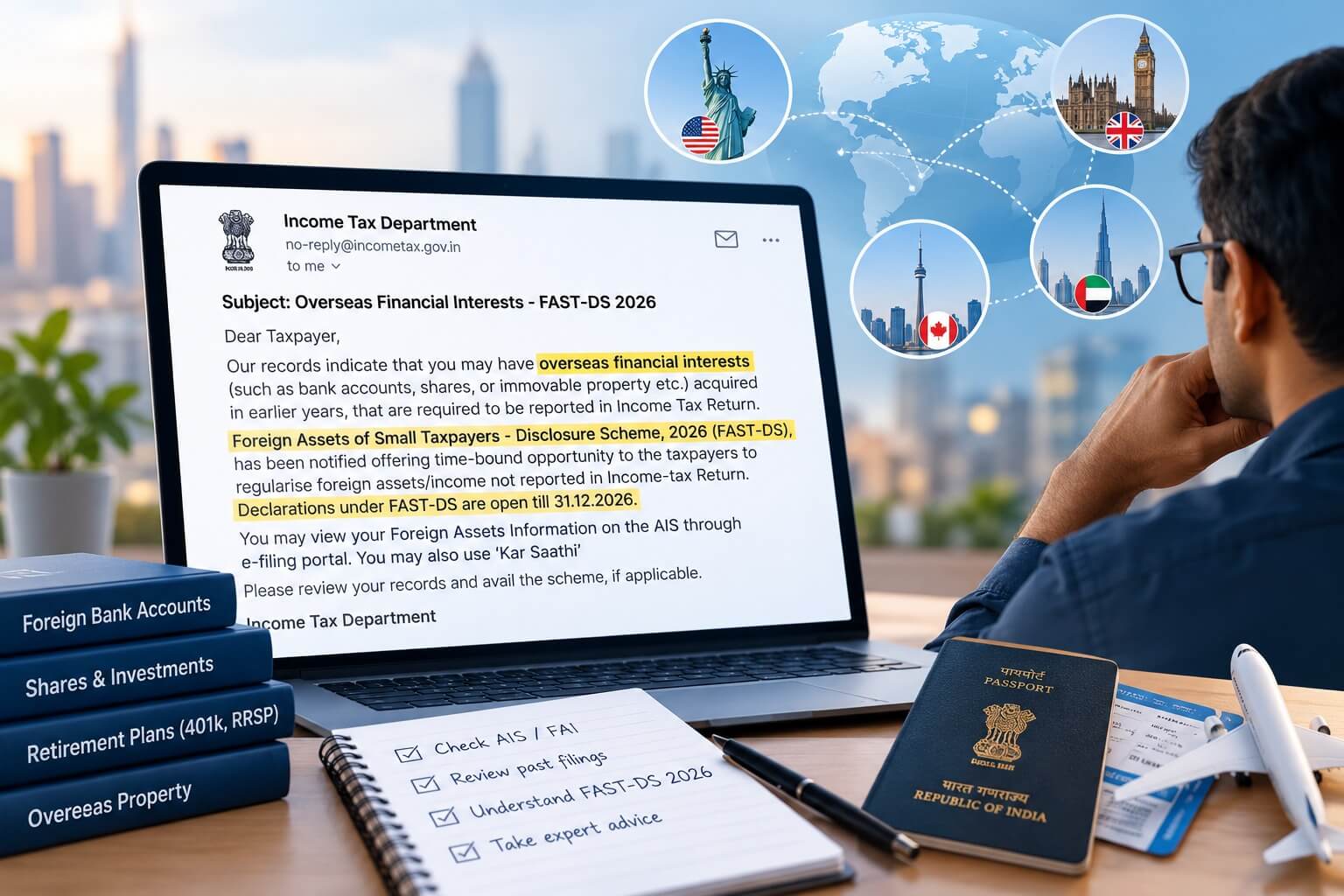
The Income Tax Department is also now writing to residents based on information it gets from abroad. If you've received one of these, see our explainer on the Income Tax "Overseas Financial Interests" email.
Here's everything side by side, so you can see which form wants what.
| Form | Who files | Period | Idle account | Closed during the year |
|---|---|---|---|---|
| FBAR (FinCEN Form 114) | US persons with foreign accounts over $10,000 combined | Calendar year | Report at peak value | Report it. No closure box. |
| Form 8938 (FATCA) | Single US residents over $50,000 at year end or $75,000 anytime (higher for joint filers and those abroad) | US tax year | Report at maximum value | Report it. Tick the closure box. |
| Schedule B, Part III | Any US taxpayer with a foreign account or signing authority | US tax year | Answer "Yes" at any value | Answer "Yes" for that year |
| Schedule FA (Indian ITR) | Indian residents who are ROR with foreign assets | Calendar year | Peak, closing balance, income | Report with zero closing balance |
Grab a coffee and go through these for every year you're unsure about. Any "I don't know" answer is the thing to chase first.
Most cases involving forgotten Indian bank accounts are pretty straightforward when you handle them in the right order: find the accounts, work out the interest, pick the right route, then file. They only get expensive when that order gets flipped.
At Dinesh Aarjav & Associates, our Chartered Accountants, US CPAs and Enrolled Agents handle both sides. We reactivate and close Indian accounts, reclaim extra TDS, and prepare current and past-year FBARs and returns under the right IRS procedure.
Check out our US Tax Returns for NRIs and Compliances & Disclosures services, or message us on WhatsApp to set up a review.
Disclaimer: This article shares general information based on rules in force in 2026 and isn't advice for any individual case. Penalty limits are adjusted for inflation every year, and the right correction route depends on your specific facts.
CA Sanyam Goel, CPA (USA), FCA, and CISA, specializes in India–US cross-border taxation, NRI tax advisory, US tax compliance, transfer pricing, and international regulatory matters. He assists clients with US and Indian tax obligations, cross-border reporting requirements, and strategic tax planning for global investments and transactions.




Stay in the loop, subscribe to our newsletter and unlock a world of exclusive updates, insights, and offers delivered straight to your inbox.

.webp)