WhatsApp
 Call Us
 Email Us
 Whatsapp Community

Would you like to schedule a call back


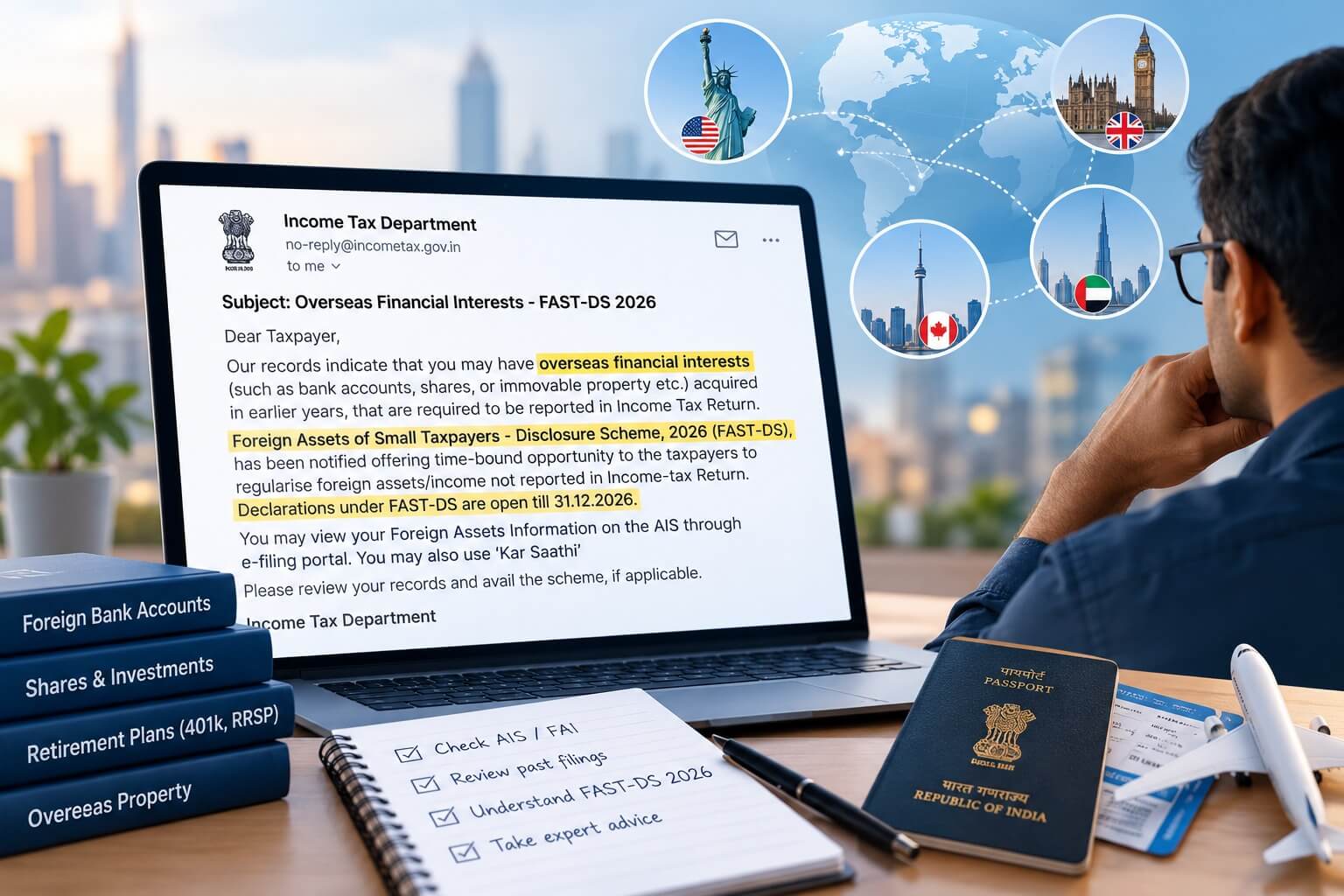


If you've received an email or SMS from the Income Tax Department saying its records show you "may have overseas financial interests," here's the short answer: it's a system-generated nudge based on foreign data shared with India, not a notice, not a penalty, and not proof of wrongdoing. It means the Department's data shows a foreign account, share holding or property linked to your PAN that doesn't match your filed returns, and it's pointing you to FAST-DS 2026 as the way to fix it before 31 December 2026.
This is the fifth post in our FAST-DS 2026 series. We've already covered eligibility, categories and valuation, AIS and FAI data, Form 1, and the overlap with ITR-U and the Black Money Act. This one exists because these emails are now landing in thousands of inboxes, including those of our own clients, and the panic they cause is usually out of proportion to what they actually are.
The message is individually addressed, carries your name and PAN, and is signed "Income Tax Department." Many taxpayers received it with the subject line "Important advisory: opportunity for voluntary compliance regarding FAST-DS, 2026."
The wording runs roughly like this:
"Our records indicate that you may have overseas financial interests (such as bank accounts, shares, immovable property etc.) acquired in earlier years that are required to be reported in the Income Tax Return. If your overseas financial interests (assets/income) have been left unreported in your earlier Income Tax Returns or have been acquired through undisclosed sources, we encourage you to utilise the ongoing, one-time compliance window under FAST-DS. This dedicated window is open till 31.12.2026. Also, you may view your Foreign Assets Information on the AIS through the e-filing portal."
Some versions also point you to "Kar Saathi" on the portal for help with forms and procedures.
It's genuine in most cases, but you should still verify it yourself rather than trusting the message. The Department has confirmed it is sending these communications to nudge taxpayers toward FAST-DS 2026, and officials have described them as system-generated.
Here's how to check safely:
If the FAI section shows foreign account or asset data, the communication is real and tied to actual information the Department has received.
This is a data match, not a human officer reviewing your file. India receives foreign account and asset details from partner countries under Automatic Exchange of Information (AEOI) and CRS arrangements. That data now flows into the Foreign Assets Information section of your AIS.
When the Department's data shows something abroad linked to your PAN that isn't reflected in your Schedule FA, the system sends this outreach.
| It is NOT | It IS |
|---|---|
| A notice under Section 148 | A PAN-linked data mismatch alert |
| An assessment order | A pointer to the FAST-DS 2026 window |
| A penalty demand | Evidence the Department already holds foreign data on you |
| Proof of prosecution or investigation | An invitation to fix things on your own terms |
So take it seriously, but don't panic. The tone is soft for a reason: the Department is asking you to check, classify and decide.
Returning NRIs are hit hardest because the timeline of their lives lines up perfectly with the AEOI data trail. The account, brokerage holding, pension or property was opened while you lived abroad, and that's exactly when the reporting trail starts overseas.
The compliance gap opens after you move back. The asset was always legitimate. But once you become a Resident and Ordinarily Resident (ROR), it must start appearing in Schedule FA, and that's the step people miss.
Typical triggers we see:
That last one matters. Many salaried employees at tech firms, startups and Indian arms of foreign companies hold RSUs or ESOPs of an overseas parent. Those are foreign assets. Even if you never sold them and made no gain, they belonged in Schedule FA.
The language is deliberately mild. Here's what each phrase really signals.
| What it says | What it actually means |
|---|---|
| "Our records indicate you may have overseas financial interests" | AEOI/CRS data from a partner country shows an asset linked to your PAN that isn't clearly matched in your returns. |
| "acquired in earlier years" | The data may relate to any past year, including years before you became a resident again. |
| "required to be reported in Income Tax Return" | This is a Schedule FA and Schedule FSI duty for ROR taxpayers, not for NRIs or RNORs in that year. |
| "acquired through undisclosed sources" | A conditional phrase covering Category 1 cases. It is not an accusation against you specifically. |
| "one-time compliance window" | FAST-DS 2026, with capped costs and immunity, instead of default Black Money Act treatment. |
| "open till 31.12.2026" | A hard deadline. It doesn't stretch just because the email reached you late. |
| "view your Foreign Assets Information on the AIS" | Useful, but partial. It shows only what partner countries have reported so far. |
| "Kar Saathi for assistance" | A self-service tool for forms and procedures, not advice on which category fits your facts. |
| "avail the scheme, if applicable" | The Department is leaving the classification call to you, which is where mistakes get expensive. |
Not automatically. The ₹1 lakh figure is the disclosure fee under Category 2 of FAST-DS, and it applies only if you actually need the scheme and fall in that category.
Here's the structure in plain terms.
| Category | What it covers | Value cap | What you pay |
|---|---|---|---|
| Category 1 | Foreign income or assets never offered to tax, or from undisclosed sources | Up to ₹1 crore | 30% of fair market value or undisclosed income as tax, plus 30% as additional tax in lieu of penalty |
| Category 2 | Asset already taxed, or acquired while you were a non-resident, but not declared in Schedule FA | Up to ₹5 crore | Flat ₹1 lakh disclosure fee |
Most returning NRIs with clean, legitimate assets fall into Category 2. The asset was earned abroad with taxed money. The only failure was the reporting line in the return.
And before you assume you need the scheme at all, check the small-asset relief. A proviso to Section 43 of the Black Money Act already removes the penalty for certain small non-immovable foreign assets: up to ₹20 lakh in aggregate, with a ₹10 lakh threshold for bank accounts under the pre-October-2024 rule. A dormant student account with a zero balance may well sit inside that relief.
No. A declaration under FAST-DS is a disclosure, not a confession of evasion, and it doesn't reopen your earlier assessments or brand you a defaulter.
That's the point of the scheme. It gives immunity for the declared asset instead of leaving it to be found later and assessed under default rules. Category 2 in particular is built for people whose assets were always clean and whose only lapse was a missing schedule.
Be concerned enough to act promptly. Not alarmed enough to panic.
If you ignore this and the asset is later treated as undisclosed, the Black Money Act's default terms apply: tax at 30%, penalty up to 300% of that tax (roughly 120% total exposure), and prosecution risk of three to ten years.
Against that, a properly classified Category 2 case can close for a flat ₹1 lakh with full immunity. The email is effectively an invitation to take the cheaper, calmer road while it's still open.
Work through these steps in order. Don't skip to filing.
This is the most common practical hurdle, especially for dormant or closed accounts. Start by emailing the foreign bank's customer service with your old account number and asking for a historical statement or closure certificate. Many banks retain records for seven to ten years.
If the account is fully purged and nothing can be retrieved, reconstruct what you can from old emails, salary records, remittance receipts and your own contemporaneous notes, and document your attempts to obtain the records. A reasoned, evidenced estimate is far better than silence.
The biggest error is treating the email as low-stakes because it's phrased so gently. Phrases like "you may have" and "if applicable" are standard for an automated nudge. They say nothing about how serious your underlying position is.
The opposite mistake is just as costly:
Keep these in front of you. The window is short and fixed.
| Milestone | Date |
|---|---|
| FAST-DS 2026 declaration window opened | 16 August 2026 |
| Valuation date for all foreign assets and income | 31 March 2026 |
| Last date to file Form 1 (declaration) | 31 December 2026 |
| If you miss the window | Full Black Money Act exposure applies if the asset is later found undisclosed: 30% tax, penalty up to 300%, possible prosecution |
If this email has landed in your inbox, the most useful next step isn't Kar Saathi or a generic FAQ. It's a proper review of your foreign-asset history against the scheme's rules by people who handle returning NRI tax compliance every day.
As part of our NRI Returning to India advisory, we reconstruct your residential status year by year, trace each foreign asset back to its source, apply the valuation method correctly, and determine whether (and under which category) FAST-DS 2026 applies to you before anything is filed.
Want a straightforward, no-obligation review of what this email means for your situation? Our NRI & OCI Services team can walk through it with you.
Aarjav Jain is the Executive Director at Dinesh Aarjav & Associates, specializing in India–US cross-border transactions, NRI taxation, international tax advisory, and global investment structuring. With over 10 years of experience in project financing and cross-border advisory, he assists NRIs and businesses with regulatory compliance, repatriation planning, and international transaction structuring.





Stay in the loop, subscribe to our newsletter and unlock a world of exclusive updates, insights, and offers delivered straight to your inbox.

.webp)