WhatsApp
 Call Us
 Email Us
 Whatsapp Community

Would you like to schedule a call back


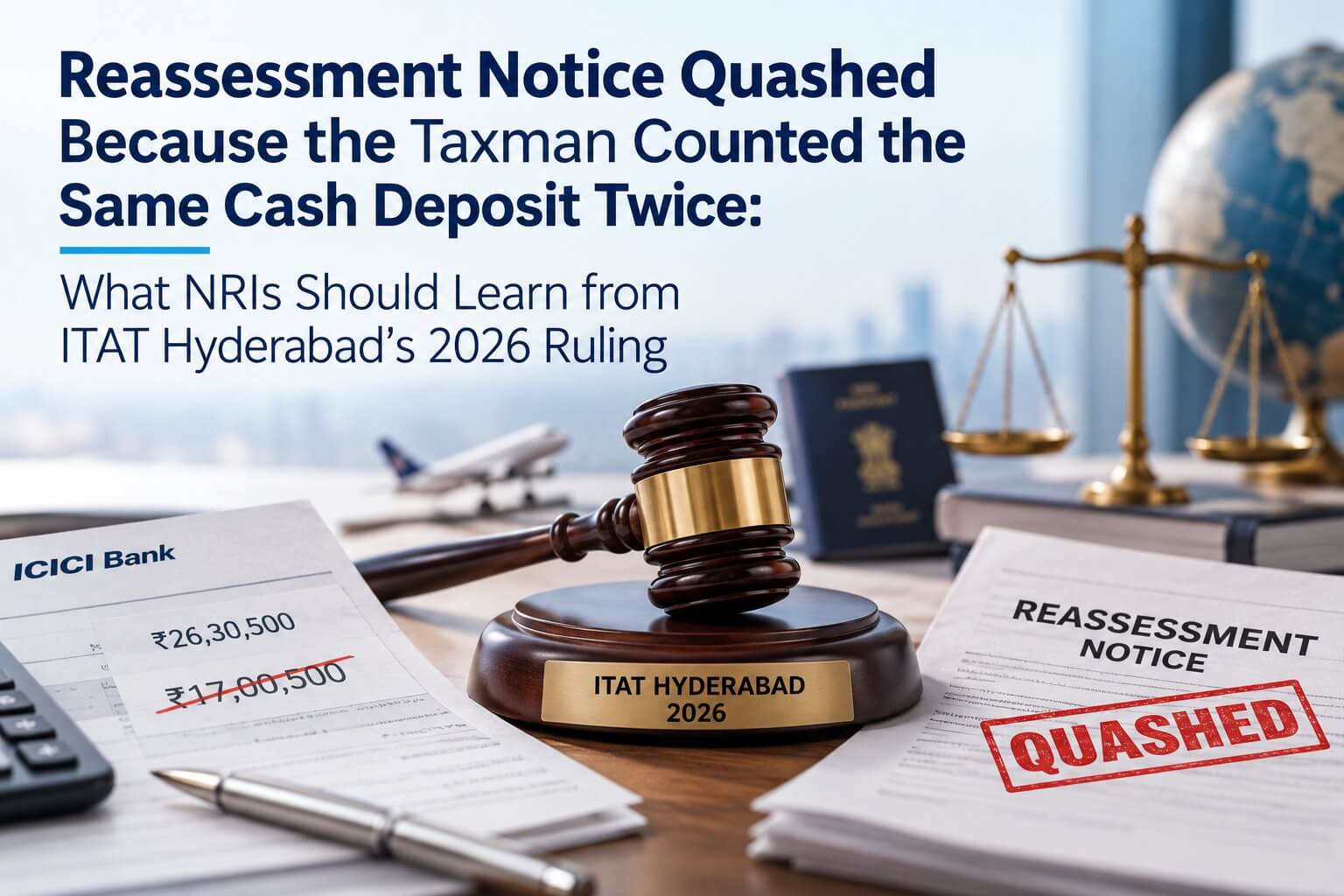


An NRI reassessment notice can be thrown out if the taxman reached the ₹50 lakh threshold by counting the same cash deposit twice. That's exactly what the ITAT Hyderabad ruling in 2026 decided in *Radhakishan Potharajula v. ITO (International Taxation)-2* (ITA No. 2340/Hyd/2025, AY 2016-17, order dated 16 October 2026). Once the duplicate ₹17,00,500 was removed, the escaped income dropped to ₹40,56,735. That's below ₹50 lakh, so the notice was time-barred under Section 149 of the Income Tax Act.
Most reassessment fights are about the merits. Was the cash from farming? Was it a loan repayment? This one never got that far. Let's walk through what happened and what you can take from it.
In short, the Tribunal held that a reassessment notice for an old year is only valid if the ₹50 lakh threshold is met with real numbers. Here's the case at a glance.
| Particular | Details |
|---|---|
| Case | Shri Radhakishan Potharajula v. ITO (International Taxation)-2, Hyderabad |
| Forum | ITAT Hyderabad 'A' Bench (Vijay Pal Rao, VP; Madhusudan Sawdia, AM) |
| Appeal number | ITA No. 2340/Hyd/2025 |
| Assessment year | 2016-17 |
| Pronounced on | 16 October 2026 |
| Addition in dispute | ₹21,80,500 under Section 69A (unexplained cash deposits) |
| Issue | Was the Section 148 notice dated 27.03.2023 barred by limitation under Section 149? |
| Result | Appeal allowed, notice held time-barred, reassessment quashed |
The assessee was a non-resident Indian who hadn't filed a return for AY 2016-17. The AO had information about cash deposits, so on 27 March 2023 he passed an order under Section 148A(d) and issued a Section 148 notice. That was just days before the outer deadline. The order put escaped income at ₹57,57,235.
The assessee then filed a return showing ₹5,26,235. Since this was a non-resident case, it went through the Section 144C draft order route. The AO proposed an addition of ₹21,80,500 under Section 69A.
No objections were filed before the DRP. The final order of 6 May 2024 assessed total income at ₹27,06,740, and the CIT(A) upheld it.
Because without ₹50 lakh of escaped income, the notice was simply too late. The notice fell under the reassessment rules brought in by the Finance Act, 2021, as they stood before the September 2024 changes.
Here's how those rules worked for an old year like AY 2016-17:
| Test (notices issued 1 April 2021 to 31 August 2024) | Position for AY 2016-17 |
|---|---|
| Three-year limit, Section 149(1)(a) | Expired 31 March 2020 |
| Extended limit, Section 149(1)(b) | Only if escaped income was ₹50 lakh or more |
| Outer cap under the first proviso | 31 March 2023 |
| Notice actually issued | 27 March 2023 |
So the notice only survived if escaped income cleared ₹50 lakh. On paper, ₹57.57 lakh did. The real question was whether that number held up.
The AO's own papers listed the same bank deposits twice, and that pushed the figure over the line. The 148A(d) order showed two separate cash deposit entries in the assessee's ICICI Bank account: ₹26,30,500 and ₹17,00,500. But the assessee had just one ICICI account. And the AO's own assessment order (paragraph 4) said total cash deposits in that account for the year were ₹26,30,500.
That meant the ₹17 lakh entry could only be part of the same total, picked up a second time. Take it out and ₹57,57,235 becomes ₹40,56,735. The extended window disappears, the three-year window closed long ago, and the notice has nothing to stand on.
Here's the neat part. The assessee needed no outside evidence. The argument came entirely from the AO's own documents, read side by side. The Department can't easily argue with its own record.
The Department said it had information of ₹57.57 lakh escaping tax when the notice went out, and that it issued the notice before 31 March 2023. The Tribunal said no, for three reasons.
The amount used to trigger the extended period has to be checked against the material behind it. A figure with a clearly duplicate entry can't give the AO power just because it was written down.
For the sake of testing jurisdiction, the Tribunal accepted every other part of the AO's computation. The total still fell short of ₹50 lakh. The same deposits can't be counted twice to cross the line.
Issuing the notice before 31 March 2023 doesn't help if the money condition in Section 149(1)(b) isn't met. A valid, timely notice is a must-have for reassessment. Without it, the AO never properly got jurisdiction.
One detail matters here. The Tribunal rested its decision on the duplication visible in the documents used to work out escaped income. It did not rely on the smaller ₹21.80 lakh finally added. Some benches have tested the threshold against the income finally assessed. This ruling doesn't need that argument, so it's harder for the Department to distinguish.
The Tribunal didn't touch the merits, including the claim that the deposits came from agricultural income. Once the notice fell on limitation, those grounds became academic.
The assessee also argued that no Section 127 order moved the case from Karimnagar to Adilabad, or from Adilabad to the International Taxation wing in Hyderabad. The Tribunal admitted those grounds but didn't rule on them. If the facts support it, that jurisdiction point is still very much open for NRIs to raise.
Start by checking the numbers, because NRIs are often caught by cash-deposit reopenings. Many don't file Indian returns because they think nothing is taxable, while family members run the accounts locally. Years later, bank reporting flags the deposits, and the notice reaches you thousands of kilometres away.
Here's what to take from this ruling.
Don't accept the escaped-income figure as one big number. Ask how it was built. In our experience, the same transaction can show up under more than one reporting code or entity in the AIS, and those entries sometimes get added together without anyone checking for overlap.
Your reply to the Section 148A(b) show-cause notice is the first and cheapest chance to flag duplication. If the AO ignores it, the 148A(d) order becomes a document you can rely on later, just as this assessee did.
For non-residents, jurisdiction usually sits with the International Taxation wing. If a ward officer issued the notice and the case was moved without a proper Section 127 order, there may be a separate challenge available.
This assessee skipped the DRP and still won on limitation. That won't always work. If the merits matter, the DRP route under Section 144C gives you a valuable second look before the final order.
The windows have changed twice since this notice was issued, so check which regime covers your notice date and year.
| Regime | Normal window | Extended window (escaped income ₹50 lakh or more) |
|---|---|---|
| Income-tax Act, 1961: notices from 1 April 2021 to 31 August 2024 | 3 years from end of the assessment year | Up to 10 years (capped by the first proviso for older years) |
| Income-tax Act, 1961: notices from 1 September 2024 (Finance (No. 2) Act, 2024) | 3 years 3 months from end of the assessment year | Up to 5 years 3 months |
| Income-tax Act, 2025 (in force from 1 April 2026; Sections 279 to 286) | 4 years 3 months from end of the tax year (Section 282) | Up to 6 years 3 months from end of the tax year |
The jump from three to four years under the 2025 Act is mostly a change in starting point. The new Act counts from the end of the tax year, while the 1961 Act counted from the end of the assessment year.
What hasn't changed is the logic. The ₹50 lakh threshold still separates the short window from the long one, so an honest computation matters just as much under the new law.
Work through these steps in order.
We regularly handle reassessment notices for NRIs and OCI cardholders, from the first 148A(b) reply through DRP, CIT(A) and ITAT. We start with the numbers: rebuilding the Department's computation, reconciling it against bank data and the AIS, and checking jurisdiction before we get to the merits.
Received a notice for an older year? Or do you hold Indian accounts that are being used without returns being filed? Reach out through our NRI & OCI Services page before your response deadline.
*Disclaimer: This article summarises a Tribunal order for general information and isn't legal or tax advice. Outcomes depend on the facts of each case. Please consult a qualified professional before acting.*
Ans: Yes, if the double counting is what pushed escaped income above ₹50 lakh and the notice came outside the normal window. In *Radhakishan Potharajula*, ITAT Hyderabad held that a duplicate entry can't be used to meet the Section 149(1)(b) threshold, and it quashed the reassessment.
Ans: For notices under the 2021 regime, the normal limit expired on 31 March 2020. The extended period, available only where escaped income was ₹50 lakh or more, ran until 31 March 2023 because of the first proviso to Section 149(1).
Ans: This ruling tested it against the underlying material, removing an entry the AO's own documents showed was duplicated. The Tribunal didn't rely on the smaller amount finally added, though other benches have also looked at income ultimately assessed.
Ans: Yes. The assessee here was a non-filer. Not filing doesn't remove the limitation protections in Section 149.
Ans: Yes. Section 282 of the 2025 Act keeps the ₹50 lakh threshold to separate the normal window from the extended one. Challenges based on an inflated computation are still relevant.
CA Dinesh K. Jain is the Founder and Mentor of Dinesh Aarjav & Associates, with over 35 years of experience in NRI taxation, cross-border advisory, project financing, and tax litigation. He has guided numerous NRIs and global families through complex tax and regulatory matters involving investments, repatriation, and international financial planning.





Stay in the loop, subscribe to our newsletter and unlock a world of exclusive updates, insights, and offers delivered straight to your inbox.

.webp)