WhatsApp
 Call Us
 Email Us
 Whatsapp Community

Would you like to schedule a call back


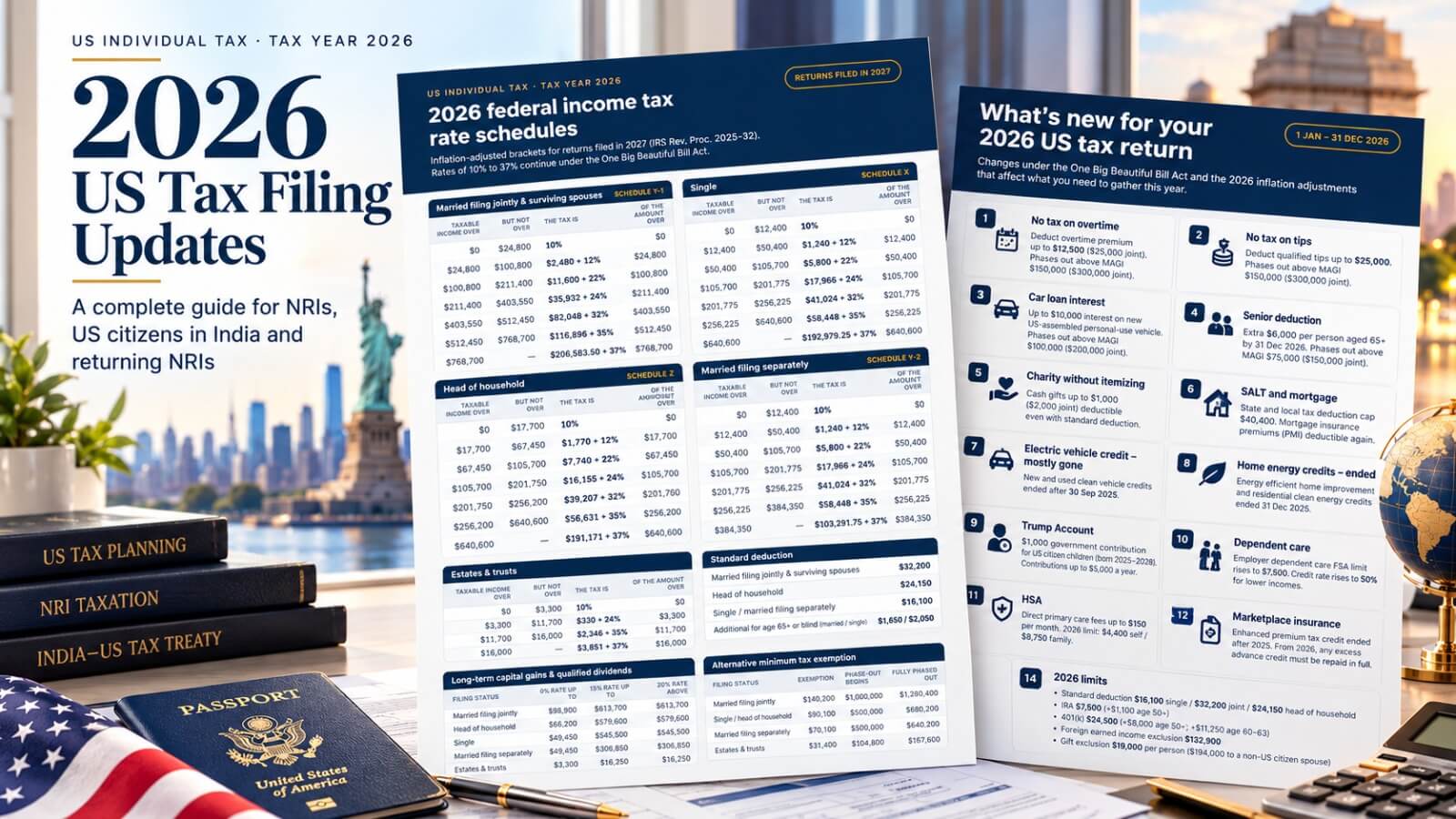


The biggest 2026 US tax filing updates for NRIs come from the One Big Beautiful Bill Act (OBBBA). It made the 10% to 37% brackets permanent, added new deductions, ended the EV and home energy credits, and put a 1% tax on cash sent abroad. This guide covers US citizens in India, returning NRIs, and US residents with money back home.
These changes sit on top of the India-specific rules you already know: FBAR, FATCA, PFIC reporting on Indian mutual funds, Form 3520 for gifts from parents, and the India-US tax treaty. We'll walk through the new numbers first, then what each type of India-connected taxpayer needs to file.
*Updated for tax year 2026 (returns filed in 2027). By the US tax team at Dinesh Aarjav & Associates.*
The 2026 US federal brackets run from 10% to 37%, and the IRS has adjusted every threshold for inflation. These figures come from IRS Rev. Proc. 2025-32 and apply to returns filed in 2027.
Here's the quick version for the three most common filing statuses.
| Rate | Single | Married filing jointly | Head of household |
|---|---|---|---|
| 10% | Up to $12,400 | Up to $24,800 | Up to $17,700 |
| 12% | $12,401 to $50,400 | $24,801 to $100,800 | $17,701 to $67,450 |
| 22% | $50,401 to $105,700 | $100,801 to $211,400 | $67,451 to $105,700 |
| 24% | $105,701 to $201,775 | $211,401 to $403,550 | $105,701 to $201,750 |
| 32% | $201,776 to $256,225 | $403,551 to $512,450 | $201,751 to $256,200 |
| 35% | $256,226 to $640,600 | $512,451 to $768,700 | $256,201 to $640,600 |
| 37% | Over $640,600 | Over $768,700 | Over $640,600 |
Numbers on a chart look simple. Add India into the mix and a few things change.
There are 14 changes that matter for 2026. Each one adds a deduction you have to prove, removes a credit you may have counted on, or changes a form you'll receive. Think of this list as your document checklist.
1. Other changes.
2. 2026 limits.
Two more OBBBA rules matter if you send money home or have family there.
You need to file a US federal return if you're a US person and your gross worldwide income is above the filing threshold. For 2026 that roughly matches the standard deduction: $16,100 single, $32,200 married filing jointly and $24,150 head of household. Self-employment income of $400 or more triggers filing by itself, and a married person filing separately has a threshold of just $5.
"US person" is wider than many people think. It includes:
Non-residents aren't off the hook either. If you live in India but earn US rent, sell US shares or own a US LLC, you still file Form 1040-NR on that US-source income.
| You are | Must you file a US return? | Typical forms beyond Form 1040 |
|---|---|---|
| US resident (H-1B, L-1, green card, citizen) with Indian investments | Yes, on worldwide income | FBAR, Form 8938, Form 8621, Form 1116, Form 3520 |
| US citizen or green card holder living in India | Yes, every year | Form 2555 or 1116, FBAR, Form 8938, Form 8621 |
| NRI who moved to the US this year | Usually, often dual-status | Form 1040 / 1040-NR, Form 8840 or first-year choice, FBAR |
| Returning NRI who left the US this year | Yes, final dual-status or full-year return | Form 1040 + 1040-NR statement, FBAR, retirement account reporting |
| Indian resident with only US-source income | Sometimes | Form 1040-NR, Form W-8BEN with brokers |
The short version: income goes on Form 1040, Indian accounts are disclosed on the FBAR and Form 8938, and Indian mutual funds, NPS and family trusts each trigger their own information returns. The treaty and the foreign tax credit usually stop double tax, but only if your return is built to claim them.
In practice, most people fall into one of four groups, and each has its own traps. Let's take them one at a time.
If you're a US resident with Indian accounts, you must report worldwide income and disclose your Indian assets. This is the biggest group we see: H-1B and L-1 professionals, green card holders and naturalised citizens who still hold NRO/NRE accounts, FDs, mutual funds, property or NPS. The tax itself is often modest. The disclosure burden is what catches people out.
Yes. NRE interest is tax-free in India, which is exactly why people forget it, but the US doesn't recognise that exemption. Interest on NRE, NRO and FCNR deposits is taxable on your US return. Report cumulative and reinvestment FDs as interest is credited, not at maturity. If India deducted TDS on NRO interest, you can usually claim it as a foreign tax credit on Form 1116.
Yes. Indian mutual funds are Passive Foreign Investment Companies (PFICs) under US law. Each fund generally needs its own Form 8621. Without a timely election, the default "excess distribution" regime taxes gains at the top ordinary rate plus an interest charge.
A SIP across six funds can mean six Form 8621s every year. For many clients we use the mark-to-market election from the first year it's available, which keeps tax predictable. We also plan exits around the RNOR window for those heading back to India.
Yes, if they're large. Money from parents isn't taxable income in the US, but receiving more than $100,000 in a year from a non-US individual (gifts and bequests together) requires Form 3520. Missing it can cost up to 25% of the gift. We file many of these for clients who inherit a parent's flat or get funds for a US home purchase.
This is where US rules are least settled. Many practitioners, including our team, treat NPS as a foreign trust needing Forms 3520 and 3520-A. EPF and PPF are looked at case by case for trust and FBAR reporting. An Indian private family trust where you're a beneficiary or grantor almost always brings in Form 3520-A. These are judgement calls, so a generic US preparer is usually the wrong fit.
Yes. The US taxes by citizenship, so moving to Bengaluru or Gurugram doesn't end your US filing. You file Form 1040 every year alongside your Indian ITR. The calendars differ too: India's year runs April to March, and the US year runs January to December. Splitting Form 16 salary and Indian TDS across two US years is one of the first things we fix for new clients.
You have two main tools to avoid double tax on Indian salary.
Indian rates at middle and higher incomes are often at or above US rates, so the credit frequently wins. Excess credit carries forward for 10 years. The FEIE covers only earned income, never FD interest, rent or capital gains, and it can cost you the refundable part of the child tax credit. We model both before filing.
In the year you arrive, you're usually a dual-status taxpayer: a non-resident until your residency start date and a resident after it. Only income from the resident period, plus US-source income before it, goes on the US return. It gets tricky because you're probably still an Indian resident that year, with salary, bonus or ESOPs from an Indian employer straddling both periods.
The cheapest option depends on your pre-move Indian income, your spouse's status, and whether either of you holds Indian mutual funds that would then need Form 8621. We run the numbers on all three.
F-1 students are generally "exempt individuals" for their first five calendar years. They file Form 1040-NR with Form 8843. Indian students get a handy extra: Article 21(2) of the India-US treaty lets them claim the standard deduction on Form 1040-NR, which students from most other countries can't. Many university tax packages don't apply it correctly.
The treaty's tie-breaker rules in Article 4 decide which country gets primary taxing rights. Claiming treaty residence in India while living in the US needs Form 8833 and can affect your FBAR and green card position. Don't tick that box casually.
Moving back to India is a two-country tax project, and the US side doesn't end when your flight lands. Your departure year is typically dual-status again, resident first and non-resident after your residency termination date. If you still hold a green card, you stay a US tax resident until you formally surrender it with Form I-407. Long-term holders (8 of the last 15 years) must also file Form 8854 and test for the exit tax.
We coordinate your final US return and first Indian ITRs as one job, so residency dates, exchange rates and credits match on both sides. Our guides on RNOR status for returning NRIs and 401(k) withdrawal for NRIs returning to India go deeper on the India side.
Every common Indian investment has a US income treatment and a separate disclosure treatment. You need both right.
| Indian asset | US income treatment | Usual US disclosure |
|---|---|---|
| Savings, NRO, NRE, FCNR accounts | Interest taxable yearly (NRE exemption ignored) | FBAR, Form 8938 |
| Fixed deposits (incl. cumulative) | Interest taxable as credited | FBAR, Form 8938 |
| Indian mutual funds, ETFs, ULIPs | PFIC rules: excess distribution or mark-to-market | Form 8621 per fund, Form 8938 |
| Listed Indian shares (demat) | Dividends and gains; treaty may give qualified rates | FBAR (demat), Form 8938 |
| Rental property in India | Schedule E with 30-year depreciation | Not on FBAR/8938 if held directly |
| Sale of Indian property | Gain in USD; Indian tax and TDS as credit | Form 1116 for the credit |
| NPS | Treated by many as a foreign trust | Forms 3520 and 3520-A, FBAR, Form 8938 |
| EPF and PPF | Case by case; accruals often reported | FBAR, Form 8938; trust analysis |
| Gifts or inheritance from Indian relatives | Not taxable income | Form 3520 if over $100,000 in a year |
| Indian private company or LLP stake | Possible CFC/GILTI or partnership rules | Form 5471 or 8865, Form 8938 |
| Indian family trust | Grantor or non-grantor trust rules | Forms 3520 and 3520-A |
Treatment of NPS, EPF and PPF isn't settled in IRS guidance. The table shows a conservative reporting position, and your own facts decide the final answer.
The FBAR and Form 8938 overlap, but they're separate filings with different thresholds and penalties. Most clients with Indian accounts file both.
| FBAR (FinCEN Form 114) | FATCA (Form 8938) | |
|---|---|---|
| Filed with | FinCEN, electronically | IRS, attached to Form 1040 |
| Threshold | Combined foreign balances over $10,000 at any point in the year | In the US: over $50,000 at year-end or $75,000 any time (single); $100,000 / $150,000 (joint). In India: $200,000 / $300,000 (single); $400,000 / $600,000 (joint) |
| Covers | Bank, demat, mutual fund folios, insurance with cash value, accounts with signing authority | Specified foreign financial assets, including direct foreign shares and foreign entity interests |
| Due date | 15 April, automatic extension to 15 October | With your tax return, including extensions |
| Penalty | Non-willful: over $16,000 per report (inflation-adjusted); willful: up to 50% of balance | $10,000, rising to $50,000 for continued failure |
Two India-specific traps come up all the time. A joint account with your parents counts at its full balance, not your share. And signing authority on a parent's or family business account is reportable even if none of the money is yours.
Indian banks and fund houses have reported US-person accounts to the IRS under the India-US FATCA agreement since 2015. The IRS can already see these accounts, whether or not you report them.
The main 2026 return is due on 15 April 2027. US persons living in India get an automatic extension to 15 June 2027. Interest still runs on unpaid tax from 15 April, whichever date you file by.
| Date | What's due | Who it applies to |
|---|---|---|
| 15 March 2027 | Form 3520-A (foreign trust, incl. NPS where treated as one) | Owners of foreign trusts |
| 15 April 2027 | Form 1040 / 1040-NR, FBAR, Form 3520, extension request (Form 4868) | US residents and citizens |
| 15 June 2027 | Automatic extended due date for Form 1040 | US citizens and green card holders living outside the US |
| 15 October 2027 | Extended Form 1040 deadline; FBAR automatic extension | Anyone who extended |
| 15 December 2027 | Further extension on request | Taxpayers abroad who asked by 15 October |
If you also have Indian income, keep the 31 July ITR deadline in view. The two returns feed each other through the foreign tax credit, so it helps to prepare them on one timetable.
The IRS Streamlined Filing Compliance Procedures are built for this. They apply if you missed FBARs, Form 8938, Form 8621 or whole US returns because of Indian accounts, as long as the failure was non-willful and the IRS hasn't contacted you first.
| Streamlined Foreign Offshore (SFOP) | Streamlined Domestic Offshore (SDOP) | |
|---|---|---|
| For | US citizens and green card holders living in India | US residents with unreported Indian accounts |
| Residency test | Outside the US 330+ days in at least one of the last 3 years | Did not meet the non-residency test |
| What you file | 3 years of returns + 6 years of FBARs + Form 14653 | 3 years of amended returns + 6 years of FBARs + Form 14654 |
| Penalty | None | 5% of the highest year-end value of foreign assets |
If the income was reported and only an information return was missed (a late Form 3520 or 8938, say), the delinquent FBAR or delinquent international information return procedures with a reasonable-cause statement can fit better. The costly mistake is picking the wrong programme, or certifying non-willfulness without a defensible story.
Most US preparers know the IRS but not the ITR, and most Indian CAs know the ITR but not the IRS. Cross-border families need one team that reads both. That's the gap our practice was built to fill.
Here's what we file for each type of taxpayer in 2026.
| Who you are | What we file for you |
|---|---|
| NRIs working in the US (H-1B, L-1, F-1, green card) | Form 1040 or dual-status return, new OBBBA deductions, FBAR, Form 8938, Form 8621, Form 3520 |
| US residents with Indian investments | NRE/NRO FDs, Indian shares, rental property, NPS (Forms 3520 / 3520-A), foreign tax credit on Indian TDS |
| US citizens and green card holders in India | Annual Form 1040, FEIE vs foreign tax credit modelling, FBAR, and your Indian ITR together |
| Returning NRIs | Final-year dual-status return, Form 8854, 401(k)/IRA withdrawal and RNOR planning, US home sale and RSU sourcing |
| Anyone behind on filings | Streamlined (SFOP / SDOP) packages, delinquent FBAR and information return submissions |
Ready to file your 2026 US tax return or catch up on past years? Book a consultation with our US-India tax team and get one coordinated plan for both countries.
CA Sanyam Goel, CPA (USA), FCA, and CISA, specializes in India–US cross-border taxation, NRI tax advisory, US tax compliance, transfer pricing, and international regulatory matters. He assists clients with US and Indian tax obligations, cross-border reporting requirements, and strategic tax planning for global investments and transactions.




Stay in the loop, subscribe to our newsletter and unlock a world of exclusive updates, insights, and offers delivered straight to your inbox.

.webp)