WhatsApp
 Call Us
 Email Us
 Whatsapp Community

Would you like to schedule a call back


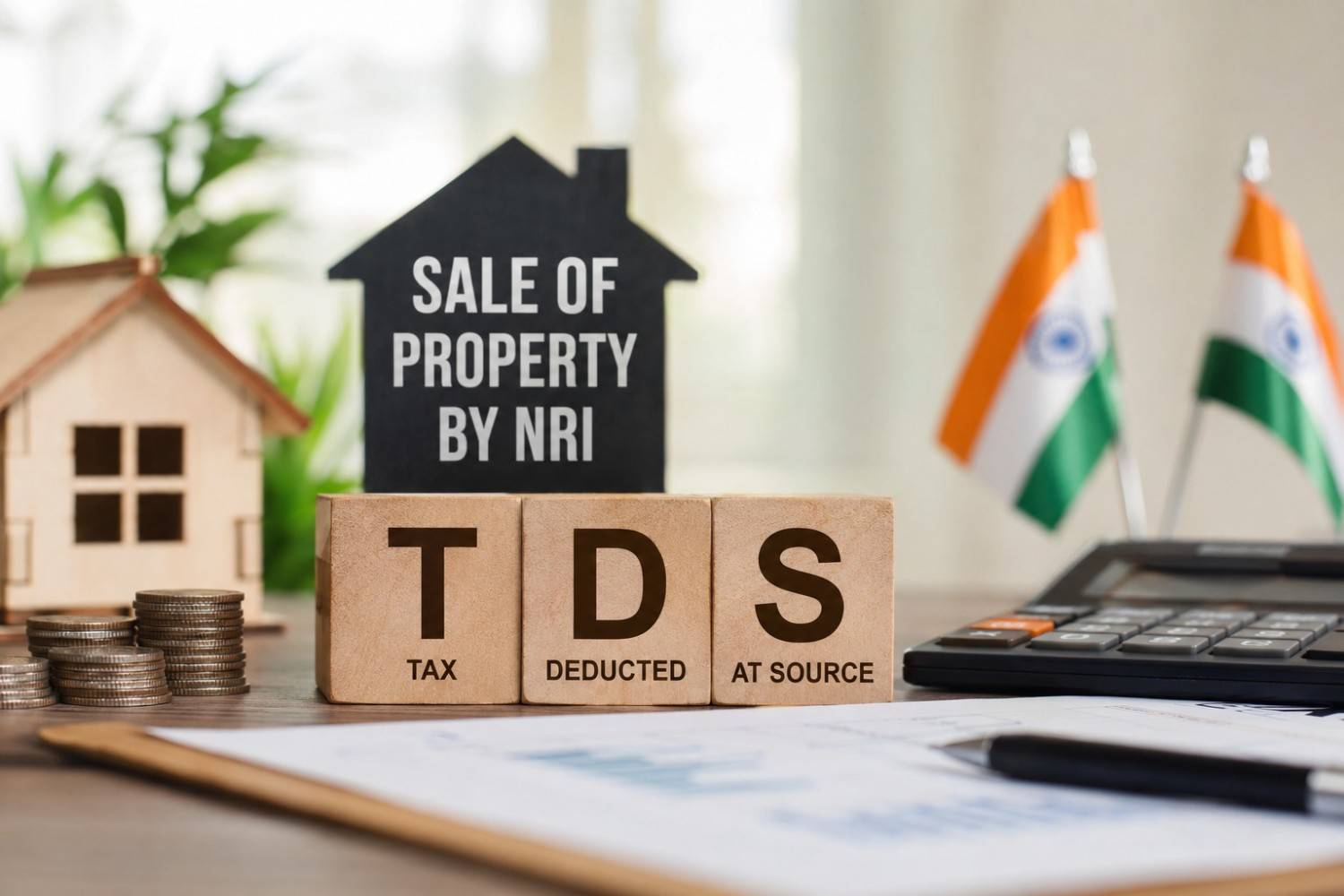


When an NRI sells property in India, TDS on sale of property by NRI is usually the first practical snag that comes up and it's often the one that catches sellers off guard. TDS rate on sale of property by NRI works nothing like TDS on a resident's sale: the rates are steeper, there's no value threshold below which it doesn't apply, and the buyer carries real legal exposure if the deduction is handled carelessly. With the Income Tax Act, 2025 in force from 1 April 2026, several of the section numbers and forms that practitioners and NRIs had grown used to have also changed.
This guide is built for three audiences: an NRI selling property in India, a resident buyer purchasing from an NRI, and an NRI still in the planning stage of a sale. It walks through the applicable TDS rates, Section 393 of the new Act, how long-term and short-term capital gains are treated differently, the newly introduced Form 128 for a Lower or Nil TDS Certificate, what buyers are on the hook for, and how FEMA and repatriation fit into the process. It also explains the NRI TDS rate on sale of property and the key compliance considerations buyers and sellers need to understand before completing the transaction.
Yes, FEMA and Indian tax law both permit it, and in practice we handle sales of residential flats, apartments, villas, commercial offices, shops and independent houses for NRI clients on a regular basis. What changes isn't the seller's right to sell; it's the tax machinery that switches on the moment the seller is non-resident.
TDS Tax Deducted at Source requires the buyer to withhold tax from the payment due to the seller and deposit it with the Income Tax Department before the seller ever receives the balance. Under Section 393(2) of the Income Tax Act, 2025, that obligation sits squarely with the buyer the moment the seller is an NRI.
What tends to surprise both sides of the transaction is that this deduction applies to every payment made to the NRI seller, regardless of the actual capital gain earned, the profit percentage, or what the seller intends to do with the money afterward. That's a real departure from how resident-seller deals work, and it's the main reason NRI property sales need to be planned differently from the outset.
No. Resident-seller transactions only attract TDS once the property value crosses ₹50 lakh, but that threshold doesn't exist when the seller is an NRI. Whether the deal is worth ₹5 lakh, ₹20 lakh or ₹45 lakh, TDS on sale of property by NRI under Section 393(2) still applies in full, and this is the one compliance point we see buyers miss more often than almost anything else.
When it comes to TDS on sale of property by NRI below 50 lakhs, the ₹50 lakh threshold applicable to certain resident-seller transactions does not provide the same relief. An NRI seller is generally subject to TDS requirements even when the property is sold for less than ₹50 lakh. For example, whether the property is sold for ₹10 lakh, ₹25 lakh or ₹45 lakh, the buyer must consider the applicable TDS provisions before making payment to the NRI. This makes early tax planning important for both parties.
Property Value → NRI Seller → TDS Applicable → Buyer Deducts TDS → Deposit & Compliance
Therefore, buyers should not assume that a transaction below ₹50 lakh is automatically exempt from TDS when purchasing property from an NRI.
The clearest way to see why NRI transactions need separate handling is to place the two side by side.
The TDS rate is a flat 1% of the sale consideration or the stamp duty value, whichever is higher, and it only applies once the property value touches ₹50 lakh. This falls under Section 393(1) of the Income Tax Act, 2025. The buyer doesn't need a TAN for this, and the tax is deposited using Form 141.
There's no minimum threshold at all, the governing provision is Section 393(2), and the applicable TDS rate isn't a flat figure; it depends on whether the gain qualifies as long-term or short-term capital gains.
If the NRI seller has held the property for more than 24 months, the gain is treated as long-term. Here's how the effective TDS rate builds up once surcharge and cess are added in.
| Particulars | Below ₹50L | ₹50L – ₹1Cr | ₹1Cr – ₹2Cr | ₹2Cr – ₹5Cr | Above ₹5Cr |
|---|---|---|---|---|---|
| Base TDS Rate | 12.50% | 12.50% | 12.50% | 12.50% | 12.50% |
| Surcharge | Nil | 10% | 15% | 15% | 15% |
| Health & Education Cess | 4% | 4% | 4% | 4% | 4% |
| Effective TDS Rate | 13% | 14.30% | 14.95% | 14.95% | 14.95% |
The ceiling to keep in mind: the maximum effective TDS rate on an NRI's property sale, once surcharge and cess are factored in, is 14.95%.
Property held for 24 months or less falls under short-term capital gains, which is taxed at the seller's applicable slab rate rather than a fixed percentage. In practice, most buyers don't know the NRI seller's overall taxable income, so they deduct conservatively typically 30%, plus applicable surcharge and cess to stay on the safe side.
This is one of the most-searched questions among NRIs, and the answer catches many by surprise: TDS is generally deducted on the entire sale consideration, not just on the capital gain itself.
| Particulars | Amount |
|---|---|
| Sale Consideration | ₹2 Crore |
| Actual Capital Gain | ₹15 Lakh |
| TDS May Still Apply On | ₹2 Crore |
The practical fallout is predictable excess deduction, cash flow getting locked up, delayed repatriation, and a large refund claim to chase afterward. This is exactly why applying for a Lower or Nil TDS Certificate is worth doing rather than skipping.
To avoid TDS being deducted on the full sale value instead of the actual gain, NRIs can apply for a Lower or Nil TDS Certificate under Section 395(1) of the Income Tax Act, 2025. In our experience, this is one of the most valuable NRI tax planning steps available before a sale goes through.
One of the more consequential procedural changes under the new Act: the old Form 13 application has been replaced by Form 128, effective 1 April 2026. Any application for a Lower or Nil TDS Certificate now has to go through Form 128.
The application for TDS on sale of property by NRI moves through five stages in practice.
Without one, a meaningful share of the sale proceeds can sit locked up until a refund comes through and refunds are rarely quick. A Lower or Nil TDS Certificate avoids the excess deduction in the first place, improves liquidity at the time of sale, cuts down on refund dependency, and generally makes both the transaction and the later repatriation smoother.
If the TDS deducted turns out to be more than the actual tax liability, the NRI seller can claim a refund by filing an income tax return in India. That said, refunds can take several months to process, and until they do, the funds stay blocked and repatriation gets pushed back which is the practical case for proactive Lower TDS planning rather than dealing with it after the fact.
A common mistake we see is buyers taking the seller's word for their residential status and treating the deal as a resident transaction without checking further. That assumption can be costly. Under the Income Tax Act, 2025, the buyer remains legally responsible for correct TDS deduction, a penalty equal to the shortfall can apply, and interest liability can follow as well. Buyers are better served independently verifying residential status, passport details and FEMA status before the transaction closes, rather than relying on a declaration alone.
On the seller's side, poor TDS compliance tends to surface later, usually at the worst possible moment, when funds need to move abroad. It can complicate repatriation of the sale proceeds, create FEMA compliance issues, delay foreign remittance, invite income tax scrutiny, and cause friction with the remitting bank. Banks typically ask for proper TDS documentation, a Form 145 self-declaration, a Form 146-CA certificate, and tax clearance documents before they process an outward remittance.
NRIs can repatriate sale proceeds outside India, but it's conditional on FEMA compliance, RBI regulations, tax compliance and the right documentation being in place. In practice, that means staying within prescribed remittance limits, making sure taxes are properly paid before the transfer, and in many cases having a CA certify the transaction.
Yes, and in practical terms its unavoidable PAN is needed for property registration, TDS compliance, filing Form 128, home loan processing, rental income taxation, and the income tax return itself. Without it, higher TDS rates kick in by default and every step of the compliance process becomes harder than it needs to be.
We work with NRIs based across the USA, Canada, UK, UAE, Australia, Singapore and Europe on exactly these transactions TDS on sale of property by NRI, NRI selling property in India, Form 128 filings, Lower and Nil TDS Certificates, capital gains computation, FEMA and RBI compliance, repatriation advisory, Form 145 and Form 146-CA compliance, DTAA consultancy, income tax return filing for NRIs, and cross-border property taxation more broadly. Handling complex NRI property transactions under the updated Income Tax Act, 2025 is a large part of what we do day to day.
Aarjav Jain is the Executive Director at Dinesh Aarjav & Associates, specializing in India–US cross-border transactions, NRI taxation, international tax advisory, and global investment structuring. With over 10 years of experience in project financing and cross-border advisory, he assists NRIs and businesses with regulatory compliance, repatriation planning, and international transaction structuring.






Stay in the loop, subscribe to our newsletter and unlock a world of exclusive updates, insights, and offers delivered straight to your inbox.

.webp)