WhatsApp
 Call Us
 Email Us
 Whatsapp Community

Would you like to schedule a call back


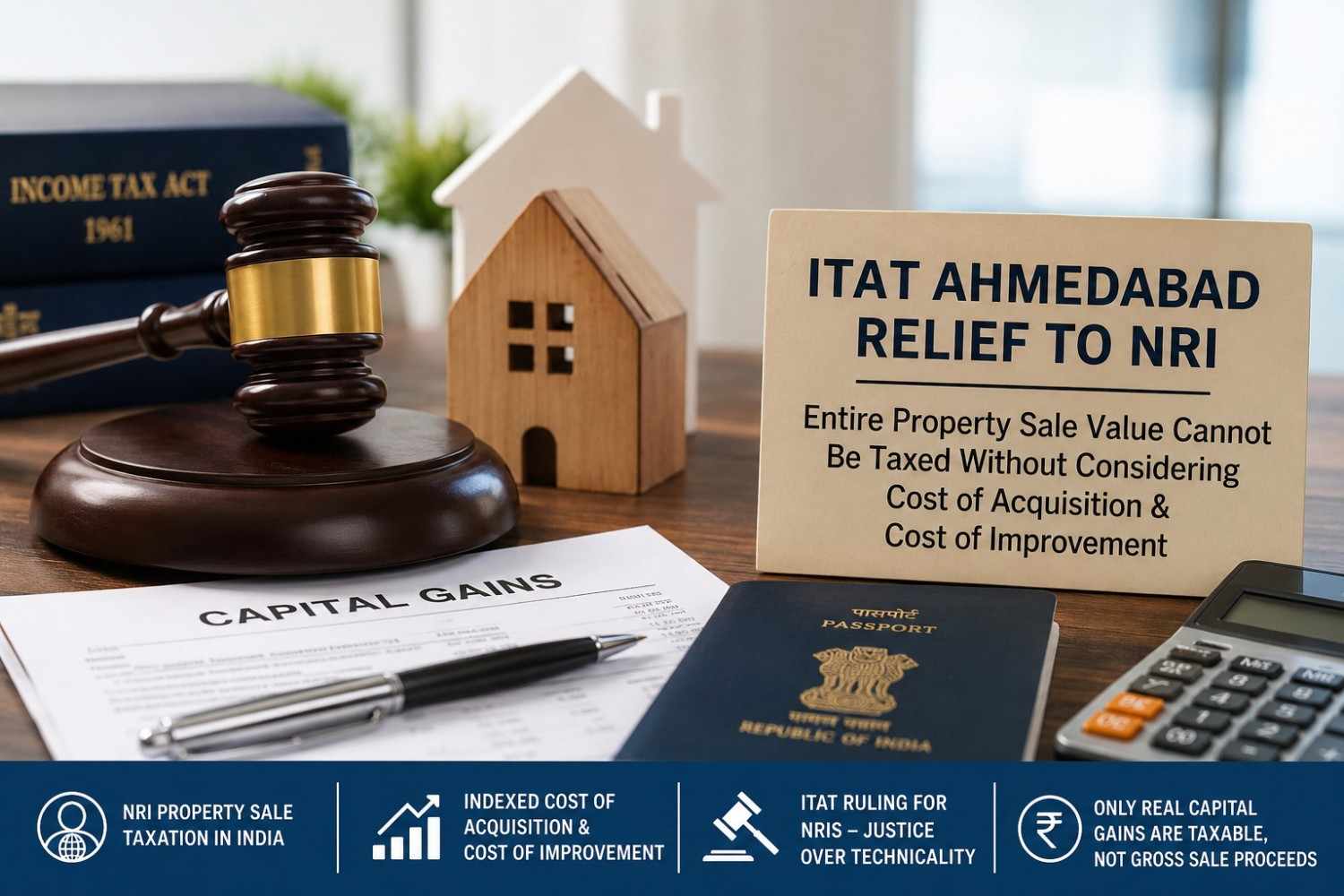


In a landmark and highly relevant ruling for Non-Resident Indians (NRIs) selling property in India, the Ahmedabad Bench of the Income Tax Appellate Tribunal (ITAT Ahmedabad) has held that the entire sale consideration from a property sale cannot be taxed as capital gains without considering indexed cost of acquisition and indexed cost of improvement.
The decision is particularly important for NRIs facing income tax scrutiny on sale of property in India, best judgment assessments under Section 144, property sale tax notices, and disputes relating to capital gains taxation for NRIs.
The ruling reinforces an important principle under Indian tax law — only real capital gains are taxable, not gross sale proceeds.
For NRIs selling property in India, this judgement provides substantial clarity regarding:
In the case of Kaminiben Jagdishbhai Patel vs Income Tax Officer (ITA No. 2/Ahd/2026), the taxpayer, an NRI, sold an immovable property in India for approximately ₹21.40 lakh.
The property had originally been acquired in 2005 for ₹1.94 lakh.
After applying the Cost Inflation Index (CII) and indexation provisions under the Income Tax Act:
Indexed Cost of Acquisition
The indexed cost of acquisition worked out to approximately ₹4.52 lakh.
Indexed Cost of Improvement
The taxpayer had also incurred property improvement expenses, supported through contractor bills and documentary evidence.
After indexation, the indexed cost of improvement amounted to approximately ₹8.87 lakh.
Accordingly, the correct taxable Long-Term Capital Gain (LTCG) on sale of property was approximately ₹8 lakh.
This becomes highly relevant for NRIs because many taxpayers selling property in India fail to properly claim:
The taxpayer was residing outside India and, being an NRI, could not effectively respond to notices issued by the Income Tax Department.
As a result, the Assessing Officer completed an ex-parte assessment under Section 144 of the Income Tax Act, 1961, commonly referred to as a Best Judgment Assessment.
In doing so, the tax department:
Ignored Cost of Improvement in Capital Gains Computation
The Assessing Officer failed to consider the taxpayer’s documented property improvement expenses, despite supporting evidence being available.
Incorrectly Taxed Entire Sale Value
Instead of computing Long-Term Capital Gains (LTCG) properly, the department effectively treated the entire sale consideration as taxable income and classified it as Short-Term Capital Gain (STCG).
Questioned Fixed Deposits Made from Property Sale Proceeds
The Assessing Officer also made additions relating to fixed deposits created using the property sale proceeds, despite the source of funds being identifiable.
This situation is extremely common in NRI property sale tax scrutiny cases, particularly where:
The ITAT Ahmedabad ruling for NRIs selling property in India provides important legal protection.
1. Entire Property Sale Proceeds Cannot Be Taxed as Capital Gains
The Tribunal categorically observed that capital gains tax must be computed after reducing eligible costs, including:
Cost of Acquisition
The original purchase price of the property.
Indexed Cost of Acquisition
Inflation-adjusted purchase cost.
Cost of Improvement
Renovation and improvement expenses incurred over the years.
Indexed Cost of Improvement
Inflation-adjusted improvement expenditure.
The ITAT clarified that tax authorities cannot tax gross sale proceeds without considering legitimate deductions.
This principle is critical for anyone searching:
“How is capital gains tax calculated for NRIs selling property in India?”
or
“Can Income Tax Department tax entire property sale amount?”
The answer, based on this ruling, is No.
2. NRI Status and Overseas Residence Are Relevant Considerations
The Tribunal acknowledged that the taxpayer was an NRI residing outside India, which explained the inability to respond to departmental notices.
The ITAT recognised that:
Procedural non-compliance should not defeat substantive justice when supporting evidence exists.
This becomes highly relevant in situations involving:
Missed Income Tax Notices by NRIs
Many NRIs miss:
because they are physically located overseas.
The ruling provides comfort that NRIs can still seek relief in appellate proceedings if documentary evidence exists.
3. Fixed Deposits Made from Property Sale Proceeds Cannot Automatically Be Treated as Unexplained Income
Another important aspect of the ruling involved fixed deposits created from sale proceeds of the property.
The Tribunal noted that:
Accordingly, arbitrary additions could not be sustained.
This issue is highly relevant for:
Many NRIs temporarily place funds into:
before repatriation or reinvestment.
Improper explanation of these movements frequently triggers income tax notices to NRIs.
The Ahmedabad Bench of the ITAT ruled in favour of the taxpayer and held that:
Correct Long-Term Capital Gain (LTCG): ₹8,00,164
after considering:
The Tribunal allowed the appeal of the NRI taxpayer.
This ruling is likely to become an important reference point for:
NRI Property Sale Taxation in India
NRIs often face disputes regarding:
1. Always Preserve Cost of Improvement Documents
Maintain records for:
These significantly reduce capital gains tax liability in India.
2. Claim Indexation Benefits Correctly
Many taxpayers fail to claim:
and
resulting in excess tax.
Professional capital gains computation for NRIs becomes extremely important.
3. Track Property Sale Funds Carefully
Maintain documentary trail where sale proceeds are moved into:
This helps defend against unexplained income allegations under the Income Tax Act.
4. Respond to Income Tax Notices Promptly
NRIs should actively monitor:
Missing notices can result in Section 144 best judgment assessments.
At Dinesh Aarjav & Associates, we specialise in:
With 25+ years of experience, offices across multiple countries, and advisory support for 2600+ global clients, we help NRIs navigate complex tax and FEMA issues efficiently.
If you are an NRI and selling NRI property in india, facing a capital gains tax dispute, dealing with TDS issues, or received an income tax notice, our experts can help structure the transaction and optimise tax exposure.
TDS on Sale of Property by NRI in India – Complete 2026 Guide Under Income Tax Act, 2025
Budget 2026: Major Relief for NRIs Selling Property in India – TDS Compliance Simplified
CA Dinesh K. Jain is the Founder and Mentor of Dinesh Aarjav & Associates, with over 35 years of experience in NRI taxation, cross-border advisory, project financing, and tax litigation. He has guided numerous NRIs and global families through complex tax and regulatory matters involving investments, repatriation, and international financial planning.






Stay in the loop, subscribe to our newsletter and unlock a world of exclusive updates, insights, and offers delivered straight to your inbox.

.webp)