WhatsApp
 Call Us
 Email Us
 Whatsapp Community

Would you like to schedule a call back


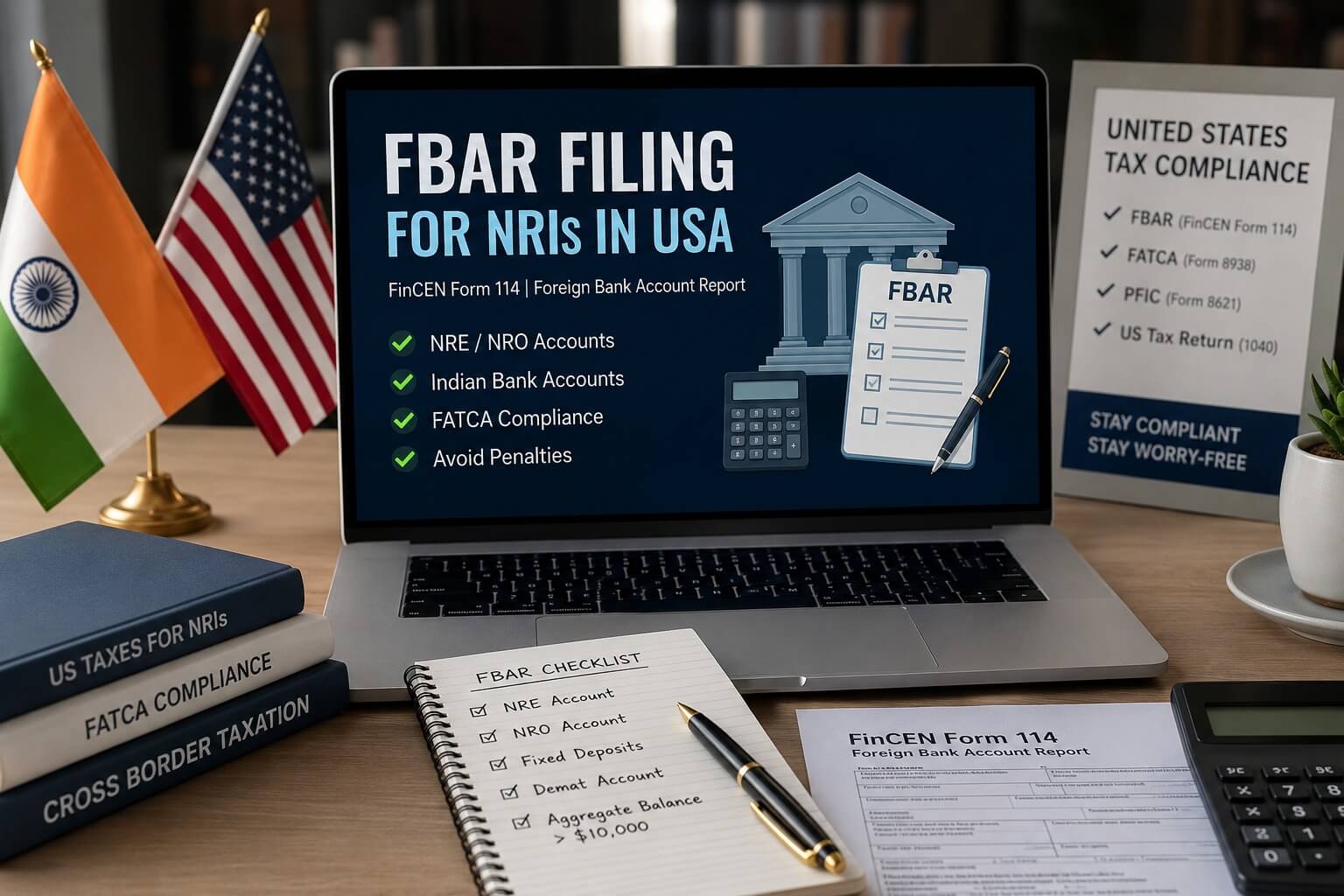


Millions of Indians living in the United States continue to maintain financial relationships with India through NRE accounts, NRO accounts, fixed deposits, demat accounts, mutual funds, provident funds, and family-owned bank accounts.
What many H-1B professionals, Green Card holders, OCI card holders, and Indian-Americans do not realize is that these accounts may trigger mandatory U.S. foreign asset reporting obligations, even when the income is already taxed in India.
Failure to comply can result in substantial penalties, increased IRS scrutiny, and complex corrective filings.
This comprehensive guide explains everything NRIs need to know about FBAR filing, reporting Indian bank accounts, FATCA compliance, Form 8938, PFIC reporting, penalties, deadlines, and common mistakes.
FBAR stands for Foreign Bank Account Report.
The official filing is:
FBAR is a disclosure form required under the Bank Secrecy Act and administered by the Financial Crimes Enforcement Network (FinCEN).
Contrary to popular belief:
Its purpose is to disclose foreign financial accounts owned or controlled by U.S. persons.
For Indians living in the United States, FBAR is often the first and most important international compliance requirement.
The global financial reporting landscape has changed dramatically over the last decade.
Indian financial institutions increasingly exchange information under international reporting frameworks, including FATCA and other information-sharing agreements.
Many taxpayers who were never informed about FBAR obligations are now discovering years later that they should have been filing annual disclosures.
This makes proactive compliance essential for anyone with Indian financial assets.
You generally must file FBAR if:
Condition 1: You Are a U.S. Person
This includes:
Condition 2: Your Foreign Financial Accounts Exceed $10,000
The combined value of all foreign financial accounts exceeds:
Many taxpayers incorrectly assume:
"My Indian account only has $4,000, so FBAR does not apply."
The law looks at the combined highest value of all foreign accounts.
Example
| Account | Highest Balance |
| SBI NRE Account | $3,000 |
| ICICI NRO Account | $2,500 |
| HDFC Fixed Deposit | $3,000 |
| Zerodha Demat Account | $2,000 |
Total Foreign Assets = $10,500
FBAR Filing Required.
Even though none of the accounts individually exceeds $10,000, the aggregate value crosses the filing threshold.
One of the biggest areas of confusion involves determining which Indian accounts are reportable.
The following accounts commonly trigger FBAR reporting.
NRE accounts maintained with Indian banks are generally reportable.
Common examples include:
NRO accounts are foreign financial accounts and are generally reportable under FBAR rules.
Regular Indian savings accounts held with any bank are generally reportable.
Fixed deposits are frequently overlooked.
Many taxpayers incorrectly assume that because a fixed deposit is linked to a savings account, it does not require separate consideration.
In many cases, fixed deposits constitute reportable foreign financial accounts.
Foreign Currency Non-Resident deposits maintained in India generally require analysis for FBAR reporting.
Demat accounts often trigger FBAR reporting obligations.
Examples include:
Indian brokerage accounts holding shares, ETFs, bonds, or other securities often require disclosure.
Many Indians maintain joint accounts with:
Joint ownership can still create FBAR filing obligations.
FBAR may also apply where a taxpayer has signature authority over an account, even if they are not the beneficial owner.
Examples include:
For many taxpayers, Indian mutual funds can trigger multiple reporting requirements simultaneously:
This is why FBAR should never be analyzed in isolation.
A comprehensive review of all foreign assets is critical to ensure complete compliance.
Many NRIs and Indian-Americans continue to hold:
These accounts often raise complex U.S. reporting questions involving:
The treatment depends on specific facts and should be reviewed carefully.
One of the most searched questions by NRIs is:
In many situations, the answer is yes.
| Feature | FBAR | FATCA Form 8938 |
| Filing Authority | FinCEN | IRS |
| Form Number | FinCEN Form 114 | Form 8938 |
| Filed With Tax Return | No | Yes |
| Reporting Threshold | $10,000 | Higher Thresholds |
| Covers Foreign Accounts | Yes | Yes |
| Covers Other Foreign Assets | Limited | Extensive |
Many taxpayers living in the United States must file both forms annually.
For Indians living in the United States, the three most common international reporting requirements are:
Reporting of Indian mutual funds and certain foreign pooled investments.
These three compliance areas form the foundation of India-U.S. international tax reporting.
To prepare FBAR accurately, gather:
Maintaining proper documentation is critical in the event of future IRS inquiries.
For Tax Year 2025:
No separate extension request is required.
Many taxpayers mistakenly assume that filing a tax return extension automatically extends FBAR obligations.
The U.S. government takes foreign account reporting seriously.
Penalties may arise for:
Depending on the circumstances, penalties can become significant.
This is why professional review is strongly recommended before filing.
Many taxpayers discover FBAR obligations years after becoming U.S. tax residents.
Common situations include:
Before submitting late disclosures, taxpayers should seek professional guidance to evaluate the most appropriate compliance path.
You may need FBAR filing if you have:
If any of these apply, an annual FBAR review should be part of your U.S. tax compliance process.
Dinesh Aarjav & Associates is a specialized India-U.S. cross-border tax advisory firm assisting:
Our team includes:
We assist with:
Serving clients across:
as well as NRIs worldwide.
If you are an H-1B professional, Green Card holder, OCI card holder, Indian-American family, or NRI with Indian bank accounts, fixed deposits, mutual funds, demat accounts, or other foreign assets, FBAR compliance should be an essential part of your annual U.S. tax filing strategy.
At Dinesh Aarjav & Associates, we help clients navigate FBAR filing, FATCA compliance, PFIC reporting, foreign asset disclosures, India-U.S. DTAA planning, RNOR planning, and cross-border tax compliance with confidence.
Aarjav Jain is the Executive Director at Dinesh Aarjav & Associates, specializing in India–US cross-border transactions, NRI taxation, international tax advisory, and global investment structuring. With over 10 years of experience in project financing and cross-border advisory, he assists NRIs and businesses with regulatory compliance, repatriation planning, and international transaction structuring.





Stay in the loop, subscribe to our newsletter and unlock a world of exclusive updates, insights, and offers delivered straight to your inbox.

.webp)