WhatsApp
 Call Us
 Email Us
 Whatsapp Community

Would you like to schedule a call back


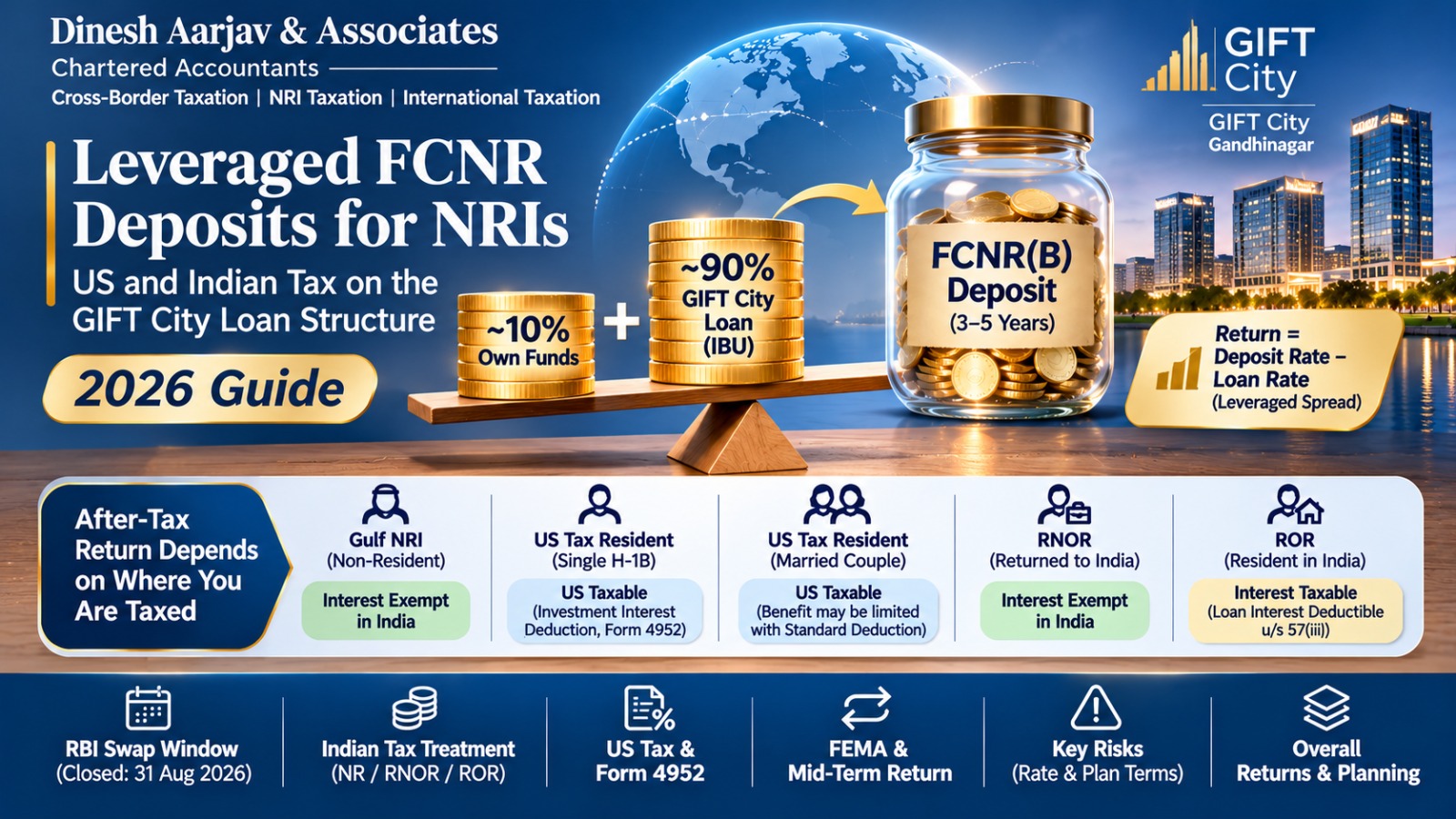


Quick answer: In a leveraged FCNR deposit, you put in about 10% of your own money, borrow the rest from a bank's GIFT City IBU or overseas branch, and place the total in a 3–5 year FCNR(B) deposit held as security for the loan. The return depends on the spread between the deposit rate and the loan rate, and on where you are taxed. India does not tax FCNR interest for non-residents or RNORs, so an NRI in the Gulf keeps the whole spread. A US tax resident (H-1B, L-1, green card holder or citizen) pays US tax on the full FCNR interest. The loan interest is deductible only as investment interest, only if you itemize, and only up to your investment income (Form 4952). For many married couples on the standard deduction, the trade loses money after tax. If you return to India mid-term, the interest stays exempt while you are RNOR and becomes taxable once you are ROR. At that point the loan interest can be deducted against it.
A Foreign Currency Non-Resident (Bank) deposit, or FCNR(B), is a term deposit an NRI holds with an Indian bank in a foreign currency such as US dollars, for 1 to 5 years. The principal and interest are repatriable, and because the deposit stays in dollars, you carry no rupee risk.
The leveraged version adds a loan:
Your return is the deposit interest minus the loan interest, on a small amount of your own money, so the headline percentage looks large. A 0.5% spread on 10 times your capital is a 5% return before tax. The tax position, which this guide covers, decides whether that survives.
Leveraged FCNR deposits became popular in 2026 because of an RBI special swap window, announced in June 2026. Banks could swap eligible new 3–5 year FCNR(B) deposits with the RBI at a concessional cost, which let them offer unusually high deposit rates. The window was originally open for deposits raised up to 30 September 2026, but the RBI brought the deadline forward to 31 August 2026 after inflows passed $52 billion. FCNR(B) deposits remain available, but without the swap support, rates for new deposits may be less attractive. Most readers of this guide already hold a deposit opened during the window and need to know how to report and plan for it over its remaining term.
Interest on an FCNR(B) deposit is exempt from Indian tax for a non-resident and for a Resident but Not Ordinarily Resident (RNOR), under Section 10(15)(iv)(fa) of the Income-tax Act, 1961. The exemption continues under the Income-tax Act, 2025 from tax year 2026-27. No TDS is deducted.
|
Your status in India |
FCNR interest |
Loan interest |
|
Non-Resident (NR) |
Exempt |
No deduction, because the income it relates to is exempt |
|
RNOR |
Exempt |
No deduction, because the income it relates to is exempt |
|
Resident and Ordinarily Resident (ROR) |
Taxable at slab rates |
Deductible against that interest as an expense of earning it (Section 57(iii)) |
India does not allow a deduction for expenses incurred to earn exempt income, so the GIFT City loan interest gives you no Indian tax benefit while the interest is exempt. That changes once you become ROR.
Many leveraged deposits run for three to five years, and many depositors move back to India within that time. Under RBI rules, an FCNR(B) deposit can generally continue until maturity at the contracted rate after you become resident. The Indian tax treatment then follows your residential status each year: exempt while you are RNOR, taxable once you are ROR. Two practical points need checking early:
Our guide to RNOR status for returning NRIs explains how the RNOR years are worked out, which is what decides how many years of your deposit stay tax-free.
This section applies to US tax residents: US citizens and green card holders wherever they live, and H-1B, L-1 and other visa holders who meet the substantial presence test. It also applies to the resident part of the year you move. An NRI with no US status is outside US tax on FCNR interest.
FCNR interest is foreign-source ordinary income, taxed at your marginal rate (up to 37%), plus the 3.8% net investment income tax above $200,000 (single) or $250,000 (joint) of modified adjusted gross income, plus state tax where it applies. California, for example, taxes it, while Washington and Texas have no state income tax. Because India collects no tax on the interest, there is no foreign tax credit to offset any of this.
For a deposit longer than one year where interest is paid only at maturity, the US generally treats the interest as original issue discount (OID). You include it in income each year as it accrues, even though you receive nothing until the end. If your loan interest is also capitalised and paid only at maturity, you face three or four years of taxable income with no matching deduction, then one large deduction at the end that the investment interest limit may largely block. A deposit that pays interest out regularly to service the loan avoids this mismatch.
Under the US interest-tracing rules, a loan whose proceeds go straight into the deposit produces investment interest under Section 163(d). It is deductible only if:
To the extent it is deductible, the loan interest also reduces the income subject to the 3.8% net investment income tax.
Holding a leveraged FCNR deposit as an H-1B, L-1 or green card holder? Whether it earns or loses money after tax depends on your filing status, your other deductions, your state and how interest is paid on both sides. Get your FCNR structure reviewed before you file your 2026 return.
Every depositor below has the same structure: $60,000 of their own money and a $540,000 GIFT City loan, placed in a $600,000 FCNR(B) deposit at 6.6% with the loan at 6.0%. Each year the deposit earns $39,600 and the loan costs $32,400, a pre-tax spread of $7,200, or 12% on their own $60,000. Interest is paid on both sides each year, so there is no OID timing mismatch.
|
Depositor |
US tax for the year |
Indian tax for the year |
After-tax result |
|
NRI in Dubai, no US status |
None |
None (exempt for NRIs) |
+$7,200 |
|
Single H-1B in Washington, 24% bracket, $3,000 of other itemized deductions |
$4,872 |
None |
+$2,328 |
|
Married H-1B couple, 24% bracket, no other itemized deductions |
$9,456 |
None |
−$2,256 |
|
Moved back to Pune, RNOR in India, no longer a US tax resident |
None |
None (exempt for RNORs) |
+$7,200 |
|
Back in India and now ROR, no longer a US tax resident |
None |
About $2,246 (30% + cess on the $7,200 net, after deducting loan interest) |
+$4,954 |
How the US numbers work. The single H-1B pays 24% on $39,600, which is $9,504. Their itemized deductions total $35,400 ($32,400 of loan interest plus $3,000 of other deductions). That is $19,300 more than the $16,100 standard deduction, which saves $4,632 at 24%. Net US tax: $4,872. The married couple's loan interest of $32,400 is only $200 more than their $32,200 standard deduction, so it saves them just $48. They pay almost the full $9,504, and the trade loses money.
The structure is the same in every row. What changes is where the depositor lives, their filing status and their residential status. The married couple would have been better off not doing the trade at all. The returning NRI does best in the RNOR years and still keeps most of the spread once ROR.
On a US return (US tax residents):
On an Indian ITR:
Our guides to Indian fixed deposits and US tax and FBAR vs Form 8938 cover the US reporting in more detail.
Moving back to India before your FCNR deposit matures? We'll map your RNOR and ROR years against the deposit term, check the loan agreement's residency clauses and plan the US exit year so the deposit is taxed as little as possible. Book a return-to-India review.
The most expensive is assuming the loan interest simply offsets the deposit interest for US tax. It does not, unless you itemize, and for most married couples it barely counts. Others we often see:
The leveraged FCNR structure works well for some NRIs and loses money for others, and the difference is almost entirely tax. Dinesh Aarjav & Associates prepares US and Indian returns for NRIs together, so the deposit, the loan and your residential status are reported consistently in both countries.
Our FCNR & NRI deposit review covers:
Book your FCNR review or message us on WhatsApp. Also read: NRE vs NRO accounts, best NRE and FCNR bank accounts, investment opportunities in GIFT City and our US tax return services for NRIs.
CA Priyal Goel Jain is a Partner at Dinesh Aarjav & Associates and a leading expert in India–US cross-border taxation, NRI taxation, and international tax advisory. She advises NRIs, OCIs, and global families on complex cross-border transactions, tax planning, foreign asset reporting, and multi-jurisdictional compliance matters.





Stay in the loop, subscribe to our newsletter and unlock a world of exclusive updates, insights, and offers delivered straight to your inbox.

.webp)